
The mountains of Gilgit Baltistan have spoken. On June 7, 2026, millions of voters across this breathtaking northern region of Pakistan went to the polls to elect their new assembly. The Gilgit Baltistan Election 2026 turned out to be one of the most talked-about elections in the region’s recent history — not just because of the results, but also because of the serious allegations of rigging, the denial of electoral symbols, and the incredible passion that PTI’s voter base showed despite every obstacle placed in their path.
In this article, we’ll break down the GB Election Results 2026 in full detail. We’ll cover the constituency-wise results, discuss how PTI, PPP, and PML-N performed, look at the controversy surrounding Form-45, and explain why PTI supporters believe the real mandate of the people of Gilgit Baltistan was stolen. Let’s get into it.
Overview of the Gilgit Baltistan General Elections 2026
The Gilgit Baltistan Assembly Election 2026 was held to elect members for 24 general seats of the 33-seat Gilgit-Baltistan Legislative Assembly. The remaining 9 seats are reserved — 6 for women and 3 for technocrats — and these are allocated after the general seats are determined.
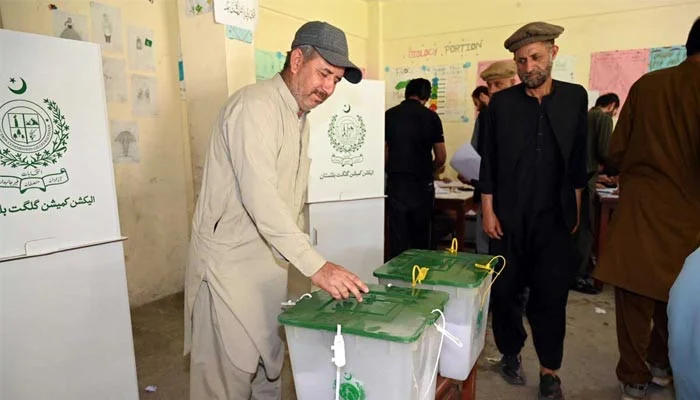
Polling took place on Sunday, June 7, 2026, and the voting process ran from 8 AM to 5 PM across the entire region. A total of 963,034 registered voters were eligible to cast their vote, out of which 566,097 were male and 396,937 were female. This was a significant turnout, and election officials noted that female voter participation was particularly high.
The Election Commission of Gilgit Baltistan (ECGB) established a total of 1,391 polling stations across all 10 districts of the region. Out of these, 488 were classified as normal, 349 as sensitive, and 551 as highly sensitive — a clear indication of the security-heavy environment in which these elections were conducted.
A whopping 396 candidates contested the elections, including 266 independent candidates. Only 8 women participated as candidates, 5 of whom ran as independents. The major parties that threw their weight into the contest included Pakistan Peoples Party (PPP), Pakistan Muslim League-Nawaz (PML-N), Pakistan Tehreek-e-Insaf (PTI), Majlis Wahdat-e-Muslimeen (MWM), Jamiat Ulema-e-Islam-Fazl (JUI-F), Istehkam-e-Pakistan Party (IPP), and Jamaat-e-Islami (JI).
Why PTI Contested as Independents in GB Election 2026
If you’ve been following Pakistani politics, you already know why PTI candidates didn’t have their famous cricket bat symbol on the ballot. The Election Commission of Pakistan (ECP) stripped PTI of its electoral symbol, forcing PTI-backed candidates to contest as independent candidates across the board — not just in Gilgit Baltistan, but in national elections as well.
This is a huge deal. In Pakistan’s political landscape, a party’s symbol is deeply tied to voter recognition, especially in rural and mountainous regions like GB where many voters identify with symbols rather than names. By taking away PTI’s symbol, the establishment created a massive hurdle for PTI’s base.
But did that stop the people of Gilgit Baltistan from supporting Imran Khan’s party? Not really. PTI fielded 19 independent-backed candidates in the GB elections, and many of these candidates still managed to put up strong performances, winning or coming close in multiple constituencies — which, in itself, shows the depth of PTI’s support in the region.
PTI Chairman Barrister Gohar Ali Khan openly stated that his party had not been allowed to hold proper election rallies, and that senior PTI leaders including Asad Qaiser and Salman Akram Raja were stopped from participating in the campaign. “We are political people and want citizens to get their rights and democracy to be strengthened,” he said, highlighting the party’s commitment to political rights even under pressure.
PTI’s Pre-Poll Allegations — A Systematic Effort to Block the People’s Voice
Before a single vote was cast on June 7, PTI was already raising red flags about the GB Election 2026. The party made several serious allegations of pre-poll rigging that deserve to be highlighted here.
PTI’s pre-poll allegations included:
- Election officials contacted PTI candidates and issued threats, directing them to abandon PTI and contest on tickets of government-backed parties.
- Federal ministers, including Kashmir Affairs Minister Amir Muqam and Information Minister Attaullah Tarar, were allegedly stationed in the region to influence the local administration.
- Opposition parliamentarians were prevented from entering Gilgit Baltistan, while ruling party figures were allowed free political activity.
- Voter lists were tampered with, and polling schemes were changed without proper notice.
- The Gilgit Baltistan Election Commission issued a notice to the mother of former Chief Minister Khalid Khursheed over the display of his photograph on campaign posters — which PTI called a clear example of “partisan and unacceptable conduct.”
- PTI’s information secretary alleged that even the Chief Election Commissioner told PTI lawyers that their candidates should be “thankful” for being allowed to submit nomination forms — a claim PTI described as shocking evidence of bias.
PTI’s stance was clear: “It is an open secret that both the PPP and PML-N are banking on yet another Form 47-style manipulation because they know the people of Gilgit Baltistan overwhelmingly support Imran Khan and the PTI.”
These were strong words, but they aligned with a well-established pattern that PTI supporters had already witnessed in the General Elections of February 2024.
Gilgit Baltistan Election Results 2026 — Unofficial Constituency-Wise Results
Now let’s talk numbers. As of June 8, 2026, unofficial results from all 24 constituencies were being compiled.
Party-Wise Seat Summary (Unofficial)
| Party | Seats Won (Unofficial) |
| Pakistan Peoples Party (PPP) | 10 |
| Pakistan Muslim League-Nawaz (PML-N) | 6 |
| Independent (including PTI-backed) | 7 (2 PTI-backed) |
| Majlis Wahdat-e-Muslimeen (MWM) | 1 |
| Total | 24 |
Constituency-Wise GB Election 2026 Results
| Constituency | Winner | Party | Votes |
| GBA-1 Gilgit-I | Amjad Hussain | PPP | 10,594 |
| GBA-3 Gilgit-III | Syed Sohail Abbas | Independent | 7,877 |
| GBA-4 Nagar-I | Muhammad Ali Akhtar | PPP | 7,530 |
| GBA-8 | MWM Candidate | MWM | — |
| GBA-9 Skardu-III | Fida Muhammad Nashad | PPP | 6,314 |
| GBA-18 | PML-N Candidate | PML-N | — |
| GBA-20 | PML-N Candidate | PML-N | — |
| GBA-22 Ghanche-I | Muhammad Ibrahim Sanai | PML-N | 9,308 |
| GBA-24 Ghanche-III | Asad Shafiq | Independent | 8,092 |
Note: Results are unofficial and based on initial counts. Final official results are subject to the Election Commission of Gilgit Baltistan’s verification.
How PTI-Backed Candidates Performed
Even though PTI had to contest without its iconic cricket bat symbol, and even though its senior leaders were allegedly blocked from campaigning, the PTI-backed independent candidates still managed to win in at least 2 constituencies, according to Dawn’s report. More importantly, in several constituencies where PTI-backed candidates didn’t officially win, they came in a very strong second place — which tells you everything about the ground-level support PTI still commands in Gilgit Baltistan.
Consider GBA-4 Nagar-I: PPP’s Muhammad Ali Akhtar won with 7,530 votes, but PTI’s Muhammad Ayub Waziri came in a very close second with 6,491 votes. That’s a gap of barely over a thousand votes. In a free and fair election — without symbol deprivation, without campaign restrictions, without alleged voter list tampering — that result could easily have been flipped.
This is why PTI supporters are not just unhappy — they’re outraged. And honestly, looking at the numbers, it’s hard to dismiss their concerns entirely.
The Form-45 Controversy — Where Did the Real Votes Go?
One of the biggest controversies of the GB Elections 2026 was the Form-45 issue. For those who don’t know, Form-45 is the official result sheet prepared at each polling station. It documents the exact vote count at that specific station and is signed by the presiding officer. It’s essentially the ground-level proof of how votes were cast.
Both PTI and PPP raised serious alarm bells about Form-45 being withheld or delayed.
PTI alleged that its polling agents were not being issued Form-46 (which is a copy of Form-45 given to candidates’ agents), calling it a clear violation of election rules. The party claimed incidents of fake ballots being recovered in some constituencies and called the situation a “systematic attempt at rigging.” PTI demanded the immediate release of Form-45 and Form-46 to all candidates.
PPP Secretary General Nayyar Hussain Bukhari also alleged that presiding officers refused to provide Form-45. PPP spokesperson Shazia Marri called the delay unacceptable, adding that altered voter lists and shifted polling stations indicated systemic rigging.
In response, the GB Chief Election Commissioner Raja Shahbaz directed all Returning Officers across all 24 constituencies to ensure the issuance of certified Form-45s and to comply with election rules. “Form-45 is being issued at all polling stations where vote counting has concluded,” he said.
But critics argued this response came too late and that the damage had already been done. For PTI supporters, the Form-45 controversy was a painful reminder of the February 2024 General Election, when similar allegations of result manipulation were raised across Pakistan.
PTI’s Track Record in Gilgit Baltistan — The Party the People Chose in 2020
To truly understand how significant the PTI factor is in the GB Election 2026, you need to look back at 2020. In the 2020 Gilgit Baltistan elections, PTI didn’t just win — it dominated.
PTI won 16 out of 24 general seats, and after the allocation of reserved seats for women and technocrats, its total rose to an incredible 22 out of 33 seats — a two-thirds supermajority. This made PTI the first-ever party in Gilgit Baltistan’s history to achieve a two-thirds majority. The people of GB had spoken loudly and clearly: they wanted PTI.
Khalid Khurshid was elected as Chief Minister following that historic win. The 2020 result was a mandate that cannot be easily erased from the memory of GB voters — and it forms the backdrop against which the 2026 results need to be understood.
The fact that PTI had to contest without its symbol in 2026, faced multiple pre-poll restrictions, and yet still managed to win seats and come close in many others, speaks volumes about the enduring loyalty of GB’s voters to Imran Khan’s vision.
PPP’s Win — Victory or a Managed Outcome?
PPP Chairman Bilawal Bhutto Zardari celebrated the early results and declared that the “arrow is raining in Gilgit Baltistan.” He expressed confidence that PPP would form the next government in GB and thanked the people of the region for their support.
Officially, PPP did perform well, winning around 10 seats based on unofficial results. But here’s the contradiction: PPP itself was raising rigging allegations even while it was leading. PPP’s Nadeem Afzal Chan alleged that two federal ministers were pressuring the administrative machinery in Gilgit Baltistan and that presiding officers were being pressured not to issue Form-45.
This is a strange situation, isn’t it? The party that was leading in the results was also complaining about the electoral process. What does that tell us? It tells us that even PPP recognized that the playing field was not level — and if the process was not transparent even from PPP’s perspective, one can only imagine how much more skewed it felt from PTI’s point of view.
PML-N’s Performance in GB Election 2026
PML-N ran 22 candidates in the GB elections and managed to secure 6 seats according to unofficial results. Their key wins included GBA-22 Ghanche-I, where candidate Muhammad Ibrahim Sanai won with 9,308 votes. In GBA-2 Gilgit-II, PML-N’s Hafeez-ur-Rehman was also leading in early counts.
PML-N had the backing of the federal government, and PTI was vocal about what it described as federal ministers using state resources to campaign for PML-N. Despite the government’s backing, PML-N’s seat count remained modest — which, in its own way, reflects the limited appeal of the party among GB’s voters when compared to the people’s natural preference for PTI.
Voter Turnout and Security Arrangements
One of the positive aspects of the GB Election 2026 was the largely peaceful conduct of polling. The GB Chief Election Commissioner praised polling staff and security personnel for their effective performance.
Security arrangements were particularly tight across the region, with 551 highly sensitive polling stations receiving extra coverage. The overall turnout was strong, and the Chief Election Commissioner specifically noted a notably high turnout among women voters — a very encouraging sign for the region’s democratic future.
However, PTI questioned turnout figures exceeding 80 percent in some areas, describing such numbers as unusually high and potentially suspicious. The party raised concerns that inflated turnout figures could be used to justify altered ballot counts in certain constituencies.
What Happens Next? Government Formation in GB
The Gilgit Baltistan Assembly consists of 33 seats in total: 24 general seats, 6 reserved seats for women, and 3 reserved technocrat seats. A party or coalition needs 17 seats to form a government.
Based on unofficial results, PPP is the largest single party with around 10 seats. PML-N has around 6 seats. Together, a PPP-PML-N alliance would have 16 general seats — just shy of the majority. With reserved seats added, however, forming a coalition government becomes more achievable.
The independent candidates — including PTI-backed independents — will also play a crucial role in government formation. If PTI-backed independents align together and possibly bring in support from MWM and other independent members, the political landscape in GB could shift significantly.
PTI supporters are hopeful that even in this difficult situation, their candidates can play kingmaker and ensure that the voice of the people is not completely drowned out.
PTI’s Response — Fighting Back Through Legal Channels
Despite the obstacles, PTI is not staying silent. The party has consistently urged its candidates and polling agents to collect Form-45 copies and approach the courts to challenge any results that appear manipulated.
PTI Chairman Barrister Gohar Ali Khan emphasized the importance of political rights and transparent elections, saying: “We are political people and want citizens to get their rights and democracy to be strengthened.” This measured but firm stance shows that PTI intends to fight for every seat through legal means.
Given PTI’s track record of using Form-45 data to challenge election results — as it did following the February 2024 General Elections — it is very likely that the party will mount serious legal challenges in constituencies where it believes the results were manipulated.
Conclusion — The People of GB Deserve Better
The Gilgit Baltistan Election Results 2026 tell a complicated story. On the surface, PPP has emerged as the leading party with around 10 seats, followed by PML-N with 6, independents with 7 (including 2 PTI-backed), and MWM with 1.
But beneath the surface, there are genuine concerns about whether the results truly reflect the will of the people. PTI — the party that won a historic two-thirds majority in 2020 — was forced to contest without its symbol, had its leaders blocked from campaigning, faced allegations of voter list tampering, and raised credible concerns about Form-45 being withheld.
The people of Gilgit Baltistan are resilient, politically aware, and deeply passionate. They have shown time and again that they stand with Imran Khan’s vision of justice, accountability, and a Pakistan that works for its citizens. Despite every hurdle placed in PTI’s path, the party’s vote count in 2026 shows that the people’s love for PTI has not faded.
As official results are finalized and legal challenges are processed, one thing remains crystal clear: the GB Election 2026 is not just a local story. It is a reflection of Pakistan’s broader democratic struggle — and the people’s demand for a truly free and fair election process will not go away.
This article is based on official reports from Dawn, Geo TV, Pakistan Today, Daily Pakistan, and the Election Commission of Gilgit Baltistan. All results are unofficial until confirmed by the ECGB.