
As a fragile ceasefire teeters on the edge of collapse and Tehran refuses to come to the table, U.S. negotiators are heading to Pakistan — with the clock ticking.
By Staff Correspondent | April 20, 2026
ISLAMABAD / WASHINGTON — The world held its breath on Sunday as U.S. President Donald Trump announced that American negotiators would be flying to Islamabad, Pakistan, for a second round of high-stakes talks with Iran — even as Tehran flatly rejected the invitation and the two-week ceasefire binding the warring parties edged closer to expiration.
The announcement, made via Trump’s Truth Social platform, was short on detail but heavy on consequence. Trump’s post confirmed that his representatives would head to the Pakistani capital on Monday for negotiations aimed at ending the U.S.-Israel war on Iran — a conflict that has already reshaped the geopolitical order of the Middle East and sent shockwaves through the global energy market.
But within hours, Iran delivered a blunt response. Iran’s official IRNA news agency reported on Sunday that Iranian officials would not take part in the talks owing to what it described as “Washington’s excessive demands, unrealistic expectations, constant shifts in stance, repeated contradictions and the ongoing naval blockade, which is considered to be a breach of the ceasefire.”
The standoff has set up one of the most consequential diplomatic flashpoints of Trump’s second term — and possibly one of the most dangerous moments in the region in decades.
The Road to Islamabad: How Pakistan Became the Unlikely Mediator
The genesis of the Islamabad peace process dates back to weeks of quiet back-channel diplomacy, with Pakistan emerging as the only neutral actor trusted, at least nominally, by both Washington and Tehran.
On March 25, Pakistani officials delivered a “15-point proposal” from the U.S. to Iran, detailing a ceasefire plan. The American proposal included an end to Iran’s nuclear program, limits on its missiles, a reopening of the Strait of Hormuz, restrictions on Iran’s support for armed groups, and sanctions relief for Iran. Tehran rejected it outright, with an unnamed official declaring that Iran would end the war on its own terms.
Iran countered with its own demands. The Iranians issued a “5-point counter-proposal,” including an end to U.S.-Israeli attacks on Iran and pro-Iranian forces in Lebanon and Iraq, security guarantees to prevent future aggression, war reparations, and international recognition of Iranian sovereignty over the Strait of Hormuz.
Despite the gulf between the two sides, Pakistan’s mediators persisted. On April 8, 2026, the United States and Iran agreed to a two-week ceasefire, mediated by Pakistan — a breakthrough that, however fragile, opened the door to direct talks.
The First Round: Historic, But Inconclusive
What followed was described by observers as the most significant direct diplomatic encounter between Washington and Tehran in a generation.
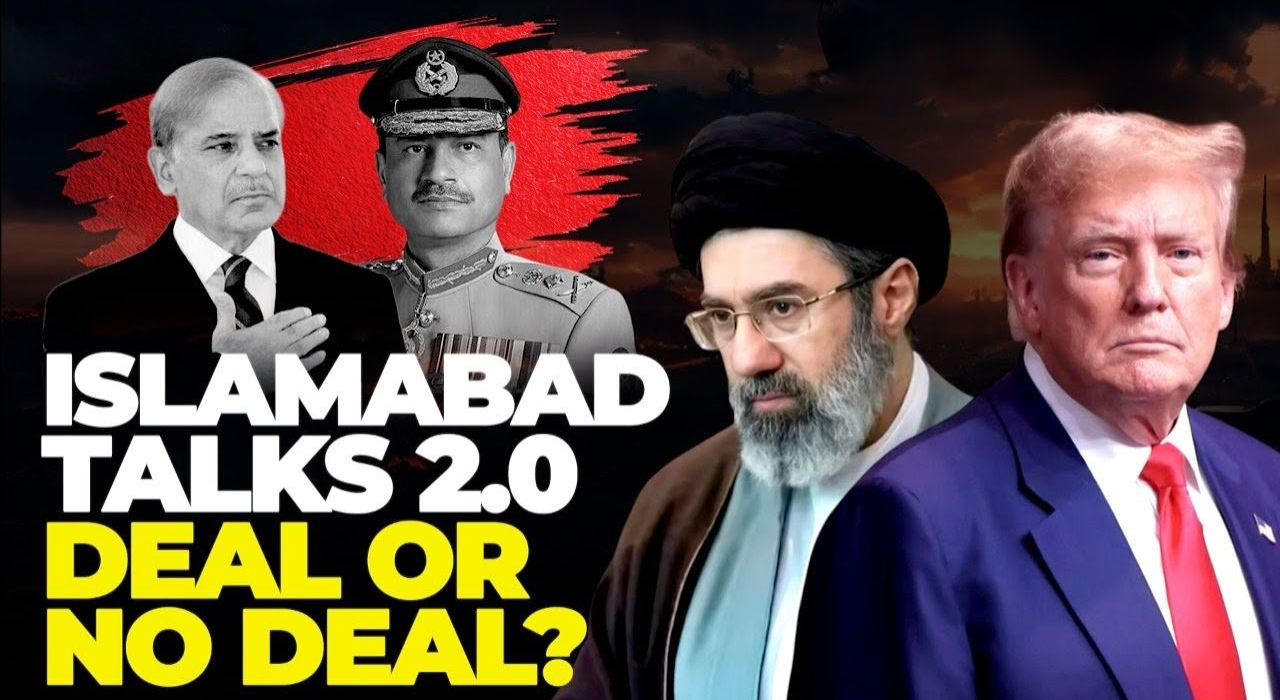
The Islamabad Talks were held on April 11 and 12, 2026. The 300-member U.S. negotiating team was led by Vice President JD Vance, alongside special envoys Steve Witkoff and Jared Kushner, while the 70-member Iranian team was led by parliamentary speaker Mohammad Bagher Ghalibaf and foreign minister Abbas Araghchi. The Pakistani mediating team was led by Prime Minister Shehbaz Sharif, Field Marshal Asim Munir, and Deputy Prime Minister and Foreign Minister Ishaq Dar. Wikipedia
The sheer scale of the delegations signaled the gravity of the moment. Yet the talks, which lasted two days, produced no formal agreement. On April 12, Vance left Pakistan, saying that the negotiations had not led to an agreement. Wikipedia
The main sticking points remain Iran’s nuclear program — particularly its stockpile of enriched uranium — and control over the Strait of Hormuz. Time Iran’s chief negotiator was unsparing in his assessment: “There is still a big distance between us,” said Ghalibaf, while insisting that Iran remained committed to diplomacy.
The Ceasefire Frays: Fire in the Strait
The days following the first round saw the situation deteriorate rapidly. The Strait of Hormuz — the narrow maritime chokepoint through which a significant portion of the world’s oil supply passes — became the flashpoint once more.
Trump accused Iran of violating the two-week ceasefire that is due to end on Wednesday by firing bullets on Saturday in the Strait of Hormuz. In his Truth Social post, the American president was unambiguous about the consequences if talks fail.
“We’re offering a very fair and reasonable deal, and I hope they take it because, if they don’t, the United States is going to knock out every single power plant, and every single bridge, in Iran,” Trump wrote.
This was not the first time Trump had made such a threat. In earlier posts on Truth Social, Trump had written that unless Iran accepts his terms, he would destroy all of Iran’s civilian power plants and bridges, adding: “NO MORE MR. NICE GUY!”
U.S.-Israeli strikes had already targeted civilian infrastructure and facilities, including bridges, schools, healthcare facilities, and universities, and experts warned that some of those strikes could constitute war crimes. When asked by the Wall Street Journal whether he was concerned about the impact on Iran’s civilian population, Trump said he was not, adding that Iranians are “living in hell.”
Iran’s Response: “Washington Is Not Reliable”
Tehran’s reply to Trump’s renewed overture was sharp and immediate. Iran’s state news agency posted on X that its absence from the second round of talks stems from what it called Washington’s “excessive demands, unrealistic expectations, constant shifts in stance, repeated contradictions, and the ongoing naval blockade, which it considers a breach of the ceasefire.”
Iranian officials went further, accusing the White House of using the announcement of talks as a political pressure tactic. IRNA also accused the U.S. of playing a “blame game,” and alleged that Washington had lied about Iran’s participation in a second round of talks in order to put pressure on Tehran.
The accusation reflects deep mistrust. Since the February 28 launch of the U.S.-Israel military campaign, Iran has faced extraordinary losses, including the death of Supreme Leader Ali Khamenei in the early strikes. Yet Tehran has shown remarkable resilience, and its negotiators have repeatedly drawn red lines around its nuclear programme and its sovereignty over the Strait.
Trump’s Optimism — and JD Vance’s Return
Despite Iran’s refusal, the White House pressed ahead. A White House official confirmed that Vice President JD Vance, special envoy Steve Witkoff, and Trump’s son-in-law Jared Kushner would lead the delegation heading to Pakistan.
In a brief call with Axios on Sunday, Trump expressed confidence bordering on bravado. “I feel fine about it. The concept of the deal is done. I think we have a very good chance to get it completed,” he said. Yet he offered no specifics on the terms.
The optimism from the White House stands in stark contrast to the ground reality: Islamabad was placed under lockdown Sunday night, with 10,000 additional security forces deployed a testament to the security concerns surrounding any renewed engagement.
Pakistan’s Role: The “Islamabad Process”
Islamabad has emerged from this crisis with its diplomatic standing considerably enhanced. Pakistani authorities began referring to the negotiations as part of a broader “Islamabad process,” suggesting an effort to frame the engagement as an ongoing diplomatic track rather than a single round of talks.
Pakistan remained in contact with both Washington and Tehran following the first round, urging a resumption of dialogue and seeking to facilitate a second round of negotiations before the expiration of the ceasefire.
Prime Minister Shehbaz Sharif and Field Marshal Asim Munir have both invested significant political capital in positioning Pakistan as an indispensable bridge between the two sides — a role that carries both prestige and peril.
What Comes Next: The 72-Hour Window
The ceasefire is set to end on April 22, pausing hostilities that began with the U.S.-Israeli strikes on Iran on February 28. With Iran refusing to attend and Trump threatening to unleash strikes on civilian infrastructure, the next 72 hours may determine whether diplomacy survives — or whether the Middle East slides into an even deeper abyss.
The key questions confronting both sides are stark: Can Iran’s negotiators be persuaded to return to the table before the deadline? Will the U.S. ease its naval blockade as a good-faith gesture? And is Trump’s optimism — “the concept of the deal is done” — based on substance, or is it the negotiating bluster of a dealmaker working to force a reluctant adversary’s hand?
What is not in doubt is that the stakes could not be higher. A failure of these talks does not merely mean a return to war — it risks a conflict that could destabilize global energy markets, draw in regional powers, and set back the cause of nonproliferation by years.
For now, the world watches Islamabad.