

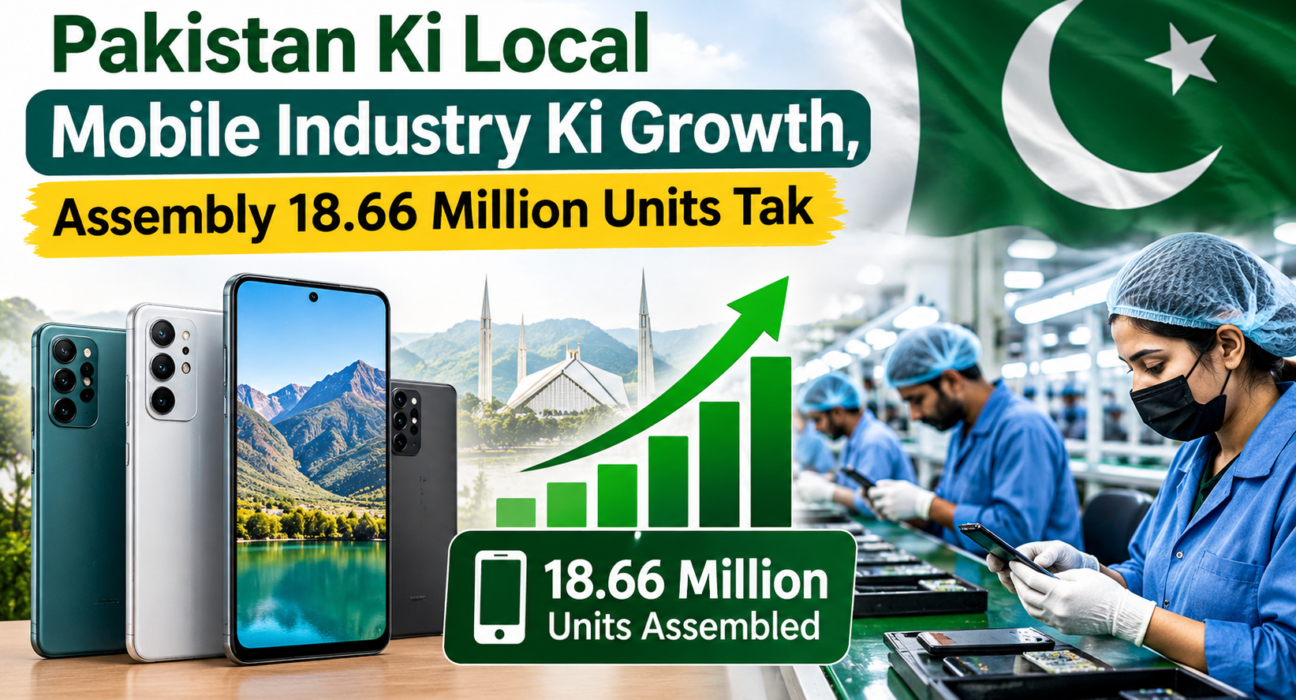
Pakistan’s mobile story has changed a lot in ten years. In 2016, almost every phone in the country came from abroad. By August 2026, local plants had assembled 18.66 million handsets in just eight months. In this article, I’ll walk you through how that happened, what the numbers say, and what it means for buyers, workers, and the economy. I’ll keep the language simple and stick to figures from official data reports.
Why This Milestone Matters to Pakistan
Let’s start with the big picture. Between January and August 2026, local mobile phone plants produced 18.66 million handsets, while commercial imports stood at only 2.74 million units. That means Pakistan now builds most of the phones it uses.
This matters for a simple reason. For years, Pakistan spent a large share of its foreign money on imported phones. Every imported phone costs dollars, and dollars were scarce. When factories at home assemble the same phones, less money leaves the country, and more people find work.
There is also a trust factor. A phone made or assembled locally goes through local approval, so it is easier to register and track. Buyers get fewer surprises at the shop.
A Quick Look at the Headline Numbers
Here is the short version of the latest data:
- Local plants assembled 18.66 million handsets from January to August 2026.
- Commercial imports were just 2.74 million units in the same period.
- Smartphones make up about 71% of all active mobile devices on Pakistani networks, according to PTA data.
Those three points explain why people call this a turning point for the sector.
Pakistan Ki Local Mobile Industry Ki Growth, Assembly 18.66 Million Units Tak: What Does It Really Mean
When you read a headline like this, it helps to slow down and unpack it. The figure of 18.66 million is not a full-year total. It covers eight months. That is a very important detail.
On average, local plants assembled about 2.33 million handsets each month in 2026. In 2025, the monthly average was around 2.52 million. So the pace is slightly lower this year, but it is still strong. If the pace holds, the country is on track for a total in the high twenties of millions by December.
Assembly Is Not the Same as Full Manufacturing
I want to be honest with you here. Most plants in Pakistan assemble phones from kits and parts that arrive from overseas. They put the pieces together, test the devices, and pack them. That is real work and real skill, but it is different from making every chip and screen at home.
Think of it like a bakery that buys flour and bakes fresh bread. The bread is local, but the flour is not. Over time, the goal is to make more of the parts inside Pakistan too.
How the Industry Got Started: A Short History
To see how far Pakistan has come, you need to look back. In 2016, only 0.29 million phones were assembled locally. That was about 1% of the market. The other 99%, or 21.36 million phones, were imported.
The picture stayed similar for years. Imports ruled the market, and local plants stayed small. Then the government decided to change the rules.
The Policy That Changed the Game
In 2020, the government announced a local mobile manufacturing policy. The aim was clear: invite global brands to set up assembly lines in Pakistan. Then, on January 28, 2021, the Mobile Device Manufacturing (MDM) regulations came into force. More than 25 companies received authorization to make mobile devices in the country. The list included names like Samsung, Nokia, Oppo, Tecno, Infinix, Vgotel, and Q-mobile.
The government also removed a 4% withholding tax on locally assembled phones sold in the domestic market. That gave local products a price edge over imported ones. Small steps like this pushed brands to invest.
Year-by-Year Growth Tells the Real Story
Numbers can feel dry, so let me put them in one place. The table below shows how local assembly and commercial imports moved across some key years.
Local Assembly vs Commercial Imports in Pakistan (Million Units)
| Year | Locally Assembled | Commercial Imports |
| 2016 | 0.29 | 21.36 |
| 2021 | 24.66 | 10.26 |
| 2022 | 21.95 | 1.53 |
| 2024 | 31.38 | 1.71 |
| 2025 | 30.21 | 2.37 |
| Jan–Aug 2026 | 18.66 | 2.74 |
Look at the gap between the two columns. In 2016, imports were almost 75 times larger than local assembly. By 2024, the picture had flipped completely.
What Happened in 2021
In 2021, local plants produced 24.66 million devices, compared to 13.05 million in 2020. That was an 88% jump. Imports fell from 24.51 million to 10.26 million in the same year. This was the first big sign that the policy was working.
What Happened in 2024
In 2024, local assembly reached 31.38 million units, up 47% from the year before. According to ProPakistani’s report on 2024 production, the country met 95% of its phone demand through local assembly that year. The five-year average before that was only 67%. Import limits and higher taxes on imported phones helped push this shift.
Smartphones vs 2G Phones: What Is Pakistan Really Assembling
Not all of the 18.66 million units are fancy handsets. According to the latest report, they include about 8 million smartphones and about 11 million 2G phones. The two numbers don’t add up exactly to 18.66 million because the source rounds them, but the message is clear: basic phones still make up a big share of local output.
You might wonder why 2G phones still sell so well. There are a few easy reasons.
Why Basic Phones Still Sell
- They are cheap, so first-time users can afford them.
- They have long battery life, which helps in areas with load shedding.
- Many people use them as a second phone for calls only.
- They are simple, so older users find them easy.
At the same time, smartphones are gaining ground on the network. PTA data shows that smartphones now hold 71% of all active devices, while 2G phones hold the other 29%. In mid-2025, that split was 67% to 33%. So people are slowly moving up, even if the factories still build plenty of basic sets.
Top Brands Behind the Local Assembly Boom
Chinese and local brands lead the list of assemblers. In 2024, Infinix topped the chart with 3.98 million units. Itel followed with 3.64 million, VGO Tel with 3.37 million, Tecno with 2.85 million, Vivo with 2.77 million, and Xiaomi with 2.35 million.
The first five months of 2025 showed a similar pattern. Infinix made 1.34 million units, VGO Tel made 1.33 million, Itel made 1.07 million, and Vivo made 0.96 million. Samsung, Xiaomi, G’Five, Tecno, Nokia, and Q Mobile rounded out the top ten.
Why These Brands Dominate
These brands focus on affordable phones. Pakistan is a price-sensitive market, so a phone that costs less and does the job wins quickly. Brands like Infinix, Itel, and Tecno built their plans around that fact.
Premium brands are in the mix too. A 2024 channel check by Topline Securities found that every major mobile brand except iPhone was now being assembled in Pakistan. That is a big shift from a decade ago.
The Xiaomi Example
Back in 2021, Xiaomi announced plans to start local production at the Quaid-e-Azam Industrial Estate in Lahore. The first target was 2.5 to 3 million handsets a year. By 2024, the company was producing 2.35 million units locally. This shows how announced plans can turn into real output.
The 5G Slowdown: A Weak Spot in the Data
Not every number in the latest report is happy news. In August 2026, Pakistan assembled only 134,501 5G handsets. In August 2025, that number was 553,079. That is a sharp fall.
I think this is the most important warning in the whole report. 5G is where the global market is heading. If local plants fall behind here, buyers may turn to imports again, or to older 4G phones.
Possible Reasons for the Drop
The reports I reviewed don’t give one clear cause, so I won’t pretend to know. But a few factors usually shape 5G demand in any market:
- Phone prices are higher for 5G models.
- Network coverage may not reach every city yet.
- Buyers may wait for better deals before upgrading.
Whatever the cause, this is a number to watch in the coming months.
How Local Assembly Helps the Economy
Let’s talk about what all this means for ordinary people. A local assembly line does more than make phones. It creates a chain of small benefits.
Jobs and Skills
Assembly plants hire line workers, testers, quality checkers, packers, and engineers. Many of these jobs are in industrial estates near big cities like Lahore. Workers also pick up technical skills that can help them later in other electronics work.
Saving Foreign Exchange
When Pakistan imports fewer complete phones, it spends fewer dollars. The analysis in the PhoneWorld report points out that local plants keep foreign exchange spending down. For a country that often struggles with its dollar reserves, this is a real gain.
A Cleaner Grey Market Story
Local assembly also helps shrink the old problem of smuggled and untaxed phones. When most phones come from registered plants, more of the market is visible to the authorities. That supports tax collection and helps buyers get genuine devices with proper approval.
What It Means for Buyers Like You
You might be thinking, “That’s nice, but what do I get out of it.” Here is the practical side.
Better Availability
Because most phones are made locally, shops stay stocked even when import rules change. You are less likely to face a long wait for a popular model.
Warranty and Support
Locally assembled phones usually come with official warranty cards and service points. That is a big plus compared with a phone that arrived through unofficial channels.
Pricing Pressure
Local competition among many brands can keep prices in check. When Infinix, Itel, Tecno, Vivo, and Xiaomi all fight for the same buyer, you often see more offers and bundles. That said, taxes and the dollar rate still shape the final price, so I would not promise that prices will always fall.
Tips Before You Buy
- Check that the phone is PTA approved before you pay.
- Keep the box and the invoice for warranty claims.
- Compare at least three models in your budget.
- If you want 5G, check that the model supports your network bands.
Challenges That Could Slow the Growth
I don’t want to paint a perfect picture. The sector has real hurdles, and you should know them.
Dependence on Imported Parts
Since plants assemble from imported kits, they still need dollars to buy components. If the dollar rate jumps or import approvals slow down, production can suffer.
Policy Changes
Local assembly grew thanks to specific rules, like tax breaks and import restrictions. If those rules change, the economics could change too. Investors like stable policies, and sudden shifts make them nervous.
Falling Monthly Output
The 2026 monthly average of 2.33 million units is below the 2025 average of 2.52 million. A small dip is not alarming, but if it continues, it could signal weaker demand or slower investment.
The 5G Gap
As I mentioned, 5G assembly fell sharply in August 2026. Closing this gap will be a key test for the sector.
The Road Ahead for Pakistan’s Mobile Sector
So where does the industry go from here? I see three clear paths.
From Assembly to Component Making
The next big step is making parts at home, like batteries, casings, chargers, and circuit boards. This is harder and needs more investment, but it adds much more value than simple assembly.
Growing Exports
Some local plants may one day ship phones abroad. Neighboring and regional markets could be natural targets, especially for budget devices. Exports would bring in dollars and give factories larger volumes to work with.
A Stronger 5G Push
As networks expand, demand for 5G phones should rise. Plants that prepare early with affordable 5G models will have an edge. The August 2026 dip shows there is work to do here.
Final Thoughts on the 18.66 Million Milestone
Pakistan’s local mobile industry has come a long way. It went from assembling about 1% of its phones in 2016 to meeting around 94–95% of demand in recent years. The figure of 18.66 million units in eight months of 2026 proves that the shift is not a one-time event. It has become the new normal.
Still, the story is not finished. Basic phones dominate output, 5G assembly is falling, and plants still rely on imported parts. The next chapter will depend on smart policy, steady investment, and a push toward making more components at home.
For now, the data gives us good reason to be proud. If you want to read the original report behind this milestone, you can find it on TechJuice. I hope this guide helped you understand the numbers in plain words.