

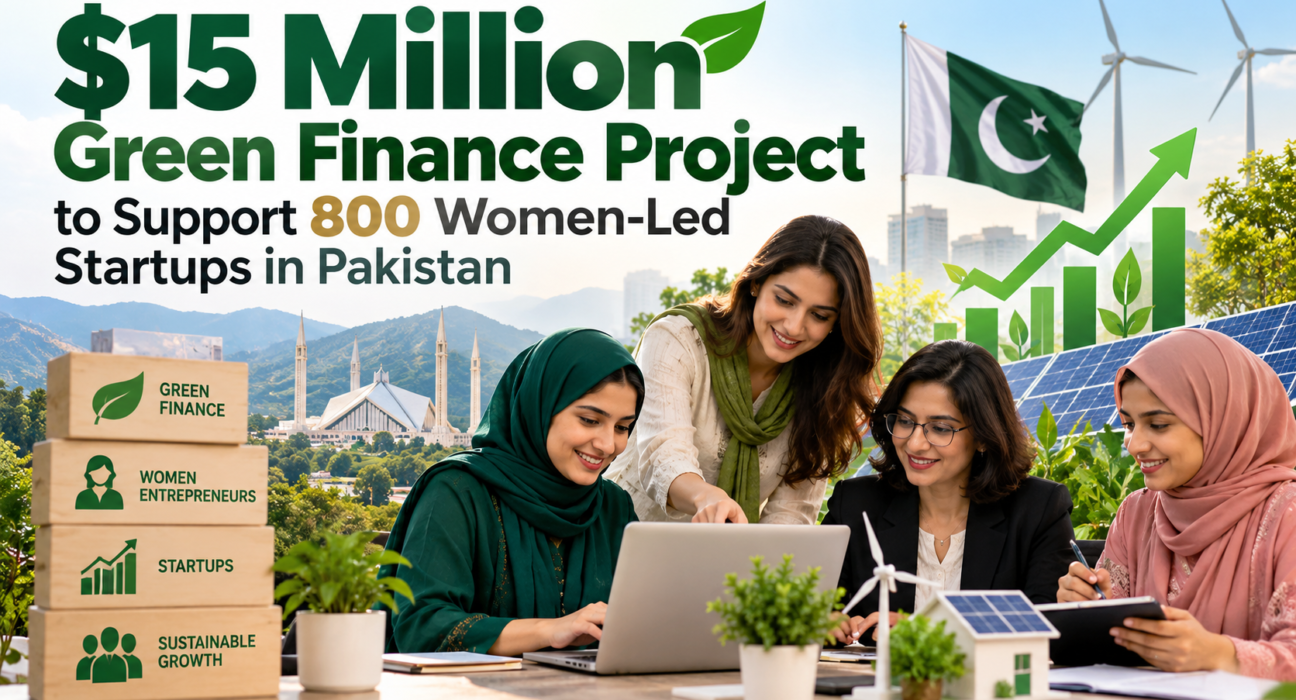
$15 Million Green Finance Project to Support 800 Women-Led Startups in Pakistan
Pakistan is considering a major new green finance initiative designed to give women entrepreneurs better access to funding, business support, and opportunities in the growing green economy. The proposed $15 million Green Finance Project in Pakistan aims to support more than 800 women-led startups, train around 3,200 women, and contribute to the creation of over 12,000 green jobs.
The initiative, called the Gender-Responsive Climate Finance and Entrepreneurship Hub, has been proposed by Punjab’s Environment Protection and Climate Change Department (EP&CCD). It is being considered under the World Bank Country Partnership Framework for Pakistan for FY2026–FY2035.
The plan is significant because it brings together two areas where Pakistan has considerable room for growth: women’s entrepreneurship and climate-friendly businesses.
Rather than focusing only on financial assistance, the proposed project includes seed capital, green grants, incubation facilities, business training, market connections, and support for climate-resilient business models.
What Is the $15 Million Green Finance Project in Pakistan?
The proposed project is designed to make it easier for women entrepreneurs to establish and expand businesses connected with the green economy.
According to details reported by Associated Press of Pakistan, the initiative would support more than 800 women-led startups while providing training and other forms of assistance to thousands of women.
The project is expected to include several important components, including:
- A Provincial Women’s Green Equity Fund
- Four Regional Green Incubation Centres
- A Punjab Green Marketplace
- Seed capital and green grants
- Entrepreneurship and business training
- Climate-resilient business development
- Sustainable supply-chain training
- Market linkages
- Support for access to carbon markets
- Digital monitoring of project results
Together, these measures are intended to provide women entrepreneurs with more than funding alone. The proposed structure would also help businesses gain knowledge, mentorship, market access, and practical support.
More Than 800 Women-Led Startups Could Receive Support
One of the biggest targets of the project is to support over 800 women-led startups in Pakistan.
Access to finance can be a major challenge for new businesses, particularly during their early stages. Research on entrepreneurship in Pakistan has previously highlighted financing gaps for startups and the need for stronger support systems for women entrepreneurs.
The proposed Green Finance and Entrepreneurship Hub could address part of this challenge by combining financing with incubation and business development.
This approach matters because capital alone does not always help a startup become sustainable. Entrepreneurs may also need guidance on business planning, operations, supply chains, technology, customers, and access to new markets.
Under the proposed model, women-led businesses could receive support in several of these areas.
3,200 Women Expected to Benefit From Training and Support
The initiative is expected to target more than 3,200 beneficiaries, with women receiving entrepreneurship training, financial assistance, incubation opportunities, and market connections.
Training could be particularly valuable for entrepreneurs entering climate-related sectors for the first time.
Green businesses can operate across a wide range of industries. Opportunities may emerge in renewable energy, sustainable agriculture, recycling, environmentally responsible products, energy efficiency, waste reduction, and other businesses that contribute to a lower-carbon economy.
The project’s focus on climate-resilient business models could also help entrepreneurs understand how environmental risks may affect their operations and how businesses can adapt.
Provincial Women’s Green Equity Fund
A major part of the proposed initiative is the establishment of a Provincial Women’s Green Equity Fund.
The fund is expected to improve access to finance for women-led green enterprises. Seed capital and green grants are also included in the project proposal.
This could provide an important starting point for businesses that have promising ideas but struggle to secure traditional financing.
However, entrepreneurs should keep in mind that the project is currently being reported as a proposal. Detailed information about eligibility requirements, funding amounts for individual startups, application procedures, deadlines, and selection criteria has not yet been announced in the available project details.
Women interested in the initiative should therefore rely on official announcements when applications or detailed guidelines become available.
Four Regional Green Incubation Centres Are Planned
The project also proposes establishing four Regional Green Incubation Centres.
Business incubators can provide an environment where early-stage companies receive guidance, training, mentorship, and connections needed to develop their ideas into sustainable businesses.
For women entrepreneurs outside major commercial centres, regional incubation facilities could potentially make business support more accessible.
These centres are expected to complement financial assistance by helping entrepreneurs strengthen their business models and prepare for growth.
The combination of finance and incubation is one of the most important features of the proposed initiative.
Punjab Green Marketplace Could Connect Businesses With Customers
Another proposed component is the Punjab Green Marketplace.
Building a business is not only about developing a product. Entrepreneurs also need customers and reliable ways to reach markets.
A dedicated green marketplace could help participating businesses showcase environmentally responsible products and services while creating connections between entrepreneurs, customers, businesses, and other stakeholders.
If implemented effectively, this could help women-led startups move beyond the early development stage and build stronger commercial relationships.
Project Aims to Create More Than 12,000 Green Jobs
The project has an ambitious employment target as well.
It aims to contribute to the creation of more than 12,000 green jobs.
Green jobs generally refer to employment connected with activities that support environmental sustainability, efficient use of resources, climate resilience, or lower emissions.
Creating these jobs could have benefits beyond the startups receiving direct support. Growing companies need employees, suppliers, service providers, logistics partners, technology specialists, and other supporting businesses.
As a result, successful women-led enterprises could potentially generate wider economic activity within their communities.
The job target, however, should be understood as a project objective, rather than an already achieved outcome.
Climate Impact Is Another Major Target
The project is not focused only on entrepreneurship.
It also has environmental goals.
The initiative aims for an estimated annual reduction of around 150,000 tonnes of carbon dioxide equivalent (tCO2e).
Participating businesses could also receive assistance related to carbon markets and sustainable supply chains.
Pakistan has been working to expand its access to climate finance and attract investment into lower-carbon development. The proposed project could add a women-focused entrepreneurship component to those broader efforts.
For readers who want additional background on the country’s startup financing challenges, the UNDP State of Youth Entrepreneurship in Pakistan report discusses issues including early-stage capital gaps and women’s participation in entrepreneurship.
Which Organizations Could Be Involved?
Punjab’s Environment Protection and Climate Change Department (EP&CCD) has been identified as the lead entity for the proposed project.
Several other organizations are expected to have supporting roles, including:
- Women Development Department
- Punjab Information Technology Board (PITB)
- UN Women
Having organizations focused on environmental policy, women’s development, and technology involved could allow the project to address different parts of the entrepreneurship process.
The initiative is being processed within the World Bank Country Partnership Framework for Pakistan FY2026–FY2035.
Digital Dashboard Could Track Project Performance
Transparency and measurement are also included in the proposal.
A digital monitoring and evaluation dashboard is planned to track the project’s progress. The proposed system would use gender-disaggregated information and verified emission reductions to measure results.
This could help policymakers and stakeholders monitor whether the project is reaching women entrepreneurs and meeting its environmental targets.
For a programme combining entrepreneurship and climate finance, measuring both economic and environmental outcomes will be important.
Why This Project Matters for Women Entrepreneurs in Pakistan
Women entrepreneurs can bring new products, services, skills, and employment opportunities into Pakistan’s economy. Yet starting and scaling a business requires access to capital, knowledge, networks, and customers.
The proposed $15 million green finance project attempts to bring these elements together.
Its potential importance comes from the combination of:
Finance: Seed capital and green grants could help eligible businesses overcome early funding barriers.
Skills: Training could help entrepreneurs develop stronger and more resilient companies.
Incubation: Regional centres could provide practical business support.
Market Access: The proposed Punjab Green Marketplace could help connect businesses with customers and commercial opportunities.
Climate Focus: Supporting environmentally responsible businesses could contribute to Pakistan’s transition toward a greener economy.
If implemented successfully, the project could therefore support both economic participation and environmental goals.
What Should Interested Women Entrepreneurs Do?
At this stage, women entrepreneurs should avoid treating reports about the project as an open call for applications.
The initiative has been proposed, and the available information does not yet provide a confirmed public application portal, final eligibility criteria, application deadline, or individual funding limits.
Entrepreneurs interested in future opportunities can use this time productively by preparing basic business documents, defining their business model, keeping financial records organized, and clearly identifying how their business contributes to environmental sustainability.
Once official applications are announced, applicants should check the published eligibility requirements carefully before submitting information.
A Potential Boost for Pakistan’s Green Startup Ecosystem
Pakistan needs both new economic opportunities and practical responses to environmental challenges. Supporting businesses that work in climate-friendly sectors could contribute to both goals.
The proposed $15 million Green Finance Project represents an attempt to connect climate finance with women’s entrepreneurship.
With plans to support more than 800 women-led startups, train 3,200 women, create over 12,000 green jobs, establish regional incubation centres, and improve access to finance and markets, the initiative has ambitious targets.
Its real impact will ultimately depend on implementation, accessibility, transparent selection, and how effectively financial and business support reaches eligible entrepreneurs.
For now, the project is an important development to watch for women entrepreneurs, startups, and businesses interested in Pakistan’s growing green economy.
The proposed $15 Million Green Finance Project to Support 800 Women-Led Startups in Pakistan could open new opportunities for women interested in building businesses connected with sustainability and the green economy.
Its combination of funding, training, incubation, market access, and climate-focused business development makes the proposal broader than a traditional startup financing programme.
However, potential applicants should wait for confirmed official guidelines before assuming they qualify or submitting information to any third-party website. As implementation details emerge, eligibility criteria, application dates, funding arrangements, and official registration channels