

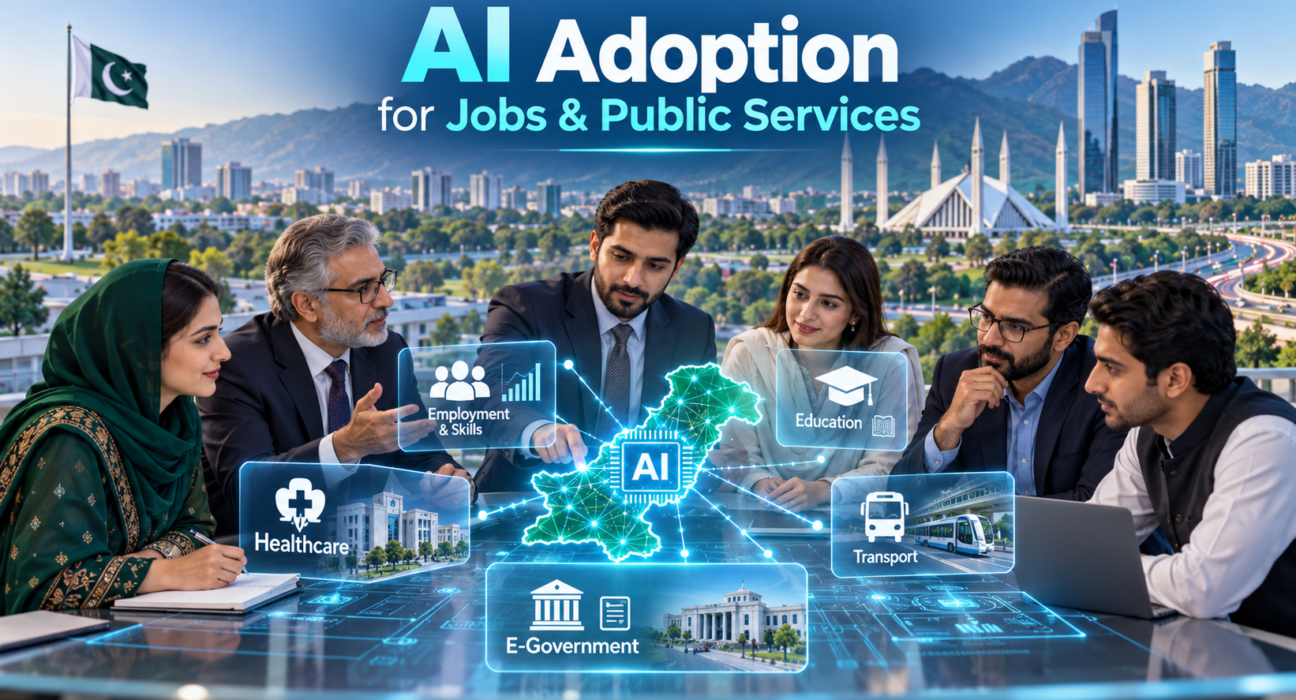
Artificial intelligence is no longer a topic for tech conferences only. It now shows up in our phones, our banks, our classrooms, and even our government offices. Across Pakistan, economists, university teachers, IT leaders, and policymakers are saying the same thing: the country needs to move on AI now, and it needs to do it carefully.
In this guide, I’ll walk you through what the experts are saying, what the government has already done, where the real opportunities are, and where the dangers hide. I’ll keep things simple and honest. By the end, you’ll understand why this debate matters for your job, your business, and the services you use every day.
Pakistani Experts Urge AI Adoption to Boost Jobs and Public Services: The Big Picture
Let’s start with the main message. Pakistani experts believe AI can raise productivity, open new career paths, and make public offices faster and fairer. They also warn that waiting too long could leave the country behind its neighbors.
Why the Experts Sound So Urgent
Pakistan has a very young population. Every year, thousands of graduates enter a job market that cannot absorb them all. Experts see AI as one tool that can help create new kinds of work, from data services to software exports to digital training.
At a seminar linked to Digital Pakistan Vision 2047, speakers called for urgent AI integration, wider youth education, and workforce upskilling. They also urged the business community to help speed up adoption. That tells us the push is not only coming from government. It is coming from business owners and educators too.
A General-Purpose Technology
At a LUMS debate, experts described AI as a general-purpose technology. They compared its economic importance to electricity, computing, and the internet. Think about that for a moment. Electricity did not just light up homes. It changed factories, hospitals, and farms. AI may do something similar, and the countries that learn to use it early will probably gain the most.
Where Pakistan Stands With AI Today
Many people are surprised to hear that Pakistan is already an active AI user. Ordinary people use chatbots, translation tools, and image apps every day. Freelancers use them to write, design, and code faster.
High Usage, Mixed Feelings
One report says Pakistan ranks among the top five global users of AI tools, and that experts want clear ethical guidelines and practical policies to manage this fast growth. Another summary of a 21-country study placed Pakistan just behind India, Kenya, and Brazil in adoption. That coverage also noted that the country has launched its own chatbot, Zahanat AI, built for local languages.
A homegrown tool matters a lot. Most global AI systems work best in English. A tool built for Urdu and regional languages can reach farmers, shopkeepers, and students who feel left out by English-first technology.
Enthusiasm and Fear Side by Side
People feel two things at once. Many are excited because AI helps them work faster. Others worry about their jobs. Industry leaders say AI is already replacing some roles in IT and service industries, and that leaning too hard on AI apps may weaken critical thinking at work. Both views are fair, and good policy has to respect both.
Inside the National AI Policy 2025
The biggest recent step came from the federal cabinet. It approved the National AI Policy 2025 to make AI more accessible, improve public services, and open new job and innovation paths. You can read the original news report on
The Main Goals in Plain English
Here is the policy in simple words. The government wants more trained people, more money for new ideas, and more AI use inside public offices.
| Policy Element | What It Aims to Do |
| Talent building | Train one million AI professionals by 2030 |
| Funding | Set up an AI Innovation Fund and an AI Venture Fund |
| Public services | Use AI to improve governance and daily services |
| Oversight | Create an AI Council to guide the master plan |
The policy aims to train one million AI professionals by 2030 and create the two funds to bring in private sector involvement. An AI Council will oversee execution through a master plan.
What the Prime Minister Said
Prime Minister Shehbaz Sharif said AI will modernize the economy and raise productivity in agriculture, public services, and governance. That is a big promise. The real test is whether the plan reaches villages and small towns, and not only big cities like Lahore, Karachi, and Islamabad.
How AI Can Create New Jobs in Pakistan
When people hear “AI,” many think “robots taking jobs.” That is only half the story. History shows that new technology kills some jobs and creates others. The key is how fast people can learn the new skills.
New Roles Are Already Appearing
At LUMS, experts said AI could help Pakistani firms cut costs, improve exports, grow startups, and create demand for skills in data, software, design, and cybersecurity. They also listed possible new roles such as AI operators, data analysts, prompt specialists, cybersecurity staff, product managers, and digital trainers.
Notice something here. Not every new job needs a computer science degree. A digital trainer, for example, needs good teaching skills and enough AI knowledge to show others how to use the tools.
Freelancing and Service Exports
Pakistan already has a strong freelancing community. AI tools can help a freelancer finish work faster, serve more clients, and offer new services like automated customer support or AI-assisted content. If more freelancers learn these tools well, the country could earn more foreign income from digital services.
Small Businesses Can Grow Too
A small shop owner can use AI to plan stock, write product descriptions, and answer customer messages. Experts at LUMS pointed out that smarter inventory planning for small businesses is one realistic benefit. Small wins like these add up across millions of businesses.
The Job Loss Worry Is Real Too
I want to be honest with you. Experts who support AI adoption do not say it is risk-free. Some of the strongest warnings come from the same people who want faster progress.
What the World Bank Warns
A World Bank report, covered by Business Recorder, warned that quick AI adoption could hurt Pakistan’s job market. It said that with Pakistan already struggling to create quality jobs, rapid AI use could shrink opportunities for skilled graduates unless policies support job creation and reskilling.
The same report offered a less scary number. It found that 4.5 percent of existing jobs in low- and middle-income countries are at risk from generative AI, compared with 14.2 percent in high-income countries. In plain words, the risk is lower here, partly because many jobs in Pakistan are in farming, retail, and informal work, which AI touches less today.
Why That Is Not a Reason to Relax
A lower risk does not mean zero risk. Office work, customer support, basic coding, translation, and data entry are the areas people mention most. Workers in those fields should start learning AI tools now, and not wait until their employer forces the change.
The LUMS discussion also suggested that businesses should tie AI adoption to better products, faster service, and staff upskilling, and not only to cutting headcount. That is a healthy rule for any company.
Smarter Public Services With AI
Jobs are only one side of the story. The second half of the title is public services, and that is where ordinary people may feel the change most directly.
The National Task Force
Pakistan has already formed a national task force on AI. Its key objective is to build a 10-year roadmap for faster AI adoption in business, development, governance, education, and health care. The task force includes AI experts along with government and private sector representatives.
Mixing public and private voices is smart. Government knows the needs of citizens. The private sector knows how to build and ship tools quickly.
Faster Hiring Through Digital Portals
Here is a concrete example. The National Job Portal, run by NITB, connects job seekers with verified public sector jobs through a central, automated system. Reports in January 2026 said the portal would get an AI upgrade for faster hiring. A smoother system like this can cut waiting time and reduce the chance of paperwork mistakes.
Where Else AI Can Help Citizens
Think about the places where you wait in long lines today. Land records, tax filing, utility complaints, and license renewals are all slow in many offices. AI can sort requests, flag errors, translate forms, and answer simple citizen questions at any hour. A high-level UNDP and Government of Pakistan dialogue in early 2026 focused on using AI to transform public services, improve governance, and speed up progress toward the Sustainable Development Goals.
Skills Pakistan’s Workforce Needs Next
None of this works without people who know how to use AI. Experts keep returning to this point, and I agree with them.
The Skills Gap
A policy brief from a Pakistani think tank pointed out something important. Even though many people graduate with computer science degrees, there is a notable shortage of people who specialize in AI. The brief also warned that without enough experts to build, apply, and maintain AI systems, many opportunities may go unused.
Retraining Current Workers
Training only new graduates is not enough. Millions of people already work in jobs that will change. One report quoted an official saying that government-backed training programs would help move traditional IT professionals into AI-capable roles. That kind of reskilling should reach teachers, clerks, accountants, and shop staff too.
Simple Skills Anyone Can Start With
You do not need to become a programmer. Here are some starting points that anyone can build:
- Learn how to write clear instructions for AI tools.
- Practice checking AI answers for mistakes.
- Understand basic data privacy rules.
- Pick one task in your work and try to improve it with AI.
These habits build confidence, and confidence is half the battle.
Industries That Can Gain the Most
Some sectors are better placed than others to benefit quickly. Experts mention several, and they match what many Pakistani families care about most: food, health, school, and money.
Where AI Can Help Pakistani Sectors
| Sector | Possible AI Use | Likely Benefit |
| Agriculture | Crop advice and yield planning | Better harvests, lower waste |
| Textiles | Automated quality checks | Fewer defects, better exports |
| Health care | Faster medical screening | Earlier detection of illness |
| Education | Personalized learning tools | Better results for students |
| Banking | Fraud detection | Safer digital payments |
These examples match what the LUMS experts discussed, including AI-powered crop advice, automated quality control in textile units, faster medical screening, personalized learning tools, and fraud detection in banking.
Farming Deserves Special Attention
Agriculture employs a huge share of Pakistanis. If AI can tell a farmer when to sow, how much water to use, and when a pest problem is starting, that could mean real money in a family’s pocket. The prime minister himself named agriculture as one area where AI can lift productivity.
Education and Health
In schools, AI can help a teacher with a class of fifty students give extra support to those who fall behind. In hospitals, it can help doctors review scans faster. The tools will not replace teachers or doctors. They will give those professionals more time for the human side of their work.
Risks, Ethics, and Trust
Moving fast is exciting, but trust is easy to lose. Experts agree that rules must grow along with the technology.
Bias and Privacy
The World Bank report made a sharp point about trust. Better public services and better school results can build trust, but if AI builds bias into government decisions or weakens data privacy, that trust will be hard to win back. Imagine an AI tool that unfairly rejects loan or benefit applications from certain regions. People would lose faith in the system quickly.
What the Policy Experts Recommend
The think tank brief suggested several steps. These included a national AI ethics board of experts from different fields, cooperation with international groups on best practices, a full national AI strategy, and regulatory sandboxes where startups can safely test new ideas. A sandbox lets companies try new tools under supervision, so mistakes get caught early and cost less.
Infrastructure Still Matters
AI needs reliable electricity, fast internet, and good data. One analysis says successful adoption will need serious investment in digital infrastructure, education, and training, along with supportive rules that address privacy and security. Without these basics, even the best policy will stay on paper.
Practical Steps for Government, Business, and Workers
Policies are useful, but action matters more. Here is how each group can move forward in a sensible way.
What Government Can Do
- Keep the AI Council active and accountable with public progress updates.
- Roll out AI tools in simple, high-volume services first, like complaint handling and job portals.
- Fund training in smaller cities, not only major hubs.
- Protect citizen data with clear and enforceable rules.
What Businesses Can Do
Start small. Pick one process, such as customer support or inventory, and test an AI tool for a few weeks. Train your staff before you change their roles. Share the gains with workers where you can, because people support change when they benefit from it.
What Workers and Students Can Do
Be curious. Spend a little time each week learning one AI skill. Join local training programs and online courses. Build a small portfolio that shows how you used AI to solve a real problem. Employers notice proof of skills more than certificates.
Why Teamwork Matters
No single group can do this alone. Government sets direction, business creates jobs, universities build talent, and citizens give feedback. When all four work together, the benefits spread wider and the risks shrink.
The message from Pakistani experts is clear and fair. AI can open new jobs, lift small businesses, and make public services faster and more honest. It can also hurt workers and weaken trust if the country rushes without a plan.
The good news is that Pakistan has already started. It has a national policy, a task force, funding plans, and a growing community of users and builders. What comes next depends on action: training people at scale, protecting data, building infrastructure, and keeping ordinary citizens at the center.
If you are a student, start learning today. If you run a business, test one small project this month. If you work in government, push for simple wins that people can see and feel. The country does not need to copy anyone. It needs to build an approach that fits its own people, languages, and needs. Done well, AI can become a tool that helps millions of Pakistanis work smarter and live better.