

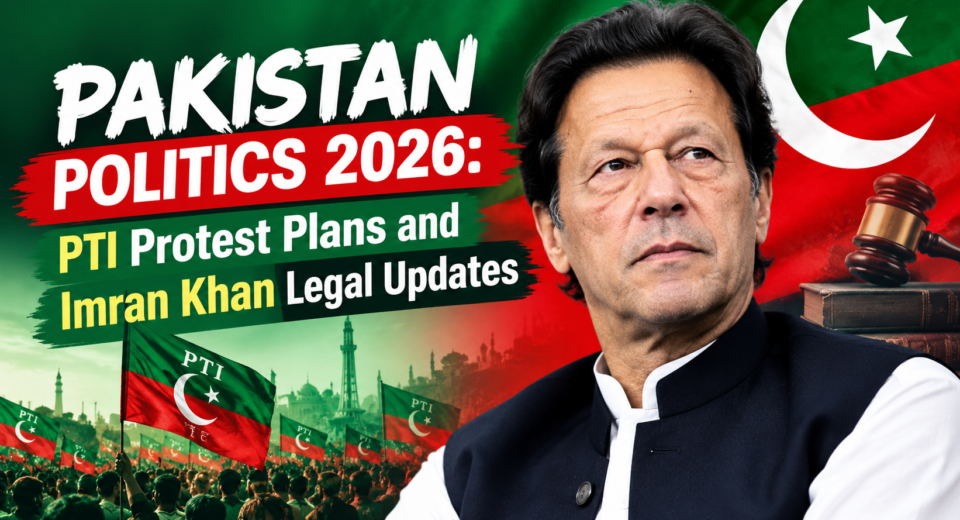
Pakistan Politics 2026: PTI Protest Plans and Imran Khan Legal Updates
If you’ve been following Pakistani news this year, you already know one topic keeps coming back: Imran Khan and his party, PTI. Between court hearings, protest marches, and health concerns, 2026 has turned into a busy year for Pakistan’s political scene. Let’s break down what’s actually happening, in plain and simple terms. A Quick Recap: Why Is Imran Khan Still in Jail? Imran Khan, the former Prime Minister and founder of Pakistan Tehreek-e-Insaf (PTI), has been behind bars since August 2023. He was removed from office after a break with the country’s powerful military establishment, and he says the legal cases against him are politically motivated. He has been imprisoned since August 2023 on charges he calls politically motivated after a fallout with the country’s military led to his removal from office. His supporters agree, and they’ve spent the past three years demanding his release. By August 2026, Khan had spent three full years in Adiala Jail. That milestone became a rallying point for his party, and it set the stage for a lot of what we’re seeing this year. PTI’s Nationwide Protests to Mark Three Years in Jail On August 5, 2026, PTI held protests across Pakistan to mark exactly three years since Khan’s detention began. Supporters staged demonstrations across the country, with one of the largest protests held outside Lahore’s Aiwan-e-Adl, where members of the Insaf Lawyers Forum led a rally demanding his release. Lawyers, party workers, and ordinary supporters showed up in big numbers, and the mood was intense. Party leaders like Salman Akram Raja and Asad Qaiser have been front and center at these events. Protesters kept chanting for Khan’s release while saying the demonstrations were peaceful, even though they viewed his imprisonment as unlawful. On the other side, analysts note that as long as Pakistan’s military and ruling parties see Khan as a serious political threat, there’s little reason for the state to ease up on him. One analyst pointed out that the state has little incentive to help Khan return to politics as long as he’s viewed as a major challenger. This wasn’t a one-time thing either. PTI had planned this well in advance. The party announced its nationwide protest movement would launch on August 5, a decision made during a meeting of its parliamentary leadership. It’s clear the party sees these anniversary protests as a way to keep public attention on Khan’s case. The September 27 Long March: What’s the Big Deal? After the August protests, PTI didn’t stop there. The party announced plans for a bigger move: a long march toward Islamabad on September 27, 2026. This one raised more eyebrows because long marches in Pakistan have a history of turning tense. The government wasn’t thrilled about it. A petition was filed asking the Islamabad High Court (IHC) to block the march. A three-member bench headed by Chief Justice Sarfraz Dogar heard arguments from both sides before reserving its verdict on the matter. During the hearing, government lawyers pointed to past PTI protests as proof things could get out of hand. The Islamabad advocate general argued that government machinery had been used during the 2022 protest, and that protesters had used cranes to remove barriers set up by the administration. He also claimed that property had been set on fire at D-Chowk, and that a similar situation happened again during protests in 2024. PTI’s side, understandably, saw it differently. The party maintains the march is meant to be peaceful and is simply about demanding Khan’s release and defending the constitution. So how did it end? The court didn’t ban the march outright. Instead, the bench made clear that no political party or public office-holder has the authority to shut down Islamabad’s roads or public spaces for political activity. In other words, PTI can protest, but not by blocking highways or disrupting daily life. The court rejected the plea to stop PTI from protesting altogether, but it directed provincial chief ministers to make sure state machinery isn’t misused in connection with the protest. The Islamabad administration was also told to make sure the march doesn’t cause major trouble for regular citizens. This is a pretty balanced outcome. PTI keeps its right to protest, but with real limits attached.https://propakistan.pk/ Imran Khan’s Legal Battles: A Timeline of Trouble Khan’s legal troubles haven’t slowed down at all in 2026. If anything, they’ve piled up. Here’s a simple table to help you keep track of the major cases and events. Case or Event What Happened Toshakhana-II Case Khan and his wife, Bushra Bibi, were sentenced over the purchase of a jewelry set gifted by the Saudi Crown Prince £190 Million Case Khan is serving a 14-year sentence linked to this corruption case Health Concerns Reports of eye problems and other health issues raised alarm among his family and supporters Hospital Transfer Dispute A contempt petition was filed after the government sent Khan to a state hospital instead of a private one On the health front, things got especially tense in August 2026. A three-judge bench had directed the government to transfer Khan from Adiala jail to the private Shifa International Hospital in Islamabad within two days for a medical examination. But instead of following that instruction exactly, authorities sent him to a state-run hospital. PTI wasn’t happy about it. The party’s legal adviser, Naeem Panjutha, confirmed that a contempt petition had been filed against the government, seeking action against the prime minister, law minister, and information minister. PTI argued the court order meant Khan should stay under proper medical supervision for a longer stretch, and supporters gathered outside the hospital to show support. As for the Toshakhana-II verdict, Khan didn’t take it quietly. After the court sentenced him in the case, he called for a nationwide protest and said he would challenge the verdict in the Islamabad High Court. His legal team argued the ruling wasn’t backed by solid evidence, while PTI leaders described it as a political move dressed up as justice. Government’s Side of