

Imran Khan Seeks Urgent Medical Care News Politics

Breaking News: Imran Khan Seeks Urgent Medical Care, Raises Concerns for His Life

Few stories in Pakistan get people talking like the health of Imran Khan. He is the former prime minister, the founder of Pakistan Tehreek-e-Insaf (PTI), and a prisoner at Adiala Jail. In mid-November 2026, he warned top judges that his health is getting worse. The government says he is stable. His family and party say he is not getting the care he needs. I’m writing this guide to help you sort out what has been reported, who is saying what, and what is still unproven. I’ll keep it simple, stick to the facts, and flag the claims that nobody has independently confirmed. Breaking News: Imran Khan Seeks Urgent Medical Care, Raises Concerns for His Life: What We Know So Far Let’s start with the basics. Imran Khan has told Pakistan’s top judges that his health is getting worse and asked for urgent treatment, while the government says hospital checks found him stable. That one sentence holds the whole dispute. Two sides, two very different pictures. The Short Version Why This Story Matters Right Now A prisoner’s health is never just a medical matter when that prisoner is a former prime minister. Every checkup, every hospital trip, and every statement gets read through a political lens. That is why this story spreads so fast, and why it also attracts rumors. I’ll cover those later, because some of them have been false. Who Is Imran Khan and Why Is He in Adiala Jail If you are new to this story, a little background helps. From Cricket Hero to Prime Minister Khan first became famous as a cricket captain. He later entered politics and founded PTI. He served as prime minister from 2018 to 2022. His time in office ended in 2022 when he lost a no-confidence vote, and he has been a leading opposition voice ever since. Arrest and a Long Legal Fight He has been in prison since his arrest in August 2023. His wife, Bushra Bibi, is also held at Adiala. She has been there since January 2025, after convictions in the Al-Qadir Trust case. His supporters call the cases politically driven. The government says the courts are simply following the law. I’m not here to settle that argument. What matters for this article is the medical side, because every person in custody has a right to health care no matter what they are accused of. A Timeline of the Key Health Events Here is a quick table to keep the dates straight. It only includes events that were reported by news outlets. Table 1: Key Medical Events Reported Date What Happened Dec 2025 Khan asked the Islamabad High Court for regular medical tests at Shaukat Khanum Hospital Early 2026 Reports of serious vision loss in one eye emerged Aug 18, 2026 The Supreme Court ordered a move to Shifa International Hospital Sep 20, 2026 A medical team checked his blood pressure, cholesterol, and eyesight at the jail Nov 10–11, 2026 He was taken to PIMS in Islamabad for an eye exam Nov 11, 2026 He met his lawyer and sent a letter to three chief justices Mid-Nov 2026 PIMS doctors visited Adiala to examine Khan and Bushra Bibi Some of these dates come from different reports, so small details may shift as more information comes out. The Letter to the Chief Justices This is the heart of the story. Khan wrote an urgent letter to the Chief Justice of Pakistan, the Federal Constitutional Court Chief Justice, and the Islamabad High Court Chief Justice. It was passed on through his lawyer, Salman Safdar, after a meeting at the jail on November 11. What He Asked For He asked the judges to make sure earlier court directions on his treatment were actually carried out. In plain words, he is not asking for new rules. He is saying the old orders have not been followed. He also asked for his personal doctors to stay involved and for family contact to continue. The Eye Problem The eye issue sits at the center of this story. In his letter, Khan said he has lost 85 percent of the vision in his right eye. That is a very serious claim. But we should be careful. A medical board later reported that vision in his right eye improved from 6/36 to 6/9, and that his left eye reached 6/6 with glasses. So we have two very different accounts. One is from Khan himself, and one is from a government-linked medical board. Nobody outside these groups has independently checked the numbers. Until that happens, the honest answer is that the reports conflict. Blood Pressure and Isolation Khan also pointed to high blood pressure and long stretches alone in his cell. He said that prolonged solitary confinement puts his life and health in extreme danger. Earlier, in December 2025, he said he had not met a single person for four weeks. Jail officials reject the idea of isolation. Still, his letter says prison medical boards earlier recommended more family contact, reading material, and television to protect his mental health, and that these advice points were ignored. That is his claim, and officials have not accepted it. What the Government and Jail Officials Say A fair article has to give the other side full weight, so let’s do that. “He Has Been Examined Again and Again” Parliamentary Affairs Minister Tariq Fazal Chaudhry rejected the claim that Khan is denied medical care. He said Khan had been taken to PIMS eight times and that doctors called his health satisfactory. The minister also said specialists are watching his blood pressure. Facilities Inside the Jail Earlier in the year, jail leaders described his conditions in detail. They said he has a secure seven-cell area, an open courtyard for daily walks, and medical checks three times a day. They also said 66 people, including family, lawyers, and party leaders, visited him over three months. The jail called talk of mistreatment baseless and political. Here is a side-by-side look at both positions. Table
Pakistan Weather Update News

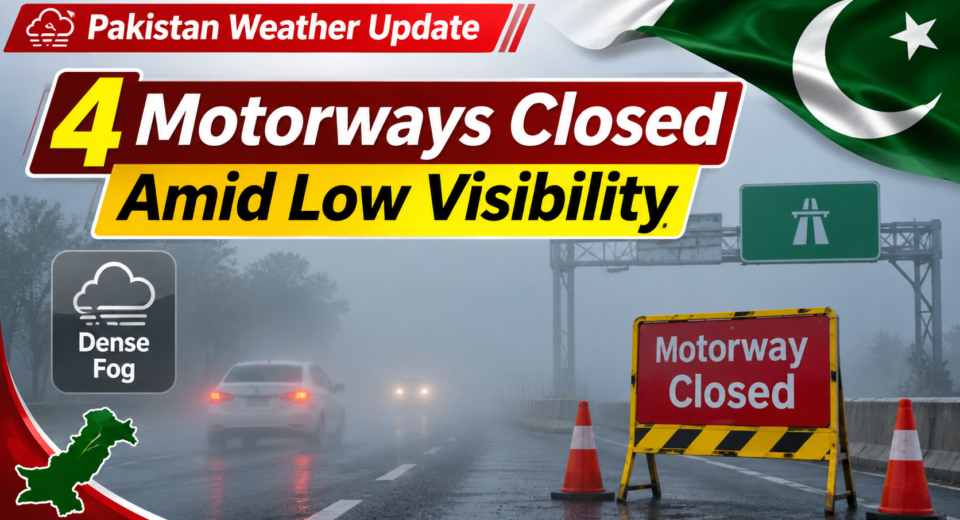
Pakistan Weather Update: 4 Motorways Closed Amid Low Visibility

If you’re planning a road trip across Punjab or Khyber Pakhtunkhwa this week, stop for a minute and read this. Winter fog is back. Every year around this time, a thick white blanket settles over the plains, and the motorway police shut down long stretches of road to keep people safe. It’s annoying, and it can wreck a travel plan. But it’s also the right call, and knowing why can help you plan better. I’ll walk you through what’s going on, which routes are usually hit, how to drive if you must travel, and where to find reliable updates. I’ll keep it simple and practical, the way I’d explain it to a friend before a long drive. One important note: motorway closures change by the hour. A road shut at 6 am can reopen by noon, and a clear road can close again at night. Use this guide as your base, and always check the latest alert before you leave. Pakistan Weather Update: 4 Motorways Closed Amid Low Visibility Let’s start with the big picture. When dense fog rolls in, the National Highways and Motorway Police (NHMP) closes the sections where you can’t see far enough to drive safely. Usually that means four or five motorway stretches at the same time, often on the M-2, M-3, M-4, M-5, M-11, or M-1. This isn’t a one-off. Earlier this month, NHMP’s Central Region reported that the M-4 was shut to all vehicles between Shamkot and Abdul Hakeem because of poor visibility. The same morning, the M-1 near Peshawar was also temporarily closed between the main toll plaza and Rashakai because of dense fog. Different routes, same cause. Why Four Closures Matter More Than One When one motorway closes, drivers shift to another. But when four close together, the alternatives are old highways such as the GT Road. These roads have junctions, slow vehicles, rickshaws, and tractors. In fog, that mix is dangerous. So even a “closed” motorway tells you something: the whole region is in trouble. How Long Do Closures Usually Last There’s no fixed answer. Fog is usually thickest from late night until mid-morning. As the sun warms the ground, visibility improves and roads reopen in stages. On bad days, though, fog can hang around until afternoon, or return by evening. I’d plan for a delay of several hours and treat anything shorter as a bonus. Why Fog Hits Punjab So Hard in Late Autumn You might wonder why this region gets hit so badly. It comes down to geography and weather. Punjab is flat, there’s a lot of moisture in the air from rivers and farmland, and nights get cold fast in November and December. Cold Nights and Moist Air On clear, calm nights, the ground loses heat quickly. The air near the surface cools down and can’t hold as much moisture. The extra water turns into tiny droplets floating just above the ground. That’s fog. Light winds mean nothing blows it away, so it simply sits there. The Smog Factor Fog isn’t the only problem. Smog usually starts in late October, peaks between November and January, and can last into February. Smoke from vehicles, factories, and crop burning mixes with fog and makes the air thick and dirty. That mix can cut visibility down to just a few meters. It also irritates your eyes and throat, which makes driving even harder. Why Motorways Are Especially Risky Motorways are built for speed. Cars travel at 100 km/h or more, which leaves very little time to react. In fog, you might not see a stopped truck until you’re nearly on top of it. One slow vehicle, one sudden brake, and you can get a chain-reaction pileup involving dozens of cars. That’s why the police prefer closing a road to risking a crash like that. Which Motorways Get Closed Most Often Over the past few fog seasons, the same routes show up again and again in NHMP alerts. Here’s a simple overview based on recent advisories. Motorway Route Commonly Affected Sections M-1 Islamabad to Peshawar Peshawar toll plaza to Rashakai M-2 Lahore to Islamabad Thokar Niaz Baig to Kot Momin or Chakri M-3 Faizpur to Abdul Hakeem Faizpur to Darkhana or Rajana M-4 Faisalabad to Multan Pindi Bhattian to Abdul Hakeem, Shorkot and Shamkot M-5 Multan to Sukkur Multan to Dera Ismail Khan, Rahim Yar Khan to Rohri M-11 Lahore to Sialkot Lahore to Sambrial These sections are the ones reported in recent fog advisories, and which ones close on any given day depends on the weather that morning. M-2 and M-3: The Busiest Corridors The M-2 carries heavy traffic between Lahore and Islamabad. The M-3 serves traffic heading toward Faisalabad. Both are busy with trucks and buses, and both pass through areas where fog gathers thickly. When these roads close, you’ll feel it in delivery times and ticket prices. M-4 and M-11: Frequent Trouble Spots The M-4 is often the first to close and the last to reopen, especially for heavy traffic. Authorities have also kept the M-4 closed to heavy traffic from Pindi Bhattian to Abdul Hakeem because of dense fog. The M-11 around Lahore and Sialkot sometimes stays shut through the evening, even after other routes reopen.  How NHMP Decides to Close a Motorway It may seem like closing a road is a simple on-off switch. It’s actually a careful decision made by officers on the ground. What Officers Look At Patrol teams drive the route and check visibility at several points. If they can’t see far enough ahead to stop safely, the section gets flagged. They also watch weather reports, traffic volume, and any crash reports. A road doesn’t have to be fully “white” to be closed. If conditions look likely to worsen, officers may close it early. Full Closure vs. Heavy Traffic Ban You’ll notice two kinds of closure in the news. A full closure stops all vehicles. A heavy traffic ban stops trucks, buses, and other large vehicles but lets cars through, usually when visibility