
The Pakistan new provinces debate has gained fresh attention after President Asif Ali Zardari and Prime Minister Shehbaz Sharif discussed the country’s administrative future. Both leaders stressed that any plan to create new provinces must follow the Constitution and receive the required parliamentary approval.
Their meeting in Lahore on November 14, 2026, came amid growing political discussion about dividing existing provinces into smaller administrative units. Interior Minister Mohsin Naqvi’s recent suggestion of a public referendum has added another important question to the debate.
Supporters believe smaller provinces could improve public services and bring government offices closer to citizens. However, opponents worry about political tensions, rising costs, and the possible division of historic regions.
The central question is simple: Can Pakistan create new provinces without parliamentary approval? Under the Constitution, the answer is no.
President Zardari and PM Shehbaz Discuss New Provinces
President Asif Ali Zardari met Prime Minister Shehbaz Sharif at the prime minister’s Model Town residence in Lahore on Saturday, November 14.
According to reports citing officials familiar with the meeting, both leaders agreed that changes to Pakistan’s provincial structure must follow constitutional rules.
They also discussed whether a referendum could help settle the growing disagreement over new provinces.
President Zardari maintained the Pakistan Peoples Party’s (PPP) opposition to dividing Sindh. Prime Minister Shehbaz supported the need to follow the legal process.
Senior political figures, including Rana Sanaullah, Raja Pervez Ashraf, and other government representatives, attended the meeting.
The Prime Minister’s Office also issued a statement about discussions on national politics, economic conditions, and government cooperation. However, that official statement did not specifically mention the new provinces debate.
This distinction matters because reports about the provincial discussion came mainly from officials familiar with the meeting.
Why Is Pakistan Discussing New Provinces Again?
The demand for new provinces in Pakistan is not new. Political leaders and regional groups have discussed the idea for decades.
However, the issue has become more important as Pakistan’s population continues to grow.
According to the 2023 national census, Pakistan had approximately 241.5 million people. Punjab alone had more than 127 million residents.
Managing large populations across distant districts can create challenges for provincial governments.
People living far from provincial capitals often complain about delayed development projects, limited public services, and unequal access to government offices.
Supporters of smaller provinces argue that local leadership could respond more quickly to these problems.
Others believe Pakistan should improve its existing institutions instead of creating more provincial governments.
What Does Pakistan’s Constitution Say About New Provinces?
The Constitution provides a clear legal process for changing provincial boundaries.
Article 239 is particularly important because it explains how constitutional amendments must receive approval.
A constitutional amendment generally requires support from at least two-thirds of the total membership of both the National Assembly and the Senate.
If the amendment changes the boundaries of an existing province, the affected provincial assembly must also approve it by a two-thirds majority of its total membership.
Therefore, the federal government cannot simply announce a new province through an executive decision.
Table 1: Constitutional Requirements for Creating New Provinces
| Constitutional provision | Requirement |
|---|---|
| Article 239(1) | A constitutional amendment needs a two-thirds majority in the house where it begins. |
| Article 239(2) | The other parliamentary house must also approve the amendment by a two-thirds majority. |
| Article 239(4) | Affected provincial assemblies must approve boundary changes by a two-thirds majority. |
| Article 48(6) | A national referendum requires approval at a joint sitting of Parliament. |
These requirements help protect Pakistan’s federal structure and ensure that major changes receive broad political support.
Can Pakistan Hold a Referendum on New Provinces?
Interior Minister Mohsin Naqvi has suggested holding a national referendum to understand public opinion about creating new provinces.
His proposal has increased interest in the issue.
Under Article 48(6), the prime minister may refer an important national question to a joint sitting of Parliament. If Parliament approves, the matter can be presented to voters through a referendum.
However, a referendum and a constitutional amendment are different procedures.
Even if voters support additional provinces, the government would still need to complete the constitutional process required to change provincial boundaries.
This means public support alone cannot replace the necessary parliamentary and provincial assembly votes.
Political Parties Have Different Views on New Provinces
Pakistan’s major political parties have not reached a common position on creating additional provinces.
Pakistan Peoples Party (PPP)
The PPP strongly opposes dividing Sindh. President Zardari has maintained this position during the latest discussions.
The Sindh Assembly also passed a resolution in September 2026 opposing the division of the province.
PPP leaders argue that Sindh’s historic identity and constitutional rights must be protected.
Pakistan Muslim League-Nawaz (PML-N)
The PML-N has supported parliamentary discussion but has not announced a final party policy covering all proposed provinces.
Defence Minister Khawaja Asif has supported considering up to 12 provinces based on administrative needs.
However, this remains a proposal rather than an approved government plan.
Pakistan Tehreek-e-Insaf (PTI)
PTI has not presented one clear, final position on the latest nationwide proposal.
Its response could influence future discussions, particularly because provincial approval is essential for boundary changes.
Which Regions Are Seeking Separate Provincial Status?
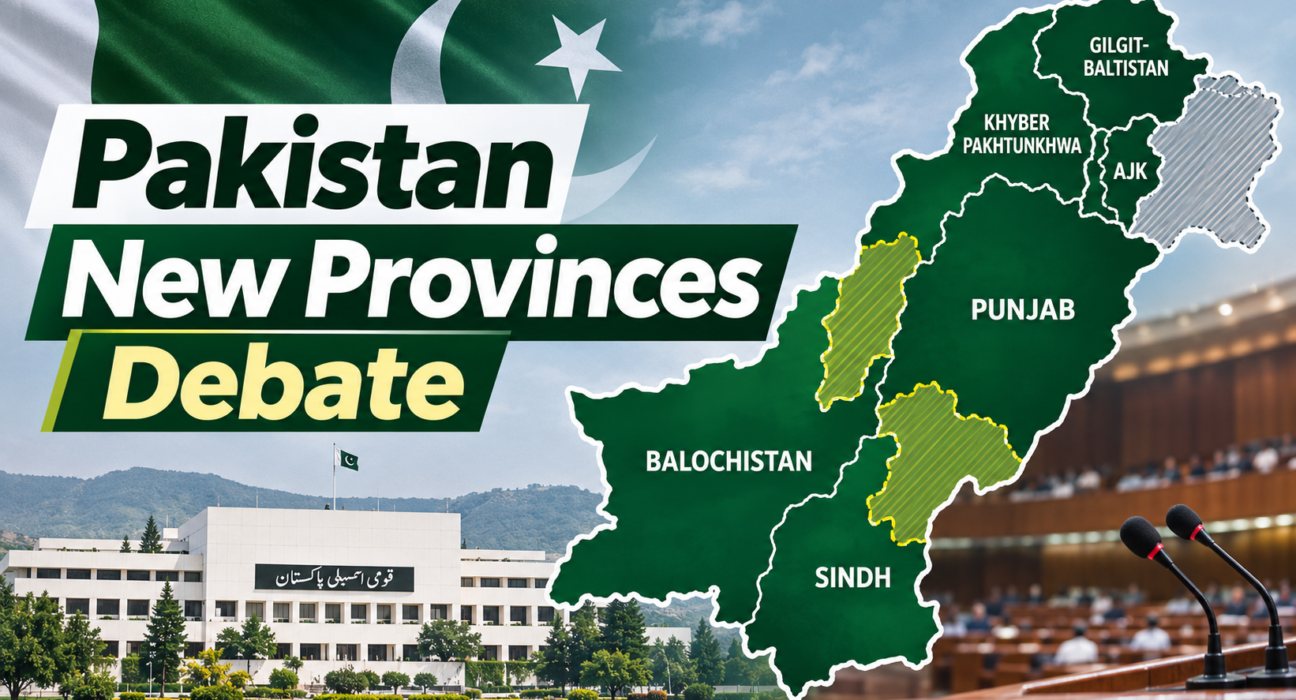
Several regions have appeared repeatedly in Pakistan’s new provinces debate.
South Punjab: Supporters argue that southern districts need greater control over development funds and public services. Many residents believe decisions made in Lahore do not always reflect local priorities.
Bahawalpur: The demand for restoring Bahawalpur’s former provincial status has a long political history. Supporters point to regional identity and administrative needs.
Hazara: Campaigners in Hazara have called for a separate province within the territory of Khyber Pakhtunkhwa. Their demands focus on representation and local governance.
Urban Sindh: Proposals involving Karachi and other urban areas have also entered political discussions. However, these ideas face strong resistance from the PPP and other opponents of Sindh’s division.
None of these proposals should be treated as an approved change to Pakistan’s provincial map.
How Could New Provinces Benefit Pakistan?
Supporters believe smaller provinces could make government services more accessible.
For example, people in distant districts may find it easier to contact provincial departments if major administrative offices are located closer to their homes.
New provincial governments could also give more attention to underserved areas.
Healthcare, education, roads, water supply, and employment programmes might receive greater regional focus.
Another possible benefit is stronger political representation. Smaller provinces could give residents more opportunities to raise local concerns through elected representatives.
However, these improvements are not guaranteed.
A new province would need capable leadership, fair budgets, effective institutions, and clear public accountability to deliver better results.
What Are the Main Challenges of Creating New Provinces?
Creating additional provinces would involve much more than drawing new lines on a map.
Pakistan would need to decide how to divide public resources, government jobs, buildings, and administrative responsibilities.
New provincial assemblies, departments, and other institutions could increase public spending.
Political disagreements over land, language, identity, and representation could also create tensions.
Another major question concerns the National Finance Commission, which plays an important role in distributing federal resources among provinces.
Changes to provincial boundaries would require careful decisions about financial arrangements and political representation.
Without proper planning, smaller provinces could face the same problems that affect existing governments.
Table 2: Benefits and Challenges of New Provinces in Pakistan
| Potential benefits | Possible challenges |
|---|---|
| Better local administration | Higher government expenses |
| Faster public service delivery | Complex administrative changes |
| Greater regional representation | Political and regional disagreements |
| More attention to local development | Disputes over financial resources |
| Government offices closer to citizens | Need for new institutions and staff |
The comparison shows why the debate requires detailed planning rather than quick political decisions.
Could Stronger Local Governments Be Another Solution?
Creating new provinces is not the only way to improve administration.
Pakistan could also strengthen district and local governments.
When local institutions have proper budgets and decision-making powers, they can address community problems without waiting for provincial departments.
For example, empowered local councils could manage smaller development projects, local roads, sanitation, and other public needs.
This approach may help improve services without changing provincial borders.
However, it would still require political commitment, financial support, and effective oversight.
The real goal should be better governance, whether Pakistan achieves it through new provinces or stronger existing institutions.
What Happens Next in Pakistan’s New Provinces Debate?
The next major step would be formal parliamentary discussion and the development of a clear proposal.
Lawmakers would need to examine proposed boundaries, financial costs, political representation, and possible effects on public services.
A referendum could also become part of the process if the required parliamentary approval is secured.
However, as of November 15, 2026, no final nationwide plan for creating new provinces has received the constitutional approvals needed for implementation.
Political parties must first address their disagreements and decide whether provincial restructuring offers meaningful benefits.
For ordinary Pakistanis, the most important result will not be the number of provinces. It will be whether public services and accountability actually improve.
Frequently Asked Questions About New Provinces in Pakistan
How many provinces does Pakistan currently have?
Pakistan has four provinces: Punjab, Sindh, Khyber Pakhtunkhwa, and Balochistan. Islamabad is a federal capital territory, not a province. Proposals for additional provinces remain under political discussion.
Can the prime minister create a new province alone?
No. The prime minister cannot independently create a new province. Constitutional amendments require parliamentary approval, while changes to an existing province’s boundaries also need approval from its provincial assembly.
Is Pakistan planning to create 12 provinces?
Some political figures have discussed a possible structure of 12 provinces. However, this idea has not become an approved constitutional plan. Its implementation would require major political and legal decisions.
Why does the PPP oppose dividing Sindh?
The PPP considers Sindh’s territorial unity an important political and historical issue. Its leaders argue that any proposal affecting the province must respect constitutional protections and the position taken by the Sindh Assembly.
Will a referendum automatically create new provinces?
No. A referendum could help measure public opinion, but it would not automatically change provincial boundaries. The required constitutional amendment process would still apply.
Conclusion
The Pakistan new provinces debate has entered another important stage following discussions between President Asif Ali Zardari and Prime Minister Shehbaz Sharif.
Their reported agreement highlights one central principle: major changes to Pakistan’s provincial structure must follow the Constitution and receive the necessary parliamentary approval.
While supporters see smaller provinces as an opportunity for better governance, opponents remain concerned about political unity, administrative costs, and regional rights.
The decision requires careful debate, public understanding, and cooperation among political parties.
Ultimately, Pakistan’s priority should be a system that brings better services, fair development, and responsible government closer to every citizen.