

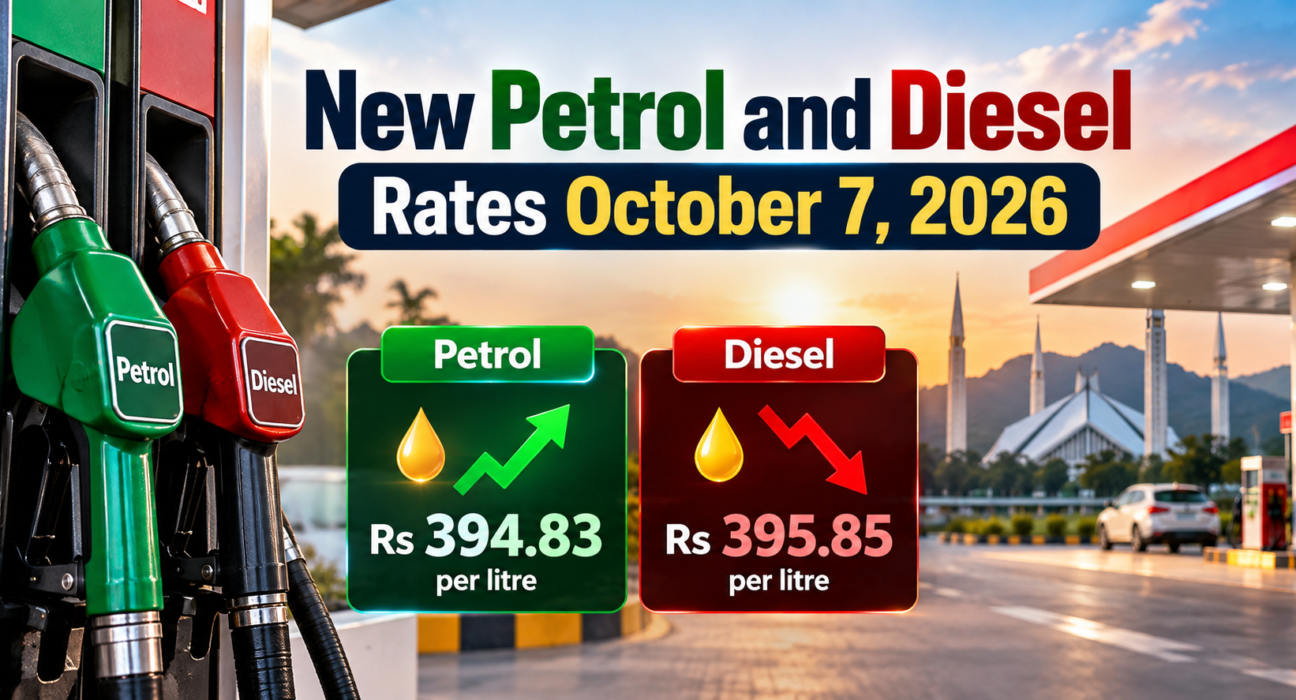
Petrol prices have changed again in Pakistan, bringing another update for motorists, commuters, businesses, and families already keeping a close eye on fuel costs. The new petrol price in Pakistan from October 7, 2026, is Rs394.83 per litre, following an increase of Rs1.19 per litre.
At the same time, high-speed diesel (HSD) has become slightly cheaper. Its new price is Rs395.85 per litre, after a reduction of Rs1.91.
The revised prices are effective from October 7, 2026, under Pakistan’s daily petroleum price review system. This means fuel rates can now respond more frequently to changes in international oil prices and other pricing factors.
For people who travel daily, run businesses, operate transport services, or manage household expenses, even a small fuel price change can matter. Let’s look at the latest rates, recent changes, and what the new petrol price could mean for consumers across Pakistan.
New Petrol Price in Pakistan from October 7, 2026
The federal government has increased the price of petrol from Rs393.64 to Rs394.83 per litre. This is an increase of Rs1.19 for every litre purchased.
High-speed diesel has moved in the opposite direction. Its price has dropped from Rs397.76 to Rs395.85 per litre, providing a reduction of Rs1.91 per litre.
According to the latest petroleum price update reported by Geo News, the revised rates became effective for October 7.
Latest Petrol and Diesel Rates in Pakistan
| Fuel Type | Previous Price | New Price | Change |
| Petrol | Rs393.64/litre | Rs394.83/litre | +Rs1.19 |
| High-Speed Diesel | Rs397.76/litre | Rs395.85/litre | -Rs1.91 |
The change is interesting because petrol and diesel have moved in different directions. Petrol users will pay slightly more, while diesel users will see some relief.
For an individual filling a small fuel tank, Rs1.19 may not appear to be a major increase. However, repeated changes can add up over time, especially for people who drive long distances every day.
Why Did the Petrol Price Increase on October 7?
Fuel prices in Pakistan do not depend on one factor alone. Several international and domestic elements can influence the final price paid by consumers.
International petroleum prices are among the most important factors. Pakistan imports a large part of its petroleum requirements, which means changes in international energy markets can eventually affect local prices.
Exchange rates also matter because international oil transactions are generally priced in US dollars. If the cost of imported fuel changes after currency conversion, it can influence the final domestic rate.
Other elements can include freight costs, premiums, taxes, duties, margins, and other components of the official fuel pricing structure.
The latest petrol increase comes during a period of volatility in international energy markets. Under the newer pricing approach, changes can reach consumers more quickly than under the older system of longer review periods.
Pakistan Is Now Using a Daily Fuel Price Review Mechanism
One of the most important things consumers need to understand is that Pakistan’s fuel pricing system has changed.
Previously, many motorists were used to waiting for scheduled petroleum price announcements. Under the current mechanism, petroleum prices can be reviewed much more frequently.
The government moved toward a daily fuel price review mechanism as global energy markets faced unusual volatility. The system is designed to allow movements in international petroleum costs to be reflected more quickly in domestic rates.
This means consumers may now see smaller but more frequent changes instead of waiting for one larger adjustment after a longer period.
For motorists, checking the latest rate before relying on an older petrol price has therefore become more important.
Petrol Becomes Costlier While Diesel Gets Cheaper
The October 7 revision has produced two different outcomes.
Petrol has increased by Rs1.19 per litre, but high-speed diesel has decreased by Rs1.91.
According to Dawn’s report on the October 7 petroleum revision, petrol is now Rs394.83 per litre and HSD is Rs395.85 per litre.
The difference is important because petrol and diesel serve different parts of the economy.
Petrol is widely used in motorcycles, cars and other personal vehicles. A rise in petrol prices therefore has a direct impact on many daily commuters.
High-speed diesel, meanwhile, is heavily used in commercial transport, trucks, buses, agricultural machinery and other economic activities.
A reduction in diesel prices can therefore be helpful for some transport and business operations, although one daily reduction alone does not necessarily mean overall transport costs will immediately fall.
Recent Petrol Price Movement Shows an Upward Trend
Looking only at the October 7 increase does not tell the complete story.
Petrol stood at Rs387.40 per litre on October 1. It increased to Rs390.66 on October 2 and later reached Rs392.76 on October 3.
By October 6, petrol had moved to Rs393.64 per litre. The latest Rs1.19 increase has now taken the rate to Rs394.83 per litre.
Recent Petrol Price Changes in Pakistan
| Date | Petrol Price per Litre | Movement |
| October 1, 2026 | Rs387.40 | Base comparison |
| October 2, 2026 | Rs390.66 | +Rs3.26 |
| October 3, 2026 | Rs392.76 | +Rs2.10 |
| October 6, 2026 | Rs393.64 | +Rs0.88 |
| October 7, 2026 | Rs394.83 | +Rs1.19 |
The table shows why consumers should look beyond a single day’s increase.
Compared with the October 1 rate of Rs387.40, petrol is now Rs7.43 per litre more expensive. That is a noticeable movement within less than a week.
How Much More Will Motorists Pay for Petrol?
The latest Rs1.19 increase may look small when viewed on a per-litre basis, but the total difference depends on how much fuel you purchase.
For example, someone buying 10 litres will pay Rs11.90 more than at the previous rate. A 20-litre purchase costs Rs23.80 more because of the latest increase, while 40 litres costs Rs47.60 more.
These calculations only measure the impact of the latest Rs1.19 increase. They do not show the wider increase compared with earlier petrol rates.
For people who use motorcycles or small cars for short daily trips, the immediate effect may remain limited. But workers who commute long distances, delivery riders, sales teams, taxi drivers and other frequent road users can feel price changes more strongly over a month.
This is why fuel prices remain closely watched across Pakistan.
What the New Petrol Price Means for Household Budgets
Petrol is not simply a vehicle expense. For many Pakistani households, it is part of the monthly budget.
Parents use vehicles for school runs. Employees travel to offices. Students commute to colleges and universities. Families need transport for shopping, medical visits and other everyday needs.
When petrol becomes more expensive, these routine journeys can gradually cost more.
Households that already have tight budgets may respond by combining trips, using public transport when practical, carpooling, or reducing unnecessary travel.
However, not everyone can easily reduce fuel use. Many people depend on motorcycles and cars because suitable public transport is not available for their route.
As a result, petrol price movements can have different effects depending on where a person lives, how far they travel and what transport options they have.
Diesel Reduction Could Ease Some Transport Pressure
While petrol users face a higher price, the Rs1.91 reduction in high-speed diesel offers a different story.
Diesel plays an important role in Pakistan’s transport and agricultural sectors. Trucks carrying goods between cities commonly depend on diesel, as do many buses, commercial vehicles and agricultural machines.
When diesel becomes cheaper, operating costs for these users can decline slightly.
Still, consumers should not expect a Rs1.91 reduction to automatically produce an immediate fall in transportation charges or product prices.
Transport costs depend on many other expenses, including maintenance, labour, tolls, vehicle financing and previous fuel-price movements.
A longer period of lower diesel prices would generally have a more meaningful impact than a single daily reduction.
Why Fuel Prices Matter Beyond Petrol Pumps
Petroleum prices affect more than the amount displayed on a petrol pump.
Transport is involved in almost every part of the economy. Food has to reach markets. Raw materials have to reach factories. Finished products must reach shops. Workers need transportation, and online orders require delivery services.
Because fuel is part of these activities, major and sustained changes in petroleum prices can influence business costs.
Small businesses can be particularly sensitive to these movements.
A shop that handles its own deliveries, a small online seller, a ride service or a local distribution company may use fuel every day. Repeated increases can make it harder to manage operating costs without changing prices or reducing other expenses.
This connection explains why petrol and diesel rates attract attention even among people who do not personally own vehicles.
International Oil Prices Remain Important for Pakistan
Pakistan is connected to the international energy market because it depends heavily on imported petroleum.
When international oil and refined-product prices rise sharply, importing fuel can become more expensive. When they fall, there may be room for domestic prices to decrease, depending on other parts of the pricing formula.
Global supply conditions, regional conflicts, shipping costs and demand can all affect energy markets.
The exchange rate is another key factor. Because petroleum purchases involve foreign currency, changes in the Pakistani rupee against the US dollar can affect import costs.
This means local petrol prices cannot be understood only by looking at domestic conditions.
A major movement in international energy markets can eventually reach motorists in Lahore, Karachi, Islamabad, Peshawar, Quetta and other parts of Pakistan.
Are Petrol Prices the Same Across Pakistan?
The notified petrol price serves as the nationwide ex-depot ceiling price rather than a separate basic rate being announced for every major city.
Therefore, people searching for the petrol price in Lahore, Karachi, Islamabad, Rawalpindi, Faisalabad or other Pakistani cities should check the current officially notified national rate.
For October 7, 2026, the petrol rate is Rs394.83 per litre, while high-speed diesel stands at Rs395.85 per litre.
Consumers should still pay attention to the rate displayed at the filling station and keep an eye on fresh official updates, especially now that petroleum pricing is being reviewed more frequently.
What Drivers Can Do as Fuel Prices Change More Often
Drivers cannot control international oil prices, but they can manage fuel use more carefully.
Regular vehicle maintenance can help. Correct tyre pressure, a properly maintained engine and sensible driving habits can reduce unnecessary fuel consumption.
Planning several errands in one trip can also reduce extra driving.
Drivers should avoid aggressive acceleration and unnecessary idling where possible. These habits may seem small, but consistent fuel-saving practices can make a difference over time.
Most importantly, motorists should check current fuel rates rather than depending on a price they saw several days earlier.
With more frequent reviews, yesterday’s petrol rate may not always be today’s rate.
Latest Petrol Price in Pakistan: What to Remember
The new petrol price in Pakistan from October 7, 2026, is Rs394.83 per litre, following an increase of Rs1.19 from the previous Rs393.64 rate.
High-speed diesel has moved lower, falling by Rs1.91 to Rs395.85 per litre from Rs397.76.
The latest revision also highlights a bigger change in Pakistan’s petroleum market: fuel prices are now being reviewed much more frequently under the daily pricing mechanism.
For consumers, this makes regular price updates more useful than before.
It is also worth looking at the wider trend. Petrol was Rs387.40 per litre on October 1 and has now reached Rs394.83. This means the price has increased by Rs7.43 per litre compared with the start of October.
For motorists and households, the best approach is to stay informed, plan fuel expenses carefully and avoid assuming that a previously announced rate is still current.
Petrol Price Outlook: What Consumers Should Watch Next
It is difficult to know the direction of the next fuel-price change simply from today’s increase.
Future rates can be influenced by movements in international petroleum markets, exchange rates, premiums, freight expenses and other parts of Pakistan’s fuel pricing system.
Consumers should therefore treat claims about future petrol increases or reductions carefully unless they are supported by an official notification.
The October 7 update provides one clear message: petrol has become slightly more expensive, while high-speed diesel has become cheaper.
With petrol now at Rs394.83 per litre, Pakistan’s motorists will continue watching upcoming revisions closely. Under a system where rates can change frequently, timely and accurate fuel-price information has become more important for household planning, transportation and business costs across the country.