
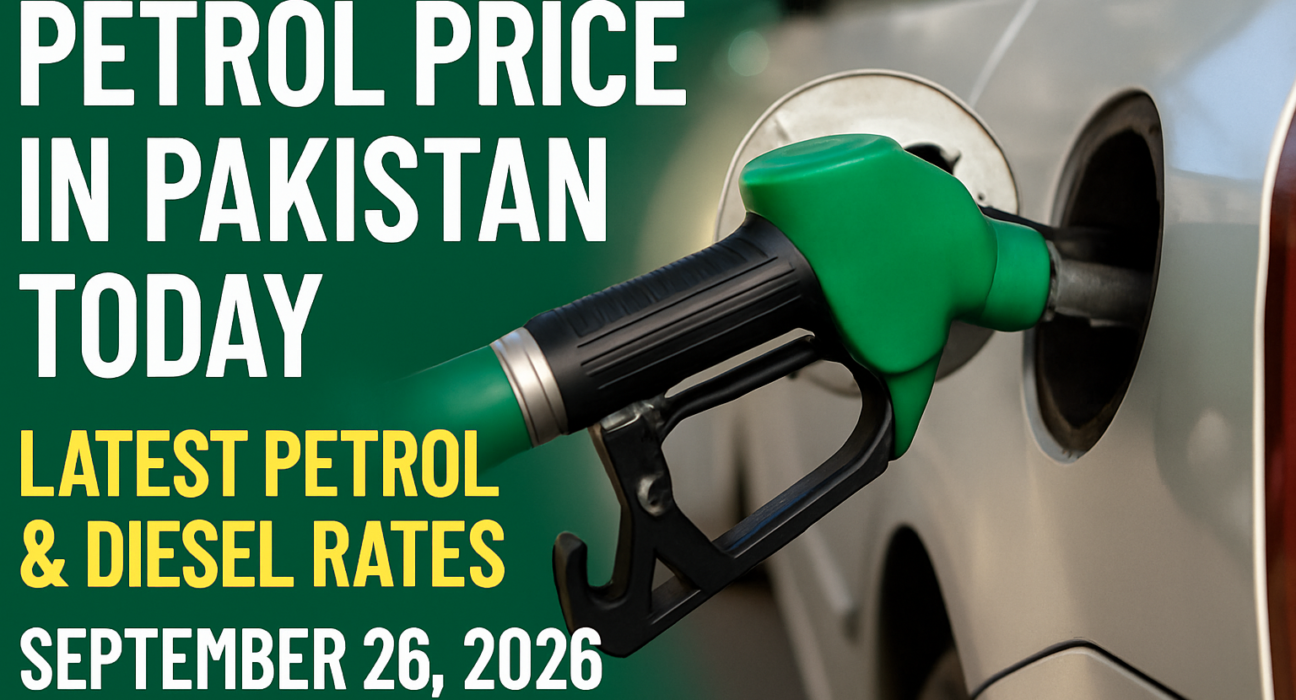
The petrol price in Pakistan today stands at Rs. 391.30 per litre, following a fresh increase announced by the government’s Petroleum Division. According to a press release issued by the Petroleum Division, the price of petrol has been increased by 2.02 rupees per litre and now stands at 391.30 rupees per litre. At the same time, the price of High Speed Diesel has been decreased by 3.59 rupees per litre to set it at 408.53 rupees per litre. These new rates took effect on September 26, 2026, and apply to petrol pumps across the country.
This update matters for daily commuters, motorcycle riders, transporters, and businesses that depend on fuel for their operations. Even small changes in the petrol price today in Pakistan can affect transport fares, delivery costs, and household budgets over time.
New Petrol and Diesel Prices
Here is a quick summary of the latest petrol and diesel prices in Pakistan, effective from September 26, 2026:
| Product | Previous Price (Rs/litre) | New Price (Rs/litre) | Change |
| Petrol (Motor Spirit) | 389.28 | 391.30 | +2.02 |
| High-Speed Diesel (HSD) | 412.12 | 408.53 | −3.59 |
These new rates apply from September 26 to September 28, since Pakistan now revises fuel prices daily, with Friday’s notified rates carrying over through the weekend.
How Much Has the Petrol Price Changed?
The new petrol price in Pakistan reflects a Rs 2.02 per litre increase compared to the previous rate. This is a relatively small adjustment compared to some earlier revisions this year. Diesel, on the other hand, moved in the opposite direction, becoming cheaper by Rs 3.59 per litre.
This kind of split movement — petrol up, diesel down — is possible under the current pricing formula because petrol and diesel are priced separately, based on their own international benchmark costs, freight, and exchange-rate calculations.
Looking at the bigger picture, petrol has risen from Rs266.17 per litre in March to over Rs390 per litre in September, an increase of nearly Rs124 per litre, or roughly 46.6%. This longer-term trend shows how much fuel costs have moved this year, largely tied to global oil markets and regional tensions.
When Did the New Petrol Prices Take Effect?
The revised rates came into force from September 26, 2026. Under Pakistan’s current pricing system, prices are reviewed daily, but Ogra will publish daily Platts reference prices from July 1, 2026, and rates notified on a Friday remain unchanged through Saturday and Sunday. That is why this update is described as covering September 26 to September 28.
Why Did Petrol Prices Change in Pakistan?
Fuel price revisions in Pakistan are tied to a formula that factors in several elements:
- International oil and refined-product benchmark prices (Platts Arab Gulf assessments)
- The Pakistani rupee’s exchange rate against the US dollar
- Freight and import costs
- Applicable petroleum levy and other taxes
Petroleum Minister Ali Pervaiz Malik has said the daily prices are calculated using a seven-day average of international market prices, in line with international practices. A slight increase in this rolling average for petrol, alongside a softer trend for diesel, explains why the two products moved in different directions this time.
It’s worth noting that the petroleum levy cannot exceed the limit approved by the federal cabinet, and any change in the levy rate requires approval from the Finance Division, so levy changes are not an automatic or hidden factor — they follow a separate approval process.
How Pakistan’s Petrol Pricing System Works
Pakistan’s fuel pricing mechanism has changed more than once in 2026. The federal government announced in July 2026 that petroleum product prices would be determined daily, following renewed regional tensions after an exchange of strikes involving the United States and Iran. Since early 2026, the government had already been revising petroleum prices weekly, moving away from the earlier fortnightly system.
Under the revised framework:
- The Free on Board (FOB) price for Motor Spirit (MS) and High-Speed Diesel (HSD) is determined using a seven-working-day rolling average of Platts Arab Gulf assessments for MS-92 RON and HSD 10 ppm.
- Ogra is authorised to announce daily prices without requiring prior approval from the prime minister or the federal government, though every publication is reported to the DG Oil office.
- Prices notified on Fridays remain unchanged on Saturdays and Sundays.
This is why some readers may notice that the “new petrol price in Pakistan” for a Saturday is the same as the rate set the previous Friday.
Role of OGRA and the Petroleum Division
Two government bodies are central to how petrol rates are set and announced in Pakistan:
Oil and Gas Regulatory Authority (OGRA): OGRA calculates ex-depot fuel prices using the pricing formula and publishes them. Petroleum Minister Ali Pervaiz Malik has said that the cabinet decided OGRA would determine petroleum prices on a daily basis, and that OGRA would publish the revised prices on its website every day.
Petroleum Division (Ministry of Energy): The Petroleum Division issues the official notification confirming the new rates to the public, as seen in today’s announcement of the Rs 2.02 petrol increase and Rs 3.59 diesel cut.
The government has stated that the new daily mechanism is part of a broader plan to gradually deregulate Pakistan’s petroleum sector, and officials have said the change is meant to make pricing more transparent and closely tied to real-time global market movements rather than to reduce or increase the public’s overall fuel burden.
Impact of Petrol Prices on Transport and Consumers
Fuel costs are a major input for transporters, and changes in the petrol price in Pakistan today can influence:
- Public transport fares: Buses, vans, and ride-hailing vehicles may face changing fuel costs, though actual fare changes depend on transport operators and relevant transport authorities.
- Goods transportation: Trucks carrying food, construction material, and other goods use diesel heavily, so a lower diesel price this cycle may offer some relief on freight costs, even as petrol becomes slightly more expensive.
- Household budgets: Motorcycle and car owners feel the petrol increase directly at the pump, since petrol is the main fuel for personal vehicles in Pakistan.
- Agriculture and small businesses: Diesel powers tractors, generators, and small machinery, so the diesel price cut may offer some cost relief for farmers and small enterprises this period.
The actual effect on transport fares and prices of goods depends on decisions made by transport unions, provincial transport authorities, and individual businesses, not on the fuel price change alone.
Petrol Prices and Inflation in Pakistan
Fuel costs are closely linked to inflation because petrol and diesel affect the cost of transporting goods, running machinery, and commuting to work. When fuel prices rise, transport and production costs can rise too, which sometimes feeds into the prices of everyday goods.
Since diesel dropped this cycle while petrol rose only modestly, the overall inflationary pressure from this particular price update is likely to be limited compared to earlier, larger increases seen in 2026. However, the broader year-to-date rise in petrol prices remains a relevant factor when looking at transport and household cost trends. Readers wanting precise inflation figures should check official releases from the Pakistan Bureau of Statistics and the State Bank of Pakistan.
Previous vs Current Petrol Prices
| Period | Petrol (Rs/litre) | HSD (Rs/litre) |
| Previous rate (before Sept 26, 2026) | 389.28 | 412.12 |
| Current rate (from Sept 26, 2026) | 391.30 | 408.53 |
| Change | +2.02 | −3.59 |
The highest petrol price in Pakistan’s recent history was Rs 458.40 per litre, recorded on April 3, 2026, giving context to how prices have moved up and down over the year under the evolving pricing mechanism.
What Could Happen at the Next Price Revision?
Because Pakistan now uses a daily pricing mechanism based on a seven-day rolling average of international benchmarks, the next adjustment could come as early as the next working day, rather than after a full fortnight as in the older system. Whether the next revision brings another increase or a decrease will depend on:
- Movements in international crude oil and refined-product prices
- The Pakistani rupee’s exchange rate against the US dollar
- Regional geopolitical developments affecting energy markets
Readers should rely on the official OGRA and Petroleum Division notifications for the most accurate and up-to-date petrol rate today in Pakistan, since daily pricing means rates can change frequently.
Frequently Asked Questions
What is the petrol price in Pakistan today?
As of September 26, 2026, the petrol price in Pakistan today is Rs. 391.30 per litre.
What is the diesel price in Pakistan today?
High-Speed Diesel (HSD) is priced at Rs. 408.53 per litre as of September 26, 2026.
Why did petrol prices increase in Pakistan?
The petroleum ministry has linked the change to movements in the international oil-price benchmarks used in the pricing formula, along with exchange-rate and freight-cost factors, calculated over a rolling seven-day average.
Why did diesel prices decrease while petrol increased?
Petrol and diesel are priced using separate international benchmarks (Platts Arab Gulf assessments for MS-92 RON and HSD 10 ppm), so it is possible for one product’s average cost to rise while the other falls in the same period.
Who determines petrol prices in Pakistan?
The Oil and Gas Regulatory Authority (OGRA) calculates fuel prices using the approved formula, and the Petroleum Division under the Ministry of Energy issues the official notification to the public.
When will Pakistan’s petrol prices be revised again?
Under the current daily pricing mechanism, prices can be revised on the next working day, based on updated international benchmarks. Rates notified on a Friday remain in effect through Saturday and Sunday.
How does the petrol price affect inflation in Pakistan?
Fuel prices influence transport and production costs, which can affect the prices of goods and services over time. The exact inflation impact depends on multiple factors beyond fuel prices alone.
How much has petrol increased in 2026 so far?
According to recent reporting, petrol prices have risen substantially since March 2026, reflecting global oil-market volatility and Pakistan’s shift to more frequent price reviews.
For More Information Please Visit Propakistan.pk