

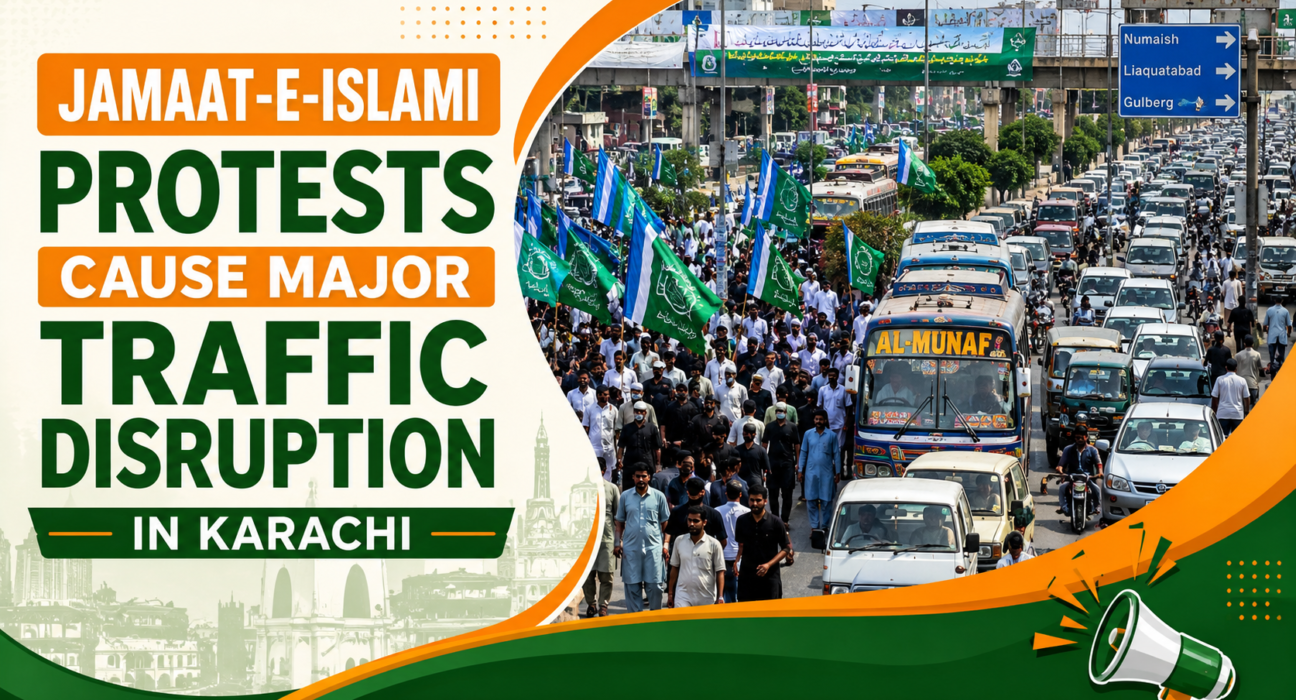
If you were trying to get anywhere in Karachi on Friday, chances are you got stuck. I mean really stuck — the kind of gridlock where you turn off the engine and just wait it out. That’s exactly what happened when Jamaat-e-Islami (JI) rolled out a massive, coordinated protest against the petroleum levy, and honestly, the whole city felt it.
Let me walk you through what actually went down.
Why Were People Protesting?
JI didn’t just pick Karachi at random. This was part of a much bigger, nationwide push. The party’s Emir, Hafiz Naeemur Rehman, had already announced that demonstrations would take place at 510 major roads and highways spread across 170 districts in the country. That’s not a small number — that’s a statement. The Express Tribune
The core grievance? Fuel prices and the petroleum levy. JI leadership argued that when international oil prices dropped, the government failed to pass that benefit on to ordinary citizens, choosing instead to keep taxes and levies high. For a country already struggling with inflation, that message clearly resonated with a lot of people, based on turnout alone. Geo News
What Happened on the Ground in Karachi
In Karachi specifically, protest rallies started from various parts of the city and made their way toward Mazar-e-Quaid, following designated routes. One of the more visible flashpoints was at Natha Khan Bridge on Shahrah-e-Faisal, where a convoy blocked the road entirely.
But it wasn’t just one street. According to traffic police, Mazar-i-Quaid, Numaish Chowrangi, Saddar, Sharea Faisal, Sharae Pakistan, UP Mor, Power House Chowrangi, Defence Housing Authority, Sea View, Shahrah-i-Orangi, Hub River Road, Super Highway, and National Highway were all affected in some way, whether that meant full closures or painfully slow-moving traffic.
If you commute anywhere near these areas, you know that’s basically half the city’s arteries clogged at once.
The Ripple Effect on Daily Life
Here’s the thing about blocking major roads in a city of over 20 million people — it doesn’t just inconvenience commuters. It disrupts everything. Ambulances trying to reach hospitals, people rushing to catch flights, parents picking up kids from school — all of it gets tangled in the same mess.
Not everyone was sympathetic to the cause, either. Some officials publicly pushed back, with one questioning how patients in ambulances were supposed to reach hospitals when major roads were shut down. It’s a fair point, and it captures the tension at the heart of these protests: the right to demonstrate versus the practical cost to a city trying to function normally.
How Traffic Police Responded
To their credit, Karachi traffic police didn’t sit idle. They issued advisories ahead of time, warning residents to avoid the affected zones unless absolutely necessary and to plan alternative routes. Personnel were deployed at key congestion points like Lasbela Chowk, Numaish Chowrangi, and the Tibet Centre stretch to try and keep vehicles moving, even if slowly.
Karachi Traffic Congestion Snapshot
| Affected Area | Type of Disruption |
| Shahrah-e-Faisal | Full road blockage |
| Numaish Chowrangi | Heavy congestion |
| Super Highway | Slow-moving traffic |
| Hub River Road | Partial closure |
| Saddar | Diversions in place |
The Bigger Picture
This wasn’t a one-off event — it’s part of a sustained pressure campaign JI has been running for weeks, with similar protests happening simultaneously in Lahore, Islamabad, Peshawar, and several other cities. Whether or not it moves the needle on government policy remains to be seen, but one thing’s certain: for Karachi residents, Friday was a reminder of just how quickly the city can grind to a halt.
If you’re planning to head out anytime soon, it’s probably worth checking local traffic updates first — just to be safe.