

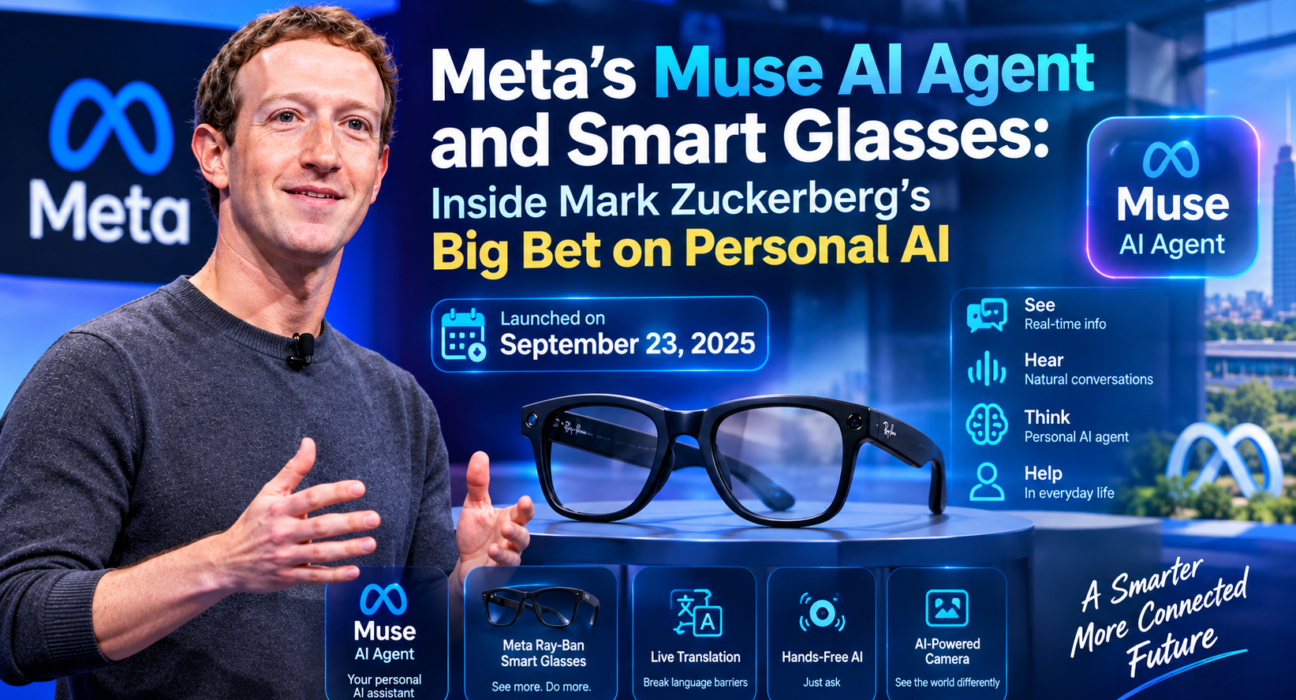
Imagine wearing a pair of glasses that not only look stylish but also think, plan, and act for you. That is the future Meta wants to build. At its yearly Connect event, held on September 23, 2026, Meta made its Muse AI agent the star of the show, alongside new AI glasses and a small gadget called Muse Charm. This wasn’t just another product launch. It was a clear sign of where Mark Zuckerberg wants to take his company next: from social media and the metaverse to personal AI that lives with you all day long.
In this article, we’ll break down what Meta Muse is, how it connects to AI glasses, what Muse Charm does, and why this matters for anyone interested in the future of wearable AI technology.
What Is Meta Muse?
Meta Muse is a personal AI assistant built to help you manage daily tasks. It can use the internet, book travel, make phone calls, send emails, and even complete purchases for you. Before doing anything sensitive, like spending money, Muse asks for your permission first.
Right now, you can use Muse through its own app on iPhone, Android, and Mac, or inside WhatsApp chats. Since its release earlier this month, the app quickly climbed to the number one spot on both the Apple App Store and Google Play Store, showing just how much interest people already have in this kind of personal AI assistant.
Muse is not meant to be a simple chatbot. It is built to act like a digital helper who works in the background while you go about your day.
Meta Connect 2026: The Big Announcement
At Meta Connect 2026, held in Menlo Park, California, Meta’s leadership team focused almost entirely on Muse. Mark Zuckerberg and Meta’s Chief AI Officer, Alexandr Wang, explained that Muse should be able to run a small business for you or finish work tasks even after you step away from your computer.
This event also introduced several new products built around the same idea: making AI a constant part of daily life, not something you only open occasionally.
The main announcements included:
- Muse Charm – a small keychain-style device for talking to Muse
- New AI glasses – bringing Muse to your eyes and ears
- Meta VR Glasses – a lighter, smaller virtual reality headset
- Ray-Ban Meta Audio – Meta’s first audio-only smart glasses
Together, these products show Meta trying to build an entire ecosystem around one idea: an AI agent that follows you everywhere, whether you are at your desk, walking outside, or relaxing at home.
Muse Charm: A Tiny Gadget With Big Ambitions
One of the most talked-about announcements was Muse Charm, a palm-sized device designed only for talking to Muse. It has a small OLED touchscreen, about two inches wide, showing a customizable character that represents your personal AI agent. You can change how this character looks, what it wears, and even how its voice sounds.
According to reports, the device was created by Meta’s new design lab, led by Alan Dye, who was previously Apple’s interface design chief. This detail alone shows how seriously Meta is taking the design and feel of this product, not just its technology.
Mark Zuckerberg described the Charm as the fastest way to talk to Muse when you are not wearing your glasses. It is small enough to carry on a keychain, making it easy to pull out whenever you need quick help.
Meta plans to start shipping Muse Charm before the end of the year, positioning it as an entry point into the larger world of Meta’s personal AI assistant products.
How Muse Will Work on AI Glasses
The most exciting part of this announcement, at least for wearable AI technology fans, is Meta’s plan to bring Muse directly into its AI glasses. According to Meta, this will let people talk to their glasses hands-free, simply by saying their agent’s name out loud.
Some of the everyday use cases Meta has shared include:
- Booking appointments without touching your phone
- Checking flight prices while walking
- Getting reminders about personal or work goals
- Getting guided support during workouts
- Logging meals and receiving basic nutrition insights
Meta also introduced upgrades like Dolby Atmos audio capture for glasses, along with improved visual understanding, so your glasses can give richer answers about whatever you are looking at in real time.
This is where Zuckerberg’s long-term thinking becomes clear. He does not see AI as something that lives only inside a phone screen. He sees it as something that should follow your eyes, your ears, and your daily movements, almost becoming an invisible layer over your everyday life.
Mark Zuckerberg’s Vision Behind Muse
To understand why Meta is investing so heavily in Muse, it helps to look at how Zuckerberg has framed this shift. For years, Meta’s biggest bet was the metaverse and virtual reality. Now, the company’s main focus has clearly moved toward AI agents that can act on your behalf.
Zuckerberg has described this new direction as building AI that works quietly in the background, handling tasks so you don’t have to think about them one by one. Instead of opening five different apps to do five different things, the idea is that one AI agent, reachable through your voice, your glasses, or a small pocket device, can manage most of it for you.
This vision fits into a bigger pattern happening across the tech industry right now. Companies like OpenAI and Anthropic are also building AI agents that can complete tasks independently. Zuckerberg’s approach stands out because he is connecting this idea directly to hardware, glasses, a keychain gadget, and even VR headsets, rather than keeping it limited to an app or website.
Privacy and Trust: The Big Question
Whenever a company asks you to trust an AI agent with your calendar, your messages, and even your payments, privacy becomes a major concern. Meta seems aware of this. The company announced a new feature called Private Processing, designed to let AI experiences run on your glasses without anyone, including Meta itself, seeing your personal data.
However, many details are still unclear. It is not fully explained which features this privacy protection covers, or how it applies when outside companies are involved in completing a task. This matters because Muse depends on partnerships with other services, such as retailers and payment platforms, to actually complete real-world actions like shopping or paying bills.
In fact, one clear example of this challenge already happened. Reports revealed that Amazon blocked Muse from working with its platform shortly before Connect 2026. This shows that even if Meta builds a powerful AI agent, other companies can limit what it is allowed to do on their platforms. For everyday users, this means the promise of a fully hands-free digital assistant may take longer to fully deliver than Meta’s presentation suggested.
How Muse Compares to Other AI Agents
Meta is not the only company racing to build agent-style AI. OpenAI, Anthropic, and other AI labs are also developing systems that can complete tasks with less step-by-step guidance from users. What makes Meta’s approach different is the hardware push. Instead of only offering an app, Meta is connecting its AI agent to physical products people already wear or carry, like glasses and small pocket devices.
This hardware-first strategy could give Meta an advantage. If people are already wearing Meta’s glasses for style or convenience, adding an AI agent on top becomes a smaller extra step compared to asking someone to open a new app on their phone.
At the same time, this approach carries more risk. Hardware takes longer to build, test, and ship compared to software updates. Meta has admitted that full glasses support for Muse is still “in the coming months,” meaning most of what was shown at Connect 2026 is still a promise rather than something you can buy and use today.
What This Means for Everyday Users
For regular people, not tech insiders, the real question is simple: will this actually make life easier? Meta believes the answer is yes, especially for tasks that are repetitive or mentally tiring, like tracking personal goals, planning workouts, or managing small business tasks.
However, it’s worth remembering that convenience always comes with trade-offs. Giving an AI agent access to your messages, calendar, or payment methods means trusting a company with a large amount of personal information. Before adopting tools like Muse fully, users should:
- Check what permissions the app actually requests
- Understand what data is stored versus processed privately
- Start with simple, low-risk tasks before trusting it with anything sensitive, like payments
The Challenges Ahead
Meta still faces several challenges before Muse and its AI glasses can become part of daily life for most people:
- Limited availability – Many features are still not live and are expected only in the coming months.
- Partner restrictions – Other companies, like Amazon, can block Muse from working with their services.
- Privacy clarity – Meta needs to clearly explain how Private Processing works across every feature.
- Public trust – After years of privacy concerns tied to Meta’s other products, some users may hesitate before fully trusting an AI agent with personal tasks.
Conclusion
Meta Connect 2026 made one thing very clear: Mark Zuckerberg is betting big on personal AI agents becoming as normal as smartphones once were. Muse, along with Muse Charm and new AI glasses, represents Meta’s attempt to turn artificial intelligence into something you wear, carry, and talk to throughout your day, not something you only visit inside an app.
Whether this vision succeeds will depend on more than clever design or a viral app ranking. It will depend on how well Meta handles trust, privacy, and real-world partnerships. For now, Muse offers an exciting look into where personal AI assistants might be heading, even if many of its biggest features are still on the way.
Frequently Asked Questions
What is Meta Muse?
Meta Muse is Meta’s personal AI agent that can complete tasks like booking travel, sending emails, and making purchases on your behalf.
What is Muse Charm?
Muse Charm is a small, keychain-sized device with a touchscreen, built specifically so people can talk to their Muse AI agent without needing their phone.
Will Muse work on AI glasses?
Yes. Meta announced that Muse will be added to its AI glasses in the coming months, allowing hands-free access by simply speaking your agent’s name.
Is Meta Muse safe to use?
Meta says it is introducing a feature called Private Processing to protect user data on AI glasses, but full details on how this applies across every feature are still unclear.
For More Information Please Visit Propakistan.pk