
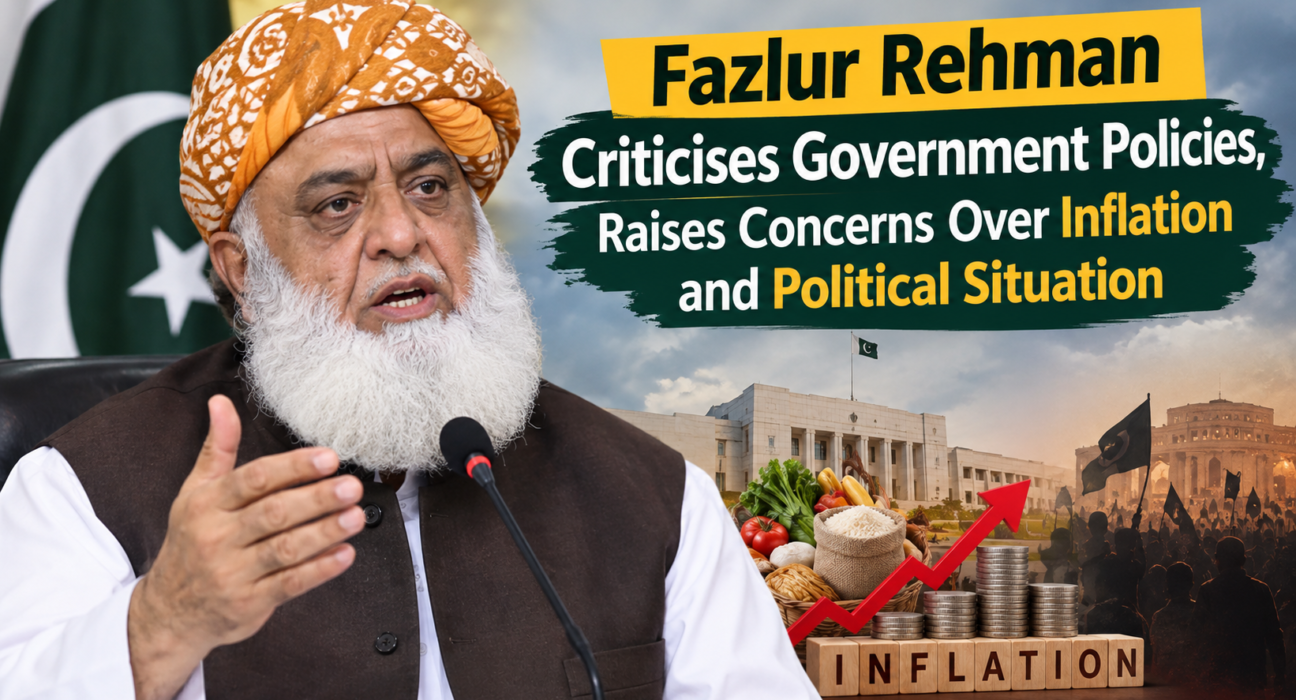
Pakistan’s political temperature keeps rising, and one voice keeps getting louder. Maulana Fazlur Rehman, the chief of Jamiat Ulema-e-Islam-Fazl (JUI-F), has once again taken aim at the government. He’s not holding back. From rising prices to what he calls unchecked power in the wrong hands, Fazlur Rehman is painting a grim picture of where the country stands right now.
If you’ve been following Pakistani politics even loosely, you’ve probably heard his name a lot lately. So let’s break down what he’s actually saying, why it matters, and what it could mean for the months ahead.
Who Is Fazlur Rehman and Why His Words Carry Weight
Fazlur Rehman isn’t a new face in Pakistani politics. He’s led JUI-F for decades and has a knack for saying things other politicians tend to avoid. He often positions himself as a bridge builder between rival camps, which gives his criticism a different flavor than what you’d hear from a straightforward opposition leader.
That’s part of why people pay attention when he speaks. He’s not just venting. He’s usually signaling where the political wind is blowing next.
Inflation Concerns: A Storm That Won’t Let Up
Let’s talk money first, since that’s what hits regular people the hardest. Fazlur Rehman has described the economic situation as being overwhelmed by a wave of inflation, and he’s openly asked where the country’s economic experts have gone. He’s pointed out that even neighboring countries like Iran and Afghanistan haven’t been hit as hard as Pakistan.
That’s a pretty bold comparison. It’s meant to sting, and it seems designed to make people ask harder questions about economic management.
He’s also connected inflation to Pakistan’s growing debt problem. He has argued that while the previous government faced criticism for its borrowing, the debt burden has grown even larger under the current setup, pushing prices higher along with it. On top of that, he’s said inflation has reached a point where ordinary people can no longer afford basic medical treatment.
That’s not a small claim. When healthcare becomes unaffordable for regular families, it stops being just an economic talking point and turns into a daily survival issue.
A “Besieged State”: Fazlur Rehman’s Bigger Warning
Beyond prices and paychecks, Fazlur Rehman has raised a much bigger red flag. He’s warned that Pakistan is gradually becoming a besieged state, alleging that powerful institutions are operating beyond what the constitution and law actually allow. He’s pushed political parties to sort out these massive challenges through Parliament instead of outside pressure tactics.
This isn’t just political noise. When a senior leader starts using language like “besieged,” it usually means he sees a serious gap between how the country is supposed to run and how it’s actually being run.
Political Freedom and the Right to Protest
Another theme running through his recent statements is the shrinking space for political activity. Fazlur Rehman has accused the government of refusing to listen to ordinary people, using force without restraint, and blocking political parties from exercising their right to protest. He’s specifically criticized the practice of filling Islamabad with shipping containers whenever opposition parties plan demonstrations.
His argument here is pretty simple: if you keep blocking peaceful protest, you’re not preventing unrest. You’re creating it. He’s said that by locking down the capital this way, the government is essentially manufacturing its own rebels.
Law and Order: A Different Story in Every Province
Fazlur Rehman hasn’t limited his criticism to Islamabad. He’s drawn a clear contrast between how different provinces are being governed. He’s noted that Punjab remains relatively stable, but conditions have worsened badly in Khyber Pakhtunkhwa and Balochistan, going as far as saying there is practically no functioning government in KP.
He’s used some pretty vivid comparisons to describe the security breakdown elsewhere too. He’s talked about a “reign of dacoits” taking hold in Sindh, alongside daylight bank robberies happening in Balochistan without any real system in place to stop them.
This regional breakdown matters because it shows his criticism isn’t just about federal policy. It’s about whether basic governance is functioning at all in large parts of the country.
Here’s a quick summary of his main concerns broken down by category:
| Area of Concern | What Fazlur Rehman Has Said |
|---|---|
| Inflation & Economy | Prices have overwhelmed the public; debt has grown larger than before |
| Governance | Powerful institutions are acting beyond constitutional limits |
| Protest Rights | Government is blocking demonstrations, pushing people toward unrest |
| Law and Order | KP and Balochistan face serious security and governance gaps |
| Parliament’s Role | Wants an in-camera session to discuss national security and economic issues |
His Personal Stakes in the Situation
This isn’t just abstract policy talk for him either. Fazlur Rehman has said his own family has been targeted by extortion attempts, claiming his sons and nephews were attacked after refusing to pay. He’s brought this up while discussing the country’s overall law and order situation, which adds a personal layer to his political criticism.
Whether you agree with his politics or not, that’s the kind of detail that makes a story feel a lot more real to everyday readers.
Calls for Dialogue and Parliamentary Action
Despite the sharp criticism, Fazlur Rehman keeps circling back to one demand: talk it out in Parliament. He’s repeatedly called for an in-camera session of Parliament to discuss the country’s economic and security challenges honestly, away from public posturing.
He’s framed this as the responsible path forward, arguing that big national problems shouldn’t be handled through backroom decisions or street confrontations. Instead, elected representatives should be trusted with the full picture and given a real say.
So far, though, he’s said these requests haven’t been accepted. That refusal itself has become part of his broader complaint about how power is being used in Pakistan today.
A Quick Timeline of His Recent Statements
Table 2: Fazlur Rehman’s Recent Public Statements Timeline
| Timeframe | Key Statement or Action |
|---|---|
| May 2026 | Delivered a fiery National Assembly speech criticizing inflation, terrorism, and parliamentary limits |
| July 2026 | Spoke publicly about democracy concerns and inflation |
| Early September 2026 | Claimed his family was targeted by extortion, criticized law and order in KP |
| Mid-September 2026 | Warned of political attitudes dividing “real” Pakistanis from others |
| Late September 2026 | Called Pakistan a “besieged state,” backed united opposition efforts |
Why This Matters for Everyday Pakistanis
Here’s the thing. Political statements can sometimes feel disconnected from daily life. But when a major party leader keeps pointing at inflation, healthcare costs, and public safety, it’s really about kitchen-table issues. It’s about whether you can afford groceries, whether your street feels safe, and whether your voice matters when decisions are being made.
Fazlur Rehman’s repeated warnings suggest he sees a widening gap between how the government talks about progress and how people are actually experiencing life on the ground. Whether or not you support his party, that gap is worth paying attention to.
What Could Happen Next
It’s hard to predict exactly where this goes. Fazlur Rehman has a track record of stirring debate without necessarily pushing things to a breaking point. But his language has clearly sharpened lately, and his openness to backing a more united opposition front is a signal worth watching.
If economic pressure keeps building and political dialogue keeps stalling, this kind of criticism from senior leaders tends to grow louder, not quieter. Whether the government responds with actual policy changes or just more pushback will likely shape how the next few months unfold.
Fazlur Rehman’s recent criticism isn’t just political theater. He’s tying together inflation, governance, and law and order into one bigger warning about where Pakistan is headed. He’s asking for dialogue, not just conflict, but he’s also making it clear that patience is running thin.
For everyday readers, the takeaway is simple: keep an eye on how the government responds. Whether it’s through economic reforms, parliamentary sessions, or renewed dialogue with opposition parties, the next moves will say a lot about whether these concerns get addressed or just repeated all over again.