
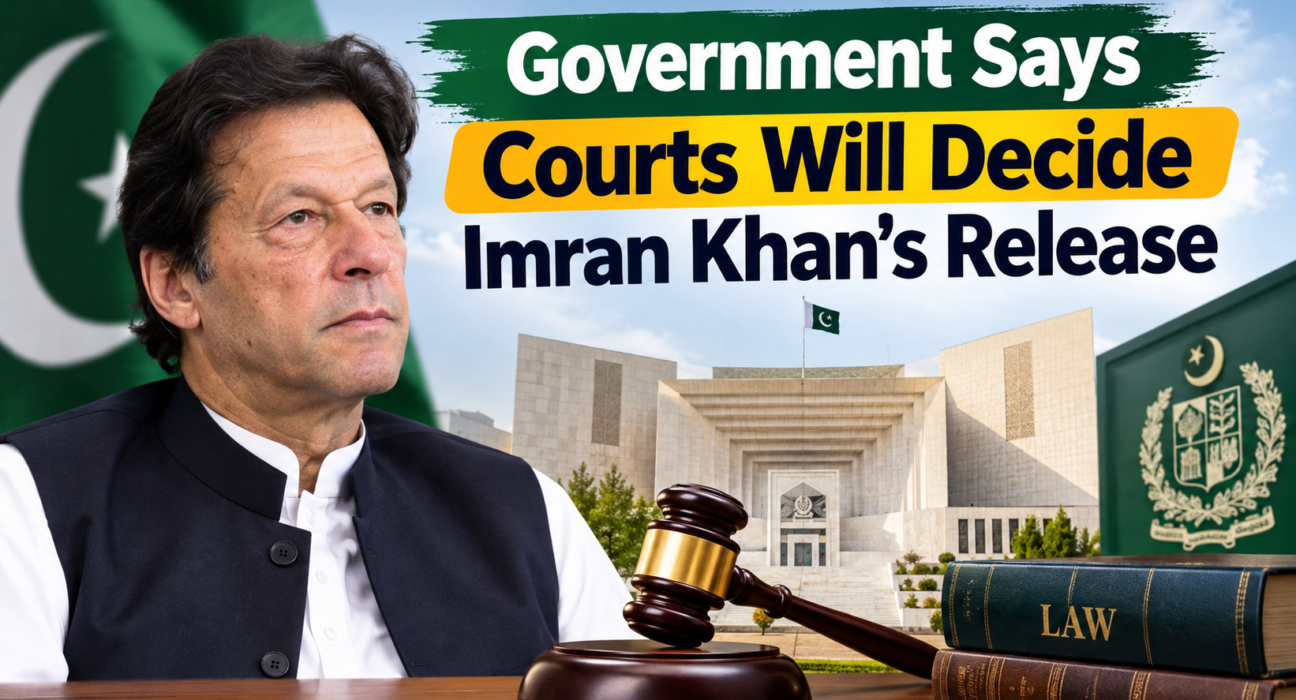
If you’ve been following Pakistani politics lately, you’ve probably heard one phrase over and over: the courts—not the government—will decide when Imran Khan walks free. It sounds simple, but there’s a lot going on behind that one line. Let’s break down what’s happening, why the government keeps saying this, and what it means for Pakistan’s political future.
What’s Happening Right Now
Pakistan’s law minister recently made it clear, once again, that Imran Khan’s release isn’t something the government can just hand over. Law Minister Azam Nazeer Tarar said Khan’s party must pursue his release through the courts, not through street protests. This came right as PTI, Khan’s party, planned a big march toward the capital to demand his freedom.
PTI had to push its march from September 27 to October 4 after officials blocked major roads leading from Khyber Pakhtunkhwa into Islamabad. The government says the roadblocks are there to keep the capital safe. PTI insists its protest will stay peaceful.
This isn’t a new fight. It’s part of a much longer struggle between PTI and Prime Minister Shehbaz Sharif’s coalition government, which formed after PTI-backed candidates won the most seats in the 2024 election but fell short of a majority.
Why the Government Keeps Saying “It’s Up to the Courts”
You might wonder why officials repeat this line so often. Simple answer: it takes the pressure off them. By pointing to the judiciary, the government avoids looking like it’s either freeing a political rival or unfairly keeping him locked up.
Tarar has said his government isn’t avoiding dialogue, but that the release of Imran Khan is a matter for the courts, not politicians, to decide. He’s also pointed out that Pakistan already has legal and constitutional systems built for exactly this kind of dispute, and that Parliament has debated related legislation at length.
There’s also a health angle to this story. A team of the country’s top doctors examined Khan on the Supreme Court’s orders, and his sister, who took part in the process, told the media he was in good health. That medical check became part of the larger argument about whether Khan’s imprisonment conditions are fair.
Tarar didn’t stop there. He said that if any legal gaps still exist in Khan’s case, the courts—not street pressure—should be the ones to fix them. His message boils down to this: demands can’t be forced by shutting down cities, and talks and threats simply don’t mix.
A Quick Timeline of Imran Khan’s Legal Troubles
To understand where things stand today, it helps to look back at how we got here.
| Date | Event |
| April 2022 | Imran Khan removed from office through a no-confidence vote in Parliament |
| May 2023 | Supreme Court rules Khan’s arrest by anti-corruption officials illegal and orders his release after violent protests break out |
| May 2023 | A Pakistani court grants Khan bail in multiple cases, allowing his release days after his dramatic arrest |
| August 2023 | Khan is jailed again, this time facing a mix of charges ranging from corruption to terrorism |
| 2024 | PTI-backed candidates win the most seats in the general election, but not a majority |
| 2026 | Government and PTI remain locked in disputes over protests, court rulings, and Khan’s conditions in jail |
As you can see, Khan’s legal story has been full of ups and downs—arrests, bail, re-arrests, and appeals. It’s not a single case but a tangled web of them.
Who’s Saying What: A Look at the Key Voices
Different people and groups have taken very different positions on this issue. Here’s a snapshot of where everyone stands.
| Voice | Position |
| Pakistani Government | Courts, not protests, should decide Khan’s release; the government denies interfering in judicial matters |
| PTI (Khan’s Party) | Believes the cases against Khan are politically driven and plans peaceful protests to push for his freedom |
| Law Minister Azam Tarar | States release is a matter for courts, cites a medical board’s health check, and warns that talks and threats can’t go together |
| US State Department | Says legal proceedings against Khan are matters for Pakistani courts to decide and avoids commenting on Congressional calls for his release |
| UK Government | Says judicial matters rest with Pakistan’s courts, while urging fair trial rights and humane treatment for Khan |
Notice a pattern? Nearly every major player—local and international—keeps landing on the same talking point: let the courts handle it. Whether that’s a genuine legal stance or a convenient way to dodge responsibility depends on who you ask.
PTI’s Protest Plans and the Government’s Response
PTI hasn’t been shy about using public pressure to push its case. The party has organized nationwide protest campaigns, calling attention to what it describes as a stolen mandate and demanding the release of political prisoners. Other opposition voices have joined in too. Even the JUI-F party, led by Maulana Fazlur Rehman, announced plans to protest the federal government’s policies around the same time, lining up with PTI’s demands.
The government’s answer to all this pressure has stayed pretty consistent: block the marches, cite public safety, and repeat that courts—not crowds—make the final call. Whether you agree with that approach or not, it’s clearly the government’s go-to strategy so far.
Why International Reactions Matter
This story isn’t just a domestic issue anymore. Foreign governments and lawmakers have weighed in too. Members of the US Congress, from both parties, have repeatedly pushed for Khan’s release, and former officials like Zalmay Khalilzad have spoken out publicly about it. Yet the official US position stays neutral on the legal specifics, leaving the decision to Pakistan’s courts.
The UK has taken a similar middle ground. British officials have consistently told their Pakistani counterparts that due process, fair trials, and humane treatment matter, even while acknowledging that judicial decisions belong to Pakistan alone.
This kind of international attention adds another layer of pressure on Pakistan’s government. It’s one thing to manage domestic political rivals. It’s another to do it while foreign governments and human rights advocates are watching closely.
What Could Happen Next
So where does this all go from here? A few things seem likely. First, expect more back-and-forth between PTI’s protest plans and government roadblocks. Second, expect court hearings to continue shaping the political conversation, since that’s where both sides keep pointing. And third, expect international voices to keep chiming in, even if they avoid picking a side on the legal details.
For everyday Pakistanis, this drags on as a mix of frustration and uncertainty. Political tensions affect daily life—from traffic disruptions during protests to broader questions about how fair the justice system feels to ordinary citizens.
At the end of the day, the government’s message is loud and clear: they say it’s the courts’ job, not theirs, to free Imran Khan. Whether that’s a fair legal position or a political dodge is something people will keep debating for a while. What’s certain is that this story isn’t over. Between PTI’s protests, court proceedings, and international attention, Imran Khan’s legal situation remains one of the most closely watched political sagas in Pakistan today.
Keep an eye on upcoming court dates and PTI’s rescheduled march—both are likely to shape the next chapter of this ongoing story.