

Published: October 24, 2026 | Location: Rawalpindi, Punjab, Pakistan
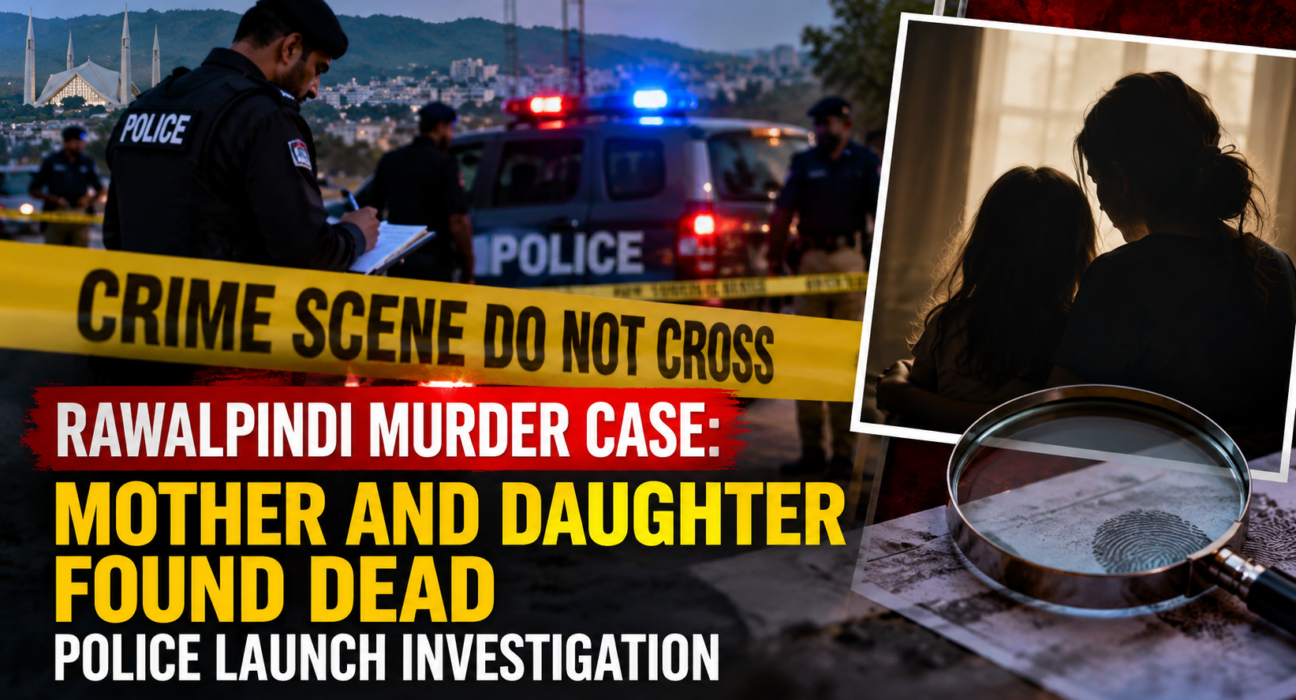
A tragic Rawalpindi murder case has raised serious concerns after a mother and her daughter were found dead inside their rented home in the Dhamial area. The incident came to light on the night of October 22, 2026, when another family member returned home and discovered the two women.
Police registered a murder case against unidentified suspects and launched an investigation to find those responsible. Forensic teams visited the house to collect evidence, while senior police officials directed investigators to examine every possible aspect of the incident.
The mother and daughter murder in Rawalpindi has also drawn the attention of senior Punjab Police officials. Authorities have ordered a detailed investigation and called for efforts to identify and arrest the people involved.
According to reports published on October 24, the motive behind the suspected double murder was still unknown. Police were awaiting medical findings to establish the exact causes of death.
The incident has placed renewed attention on public safety, criminal investigations, and the importance of protecting families in residential areas across Rawalpindi.
Rawalpindi Murder Case: Mother and Daughter Found Dead, Police Launch Investigation
The Rawalpindi double murder investigation began after two women were discovered dead inside a rented house in Mohalla Qureshi Abad, located in the Dhamial Police Station area.
According to the complaint filed with police, the victims were a mother and her adult daughter. They had been living in the rented property with other family members.
The case was reported to police after another daughter returned to the house late on Thursday evening. She found the main gate locked from the inside and knocked repeatedly before her young daughter opened it.
After entering the house, she discovered her sister and mother in separate rooms. She raised an alarm, attracting the attention of nearby residents. The police were then informed about the incident.
Police officers reached the property and began their initial investigation. The bodies were taken to hospitals for the required medical and legal procedures.
The case quickly received attention because two members of the same family had died in suspicious circumstances inside their own residence.
Investigators are now working to establish the sequence of events, identify possible suspects, and understand the circumstances surrounding the deaths.
Police Register Case Against Unidentified Suspects
A First Information Report, commonly known as an FIR, was registered following a complaint from a family member.
The complainant informed the police that his mother and sister had been killed by unidentified individuals. At the time of the initial reports, the family had not identified a clear motive.
The FIR provides the legal starting point for the investigation. It records the allegations made by the complainant and allows police to proceed with their inquiries.
However, an FIR is not proof that a particular person committed a crime. Investigators must establish the facts through reliable evidence and the legal process.
Mother and Daughter Found Dead in Dhamial, Rawalpindi
The incident took place in the Qureshi Abad area, which falls within the jurisdiction of Dhamial Police Station.
The victims were living in a rented house along with other family members. Reports identified the surviving daughter as Roshni or Roshani, while the deceased daughter was identified with varying spellings across news outlets.
The victims’ names also appeared differently in some published reports. These differences should be verified against official police records before being treated as final.
The family reportedly had connections to Gujranwala, and the complaint was submitted by the deceased woman’s son, Suleman Ejaz, whose name was also spelled differently in some reports.
According to the family account, the two sisters had left home during the evening for personal work in Quaid-i-Azam Colony.
One sister returned home earlier, while the other arrived later that night.
When the surviving sister reached the house, she discovered that the gate was locked from the inside. Her six-year-old daughter eventually opened it.
Inside, she found both her mother and sister unresponsive in separate rooms.
The discovery led to immediate concern among family members and neighbours.
Family Members Alert Police After Discovery
After discovering the women, the surviving daughter called for help.
Neighbours gathered outside the house and contacted the police emergency service.
Police arrived to examine the property and begin collecting information.
Investigators had to establish the circumstances leading up to the incident. The time family members left and returned, the condition of the house, and the statements of people nearby could all help build an accurate record.
At this stage, the statements contained in the FIR remain part of the investigation and should not be confused with independently established findings.
Rawalpindi Double Murder Case Timeline
The sequence of reported events provides an important starting point for understanding the Rawalpindi murder investigation.
The following timeline is based on the initial family complaint and information published on October 24, 2026.
| Date and Time | Reported Development |
| October 22, evening | Two sisters reportedly leave their residence for work in Quaid-i-Azam Colony. |
| Around 8:30 PM | Their reported evening journey begins. |
| Before 11:00 PM | One sister reportedly returns home earlier than the other. |
| Around 11:00 PM | The surviving sister returns and discovers her mother and sister. |
| October 22, late night | Neighbours alert police, who respond to the incident. |
| October 23 | Police investigation and senior-level review of the incident are reported. |
| October 24 | Newspapers publish further details of the case and the ongoing investigation. |
The timeline gives readers an overview of the information available during the first stage of the investigation.
However, it does not establish when the deaths occurred or who was responsible.
Police must compare witness statements with medical findings, forensic evidence, and other available information before reaching firm conclusions.
The Importance of Establishing an Accurate Timeline
An accurate timeline can help investigators understand what happened before and after a reported crime.
In this case, investigators may need to review the movements of family members, the timing of the discovery, and the information provided by witnesses.
Even a small difference between two accounts may require further examination.
Police investigations often develop as new evidence becomes available. Early information can change when it is checked against medical reports or independent records.
For this reason, the reported timeline should be treated as preliminary until the relevant details have been officially confirmed.
Key Details of the Rawalpindi Mother and Daughter Murder Case
The following table provides a clear summary of the main information reported about the incident.
| Case Information | Reported Details |
| Incident | Suspected double murder |
| Location | Mohalla Qureshi Abad, Dhamial, Rawalpindi |
| Date of Discovery | October 22, 2026 |
| Victims | A mother and her adult daughter |
| Police Station | Dhamial Police Station |
| Complaint | Registered by a family member |
| Suspects | Unidentified in the initial reports |
| Possible Motive | Not established |
| Medical Examination | Postmortem examinations requested |
| Forensic Investigation | Evidence collected from the property |
| Police Response | Senior officers ordered a detailed investigation |
| Case Status | Investigation ongoing as reported on October 24, 2026 |
These details reflect the initial reporting. They should be updated whenever police release confirmed findings or important new developments.
Rawalpindi Police Launch Investigation Into Double Murder
The Rawalpindi Police investigation began soon after officers received information about the two deaths.
Police reached the property, examined the scene, and started the necessary legal procedures.
Investigators also collected statements and requested forensic assistance to better understand the circumstances of the incident.
The case is being handled within the jurisdiction of Dhamial Police Station.
According to the initial reports, the investigation was not limited to one possible explanation. Police officials said they were examining different aspects of the case.
This approach is important because the motive and identity of the people responsible had not been established.
Investigation Under the Supervision of Senior Officers
The incident received attention from senior police officials in Punjab.
Rawalpindi City Police Officer Hassan Mushtaq Sukhera visited the scene and reviewed the initial investigation.
Punjab Inspector General of Police Abdul Kareem also took notice of the incident and requested a report from the Rawalpindi Regional Police Officer.
The provincial police chief directed local authorities to investigate the matter thoroughly and make efforts to identify and arrest those responsible.
The involvement of senior officers shows that the case received attention beyond the local police station.
However, official instructions and public statements do not establish that a crime has been solved. The investigation must still produce evidence that supports any action against a suspect.
Forensic Teams Collect Evidence From the Crime Scene
Forensic evidence may play an important role in determining the circumstances surrounding the Rawalpindi murder case.
According to the initial police account, teams from the Punjab Forensic Science Agency visited the residence and collected evidence.
Forensic specialists help investigators examine physical material that may be relevant to a criminal case.
Their findings can support or challenge information provided through statements and other records.
In this incident, forensic work is especially important because the available reports do not establish who was responsible or why the two women were targeted.
Role of Scientific Evidence in Criminal Investigations
Scientific evidence can help investigators examine claims about an incident without relying entirely on witness accounts.
Different types of physical evidence may be examined depending on the circumstances and the material available.
The police have confirmed that forensic teams collected evidence in this case, but the complete findings had not been made public in the initial reports.
It would therefore be inaccurate to claim that specific forensic results have identified a suspect.
Investigators must also consider the quality and reliability of any evidence they collect.
A careful scientific examination can help establish facts, but the findings need to be assessed alongside the full investigation.
Importance of Preserving the Scene
Protecting a crime scene is an important part of police work.
When an incident occurs inside a home, officers need to control access to the property so that evidence can be examined properly.
Unnecessary movement and disturbance can make an investigation more difficult.
In the Rawalpindi double murder case, police and forensic teams visited the residence as part of the inquiry.
Their work may help authorities develop a more accurate understanding of the incident.
Postmortem Reports Expected to Help Establish Cause of Death
The bodies of the two women were taken to medical facilities for examination.
According to reporting by Dawn, the bodies were initially moved to Benazir Bhutto Hospital and later transferred to District Headquarters Hospital for postmortem procedures.
Medical examinations are an important part of a suspected murder investigation.
A postmortem, also called an autopsy, allows medical professionals to examine a deceased person’s body and document findings relevant to the cause of death.
The initial police statements suggested possible causes, but the final medical conclusions were still awaited.
Preliminary Findings Remain Unconfirmed
Early news reports contained different descriptions of the suspected causes of death.
Some accounts suggested that the women may have died from strangulation, while others reported evidence of a head injury in one of the victims.
These details came from preliminary observations rather than completed medical findings.
The final cause of death must be based on the relevant medical evidence.
It is important not to present early observations as confirmed conclusions.
Medical Reports and Police Findings Must Be Considered Together
The medical findings may help investigators determine the nature of the deaths and examine the reported sequence of events.
However, a postmortem report does not automatically identify the person responsible for a death.
Police must consider medical findings alongside physical evidence, witness statements, and any other verified information.
A reliable investigation depends on how these different sources of evidence fit together.
The medical report is therefore an important part of the inquiry, but it is not a substitute for the complete investigation.
Police Continue Search for Suspects in Rawalpindi Murder Case
The identity of the suspected offenders had not been publicly established in the initial reports.
Police registered the case against unidentified individuals after receiving the complaint from the victims’ family.
The motive behind the incident also remained unknown.
Officials said investigators were examining the case from different angles and would pursue those responsible.
At this stage, there is no verified basis for naming any person as the offender.
Police Examine Different Aspects of the Incident
Investigators need to understand the circumstances surrounding the deaths before determining who may have been involved.
The reported movements of family members, the condition of the residence, and statements from people connected to the case may help police assess the available information.
The investigation may also depend on the medical and forensic findings.
No single explanation should be accepted without sufficient evidence.
This is particularly important in cases where early reports contain limited information.
Arrests Must Be Supported by Evidence
The Punjab Police leadership directed officials to identify and arrest those involved in the incident.
An arrest, if made, would represent a development in the investigation rather than proof of guilt.
Any accused person has the right to legal proceedings, and the evidence must be examined through the justice system.
Responsible reporting should distinguish between allegations, police findings, criminal charges, and court judgments.
This helps protect the fairness of the investigation and prevents the spread of unsupported accusations.
Punjab Police Take Notice of Mother and Daughter Murders
The Rawalpindi murder incident attracted the attention of the provincial police leadership.
Punjab Inspector General Abdul Kareem directed the Rawalpindi Regional Police Officer to provide a report.
The inspector general also instructed the city’s police leadership to use available resources to investigate the deaths and trace those responsible.
These directions placed the case under senior-level review.
Senior Police Officials Review the Case
The Rawalpindi City Police Officer visited the scene following reports of the incident.
Senior officers reviewed the situation and directed investigators to examine all relevant aspects.
Such supervision can help ensure that an investigation receives the necessary attention and resources.
However, the success of the investigation will depend on the evidence collected and the ability of authorities to establish the facts.
The public statements made by senior officers should therefore be understood as commitments to investigate, not confirmation of the outcome.
Accountability and Transparent Investigation
Transparency is important whenever a serious criminal case receives public attention.
Families need accurate information about the legal process, while the public needs reliable updates that do not interfere with the investigation.
Police should communicate confirmed developments clearly and avoid releasing details that could harm the inquiry or affect vulnerable witnesses.
The Rawalpindi case has shown why careful communication matters during the early stages of a criminal investigation.
Family Faces Tragedy After Losing Two Members
Behind the headlines, the incident involves a family that has lost two relatives in deeply distressing circumstances.
The surviving daughter discovered the deaths after returning home.
Her brother later travelled from Gujranwala to Rawalpindi after receiving information about the incident.
The family is now dealing with grief while police investigate the deaths.
The sudden loss of a mother and sister can affect many aspects of family life.
Daily routines, financial responsibilities, and emotional well-being may all change after such an event.
Impact on Surviving Family Members
News reports also mentioned that young children were living in the house.
Children who experience a frightening event or the sudden loss of relatives may need emotional support and reassurance.
Their privacy should be protected, especially when an incident receives public attention.
Family members, trusted adults, and suitable support services can help children feel secure during difficult circumstances.
News coverage should avoid unnecessary personal details about minors.
The most important public-interest information concerns the incident, the police response, and verified developments in the investigation.
Respect for the Victims and Their Relatives
Victims of serious crimes deserve respectful coverage.
News reports should not reduce people to shocking descriptions or turn family suffering into entertainment.
The identities and personal histories of victims should only be included when they are relevant, reliable, and appropriate for publication.
In this case, reports have provided different spellings of the victims’ names.
It is better to acknowledge this uncertainty than publish an unverified version as a confirmed fact.
Rawalpindi Residents Concerned About Safety After Double Murder
The discovery of two women inside a residential property has brought attention to concerns about safety in Rawalpindi.
A suspected double murder inside a family home is a serious incident, particularly when the circumstances remain unclear.
However, one criminal case cannot establish that crime is increasing across an entire city.
A broader claim about crime trends would require reliable police statistics covering a defined period.
Importance of Community Awareness
Communities can play a useful role in supporting public safety.
Residents who notice an emergency can contact the police and provide accurate information.
In the Dhamial case, neighbours reportedly alerted police after hearing the surviving family member calling for help.
This response helped bring the incident to the attention of authorities.
The role of local residents should remain focused on providing assistance and sharing reliable information rather than making accusations.
Avoiding Rumours During an Active Investigation
Serious criminal cases often lead to rumours on social media.
Unverified messages may suggest motives, name suspects, or describe events without supporting evidence.
Such claims can harm innocent people and create confusion.
They may also cause further distress to families already affected by tragedy.
Readers should rely on confirmed police statements and credible reporting.
Information shared without a reliable source should not be presented as fact.
Legal Process Following the Rawalpindi Double Murder
The Rawalpindi case has entered the criminal investigation process following the registration of an FIR.
In Pakistan, a murder investigation generally involves the collection of evidence, examination of relevant statements, medical findings, and legal review.
The exact steps depend on the facts of each case.
An FIR records the complaint and allows police to investigate an alleged offence.
It does not mean that the allegations have already been proved in court.
From FIR to Investigation
After the registration of a criminal case, investigators work to gather information and identify relevant evidence.
They may examine witness accounts, obtain medical reports, and consider findings from forensic specialists.
The purpose of the investigation is to determine whether sufficient evidence supports action against any individual.
Police are expected to follow the law while carrying out these duties.
Accurate records and careful handling of evidence are important throughout the process.
Role of the Courts
If investigators identify suspects and the case proceeds, the courts have a central role in deciding the legal outcome.
The prosecution must present evidence in accordance with the law.
An accused person is entitled to a fair trial and the opportunity to respond to the allegations.
A conviction can only follow the required legal process.
In the Rawalpindi incident, the initial reporting did not establish that suspects had been convicted or that the case had reached trial.
Challenges in Investigating a Double Murder Case
A case involving two deaths inside a private residence can present several challenges.
Investigators may have limited information about the events that occurred before the discovery.
Witness accounts may also cover different periods or describe events from different viewpoints.
This makes it necessary to examine each piece of information carefully.
Unclear Motive
The motive behind the deaths was not known when the initial reports were published.
Investigators may consider different possibilities, but none should be presented as established without evidence.
Speculation about personal disputes, property, or other possible reasons would be misleading at this stage.
A responsible account should clearly state that the motive remains under investigation.
Different Accounts in Early Reporting
Some early reports provided different spellings of names and slightly different descriptions of medical observations.
Such differences can occur when information is released before official records and final reports become available.
Journalists should cross-check the information and correct any errors when reliable confirmation emerges.
The absence of complete details should not be filled with assumptions.
Need for Reliable Witness Information
Witness statements may help investigators understand the events before and after the discovery.
However, statements must be checked against available evidence.
People may remember events differently, particularly during stressful circumstances.
An investigation should examine these differences carefully instead of assuming that every early account is complete.
Responsible Crime Reporting and Public Awareness
Crime reporting serves an important public purpose.
It informs readers about incidents, explains the response of authorities, and helps the public understand the justice process.
However, reports about violent crimes must be handled carefully.
The Rawalpindi mother and daughter murder case involves a grieving family, an active police investigation, and allegations that have not yet been tested in court.
Accuracy Matters More Than Sensational Headlines
A news headline should accurately describe the available facts.
It should not suggest that a suspect has been identified when police have not confirmed an identity.
Similarly, an article should not announce a motive without reliable evidence.
Clear language helps readers understand the situation without confusion.
Reliable reporting also makes it easier to correct and update information as a case develops.
Protecting Personal Privacy
Personal information about surviving relatives should be handled with care.
Children deserve particular protection because they may be affected by public attention and online discussion.
Publishing unnecessary information about their lives can create additional difficulties.
The public can remain informed about a police investigation without being given every private detail about the family.
Reporting Verified Developments
Meaningful developments include official identification of suspects, confirmed arrests, completed medical findings, and court proceedings.
Each development should be attributed to a credible source.
Readers should also be able to distinguish between an official finding and a statement made by a complainant.
This approach supports accurate reporting and public trust.
Latest Rawalpindi Murder Case Update as of October 24, 2026
As of the reports published on October 24, 2026, the double murder investigation remained ongoing.
The available reporting established that two women had been found dead inside a residence in the Dhamial area of Rawalpindi.
A murder case had been registered following a family complaint, and forensic evidence had been collected.
Senior Punjab Police officials had instructed local authorities to investigate the incident and identify those responsible.
The final medical findings and confirmed motive had not been publicly established in the sources reviewed for this article.
There was also no verified announcement in those reports that the suspects had been convicted.
Confirmed Developments
The main confirmed developments include the discovery of the two women, the registration of the case, the police response, and the collection of evidence.
The involvement of senior police officers was also publicly reported.
These developments show that the matter had entered the formal investigation process.
Details Still Awaiting Confirmation
Several important details remained unresolved.
These included the final causes of death, the motive, the identification of those responsible, and the outcome of the police investigation.
Any future article update should separate newly confirmed information from earlier allegations.
This will help readers follow the case without confusing preliminary reports with established findings.
Importance of Justice and Public Trust in the Rawalpindi Case
The Rawalpindi mother and daughter murder case highlights the importance of a fair and effective criminal justice process.
When a family loses two members in suspicious circumstances, authorities have a responsibility to establish what happened through lawful investigation.
Forensic findings, medical reports, and reliable statements can all contribute to that process.
The role of police is to investigate the allegations, identify relevant evidence, and follow the legal requirements.
The role of the courts is to evaluate the case and determine legal responsibility.
Public trust depends on these institutions performing their duties fairly and transparently.
A Fair Investigation Protects Everyone
A fair investigation helps victims’ families seek justice while also protecting people from unsupported accusations.
It ensures that decisions are based on evidence rather than rumours or public pressure.
This matters particularly when a case receives attention on social media.
The seriousness of an allegation should never replace the need for reliable proof.
Continued Attention to Verified Information
The Rawalpindi case may develop as further medical findings and police information become available.
Until then, reports should remain focused on confirmed facts.
Readers deserve updates that explain the progress of the investigation without creating false expectations.
The family’s loss remains the central human tragedy behind the case.
A careful investigation and a fair legal process are essential to establishing accountability.
The Rawalpindi murder case involving a mother and daughter has become a serious criminal investigation after both women were found dead inside their rented house in the Dhamial area on October 22, 2026.
Police registered an FIR against unidentified suspects, collected forensic evidence, and arranged medical examinations. Senior Punjab Police officials also took notice of the incident and directed investigators to examine the case thoroughly.
As of October 24, the exact motive and final medical findings had not been publicly confirmed in the initial reporting.
The tragedy has left a family grieving and brought attention to the importance of public safety and responsible crime reporting.
The next important developments will depend on verified medical findings, police evidence, and any lawful action taken against identified suspects.
Justice in this case depends on an accurate investigation, reliable evidence, and a fair legal process.