

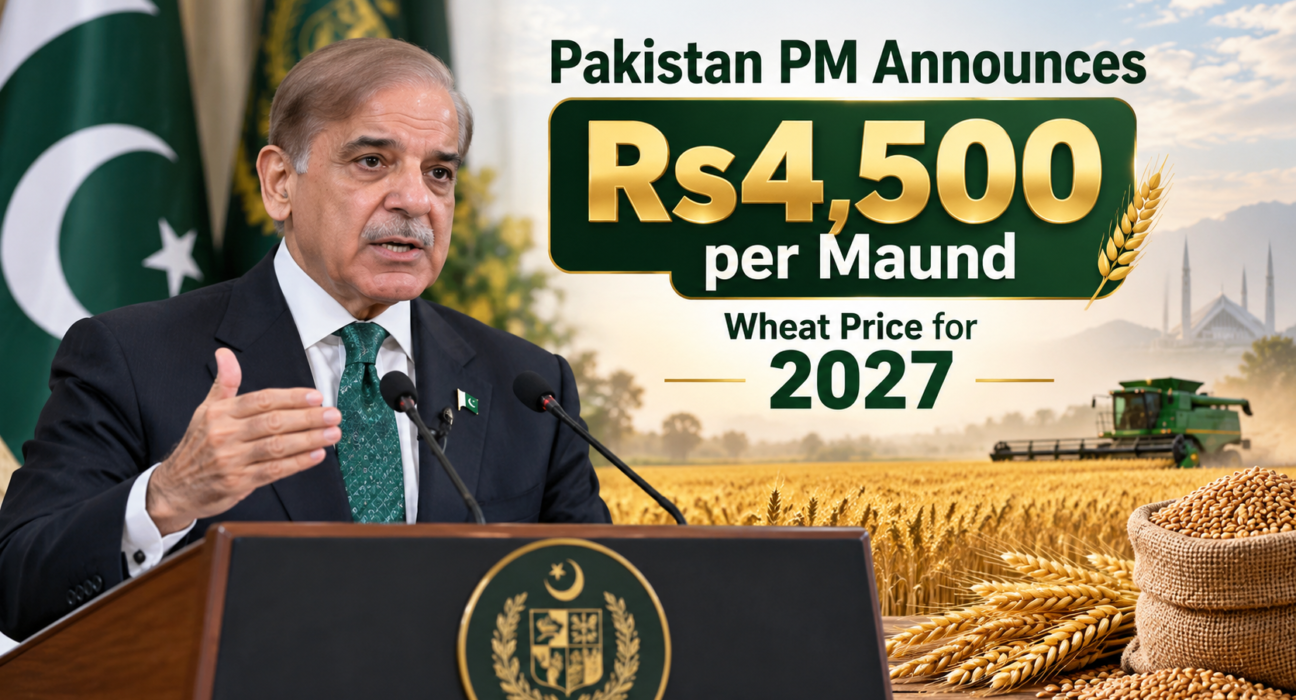
Wheat is more than a crop in Pakistan. It is the flour in your roti, the income of millions of farming families, and a big piece of the country’s food security. So when the Prime Minister names a new wheat price, people pay attention, from the village farmer to the shopkeeper in the city.
On Friday, October 23, 2026, Prime Minister Shehbaz Sharif set the illustrative price for wheat at Rs4,500 per maund for 2027, raising the procurement price set last year by Rs1,000. In this guide, I’ll walk you through what was announced, what it means, who gains, who worries, and what to watch next. I’ll keep it simple and honest, because this topic affects real kitchens and real fields.
Pakistan PM Announces Rs4,500 Wheat Price Per Maund for 2027
Let’s start with the facts. The Prime Minister’s Office said the decision aims to support farmers and encourage more wheat sowing in the coming season. The Rs4,500 per maund price has so far been described only as a proposed or indicative price. That detail matters, and I’ll come back to it later.
The Key Numbers at a Glance
Here is the short version:
- The new price is Rs4,500 per maund, and one maund equals 40 kilograms.
- It represents a Rs1,000 increase from last year’s Rs3,500.
- It applies to the 2027 wheat crop, which farmers will sow in the coming season.
That is a jump of roughly 29 percent in one year. For a crop that farmers sell by the maund, it is a big move.
Who Was Involved in the Decision
The announcement did not come out of nowhere. The statement said the proposal had been made with input from President Asif Ali Zardari and PML-N leader Nawaz Sharif, after consultations with the chief ministers of Punjab and Sindh. The Prime Minister also thanked Punjab Chief Minister Maryam Nawaz and Sindh Chief Minister Murad Ali Shah for their help.
This is a good sign in one way. Punjab grows most of Pakistan’s wheat, and Sindh is also a major producer. When both provinces sit at the table, the final price has a better chance of working across the country.
What a Maund Means and Why It Matters
If you are new to farm markets, the word “maund” might sound old-fashioned. It is still the everyday unit that farmers, traders, and flour mills use across Pakistan.
One Maund Equals 40 Kilograms
A maund is 40 kg. So when you hear Rs4,500 per maund, think of it as Rs4,500 for a 40 kg bag of wheat. That works out to about Rs112 per kilogram at the farm gate.
Why the Unit Is Still Used
Pakistan officially uses the metric system, but grain markets run on habit and trust. Farmers talk in maunds, mandi traders quote in maunds, and government announcements follow the same style. Using the same unit keeps everyone on the same page, so nobody gets confused during a sale.
How Rs4,500 Compares With Last Year
Numbers become clearer when you put them side by side. Here is a simple comparison.
Table 1: Wheat Price Comparison
| Item | Price per Maund (40 kg) |
| 2025-26 procurement price | Rs3,500 |
| 2027 indicative price | Rs4,500 |
| Increase | Rs1,000 |
| Farmer group demand | Rs5,000 |
| Gap between offer and demand | Rs500 |
A Big Step Up
Last October, the government approved a wheat policy under which it would procure wheat from farmers at Rs3,500 per maund. Many growers felt that rate did not cover their costs. A Kisan Ittehad leader even said the cost of growing wheat had climbed to between Rs4,000 and Rs4,500 per maund. So the new figure at least matches the cost level farmers were talking about.
Still Below What Farmers Asked For
Farmers wanted more. Last month, the Pakistan Kissan Ittehad demanded a Rs5,000 per 40 kg support price for wheat, warning that farmers may not sow wheat if the government delays announcing crop policies. The gap is Rs500, or about 10 percent. Not huge, but enough to start a debate.
Why the Government Raised the Price
Governments don’t raise prices by Rs1,000 for fun. Several pressures pushed this decision.
Rising Cost of Growing Wheat
Fertilizer, diesel, electricity for tube wells, seed, and labor have all become more expensive. The Prime Minister said the increase was meant to support growers facing higher production costs, rising petroleum prices, and inflation. If the sale price stays flat while costs rise, a farmer’s profit shrinks fast. At some point, growing wheat stops making sense, and farmers switch to other crops.
Too Much Dependence on Imports
The government also pointed to imports. Pakistan has had to import wheat over the past two years, as the prime minister noted. Importing wheat costs foreign exchange, and it leaves the country open to global price swings. If farmers grow more at home, Pakistan relies less on other countries to feed its people.
Encouraging More Sowing
The simplest goal is to get more wheat in the ground. A good price announced early gives farmers confidence before sowing time. When growers feel safe, they plant more acres, and bigger harvests help keep flour prices calmer later.
What Farmers Are Saying
Farmers are not one voice, but a few themes keep coming up.
Relief Mixed With Caution
Many growers will welcome a Rs1,000 jump. After a few hard seasons, it feels like someone finally listened. Still, farmers have heard big promises before. Their main worry is simple: will the price they see on paper be the price they get in the mandi.
The Rs5,000 Demand
Kissan Ittehad had asked for Rs5,000. Their warning was blunt: if policies come late or prices stay low, farmers may skip wheat. The new announcement lands between last year’s price and that demand, so it may calm some tension without ending the talk. Expect farmer groups to keep pushing for a better deal while they plan their sowing.
What an Indicative Price Really Means
This is the part many headlines skip, so let’s slow down.
Indicative Is Not the Same as Guaranteed
The word “indicative” or “illustrative” means the figure points the way, but it may not be a binding rule. The announcement described Rs4,500 per maund as an illustrative price and did not clarify whether it would be adopted as a guaranteed procurement rate. In plain words, the government has shown its target, but the final legal and buying details are still to come.
What Needs to Happen Next
For the price to become real money in a farmer’s hand, a few steps usually follow:
- A formal wheat policy or notification
- Agreement on how much wheat the government will buy
- Clear procurement centers, gunny bags, and payment timelines
- Coordination between the federal and provincial governments
Until those pieces appear, farmers and traders will watch closely. Smart growers will wait for the formal notice before making big financial moves.
Effect on Flour and Bread Prices
Now let’s talk about your dastarkhwan. Wheat price changes travel down the chain to flour, roti, and naan.
Where Market Prices Stand Today
Market prices have already been high. A news report in August 2026 highlighted a wheat price hike in Lahore, with prices around Rs5,200 per maund. Farmers had earlier warned that wheat could climb toward Rs6,000 if the government did not act. One recent report that uses weekly price data says open-market wheat averaged about Rs5,517 per 40 kg in the week ended October 22, 2026. Treat that number as a rough guide, since prices change by city and day.
This tells us something interesting. The new Rs4,500 indicative price is actually lower than recent open-market rates. That means the announcement is a signal for next season’s crop and a farmer-support step. It is not a promise that today’s flour will suddenly get cheaper.
Government Releases to Cool the Market
Provinces have been trying to calm prices in the short term. In early October, Sindh Chief Minister Murad Ali Shah approved the release of government wheat at Rs12,500 per 100 kg bag from October 15 to stabilise flour prices and keep supply available. Stock releases like this give mills enough wheat so prices don’t spike.
Food Security and the Import Question
Food security means every family can get enough affordable food, not just in a good year but in every year.
Growing More at Home
Pakistan is one of the world’s larger wheat producers, but it still needed imports recently. A stronger price can help bring that back in line. When farmers earn a fair profit, they invest in better seed, timely fertilizer, and proper irrigation. Those choices raise yields, and higher yields reduce the need for imports.
A Safer Buffer Against Global Shocks
Global wheat prices swing with wars, weather, and shipping costs. A country that grows most of its own wheat is much less shaken by those events. The government made this link clear, saying the move aims to strengthen domestic production and reduce the country’s reliance on imported wheat.
How Wheat Prices Moved Through 2026
To see why this announcement matters, it helps to look at the past year. Prices did not move in a straight line. They jumped, cooled, and jumped again.
Table 2: Wheat Price Timeline, October 2025 to October 2026
| Date | What Happened |
| October 2025 | Government approves wheat policy at Rs3,500 per maund |
| January 2026 | Lahore prices jump from about Rs3,700 to nearly Rs4,450 in ten days |
| July 2026 | Farmers warn prices could reach Rs6,000 per maund |
| August 2026 | Lahore market reports wheat near Rs5,200 per maund |
| October 13, 2026 | First National Agricultural and Food Security Council meeting |
| October 15, 2026 | Sindh begins releasing government wheat |
| October 23, 2026 | PM sets Rs4,500 indicative price for 2027 |
What the Timeline Tells Us
The big lesson is that the 2025 support price of Rs3,500 sat far below where the market ended up. Reports from January showed wheat prices in Lahore rising from around Rs3,700 to nearly Rs4,450 per maund within ten days. When the official price trails the market this much, farmers feel cheated and consumers feel squeezed. A higher, earlier announcement tries to fix that gap.
The Council Meeting Matters Too
On October 13, the Prime Minister chaired the first National Agricultural and Food Security Council meeting and said the government wanted farmers to get a fair price while consumers keep affordable wheat. Just ten days later came the price announcement. That suggests the council is turning talk into action.
The Role of Provinces and Federal Coordination
Agriculture is largely a provincial subject in Pakistan, so the federal price needs provincial support to work.
Why Uniform Rates Matter
Different rates in different provinces can cause trouble. Traders may move wheat from a low-price area to a high-price area, which creates shortages and black markets. National Food Security Minister Rana Tanveer Hussain has said the Prime Minister will coordinate with the provinces to set a uniform rate. A single national figure keeps the market fair and simple.
Lessons From Last Year
Last year, Sindh had reservations about the federal price and asked for a higher support rate. Disagreements like that slow down procurement and leave farmers unsure. This time, the Prime Minister stressed consultation with the chief ministers before announcing the figure. If that teamwork holds, the process should be smoother.
Challenges That Could Still Get in the Way
A good price on paper does not solve everything. Here are the real hurdles.
Input Costs Remain High
Even at Rs4,500, farmers can lose their gains if fertilizer and fuel keep climbing. Farmer groups have long complained about expensive urea and DAP. If input prices stay high, the profit from the higher wheat price may shrink. Cheaper inputs would make this plan much stronger.
Timely Purchase and Payment
A price only helps if the government or private buyers actually pay it. Small farmers often can’t wait weeks for payment, and some sell to middlemen at lower rates just to get cash. Clear purchase centers, enough gunny bags, and quick payments will decide whether this announcement helps ordinary growers.
Keeping Flour Affordable
If wheat costs more, flour could cost more too. The government has to balance two groups: farmers who want higher prices and consumers who want cheaper bread. Stock releases, careful import decisions, and watching hoarders will be key tools.
Practical Tips for Farmers
If you grow wheat, here is some friendly advice as you plan the season.
Plan Early and Track the Official Notice
Watch for the formal wheat policy and procurement rules. Don’t rely only on social media rumors. Check announcements from your provincial agriculture or food department.
Control Your Costs
Test your soil if you can. Buy seed and fertilizer on time instead of at the last minute, when prices rise. Good timing on irrigation and sowing can also lift your yield without adding much cost.
Keep Records
Write down what you spend on seed, fertilizer, diesel, and labor. If you know your cost per maund, you can judge any price offer with confidence and speak up with real numbers.
Practical Tips for Consumers and Small Traders
You are affected too, so here is what you can do.
Don’t Panic Buy
The new price is for the 2027 crop, not a sudden jump in today’s flour. Buying huge stocks out of fear only pushes prices up for everyone. Buy what your family needs for a few weeks.
Watch Official Rates
District administrations often publish flour and wheat rates. Compare them with what your local shop charges. If you see a large gap, report it to the local price control office.
Small Traders Should Stay Flexible
If you run a flour shop or bakery, keep a close eye on mill rates and avoid locking in long contracts at high prices. Prices may shift once the formal policy lands.
So where does all this leave us. The Prime Minister’s announcement is a clear attempt to put farmers first, cut import dependence, and bring more stability to the wheat market. A Rs1,000 rise is meaningful, and the consultation with Punjab and Sindh shows some teamwork. The price is still labeled indicative, farmers wanted Rs500 more, and the real test will be how smoothly the government buys and pays.
For now, the best move is to stay informed and wait for the official notification. If you want to read the original reports, Dawn and Business Recorder both covered the announcement in detail. Wheat touches every home in Pakistan, so this story is worth following as it develops.