

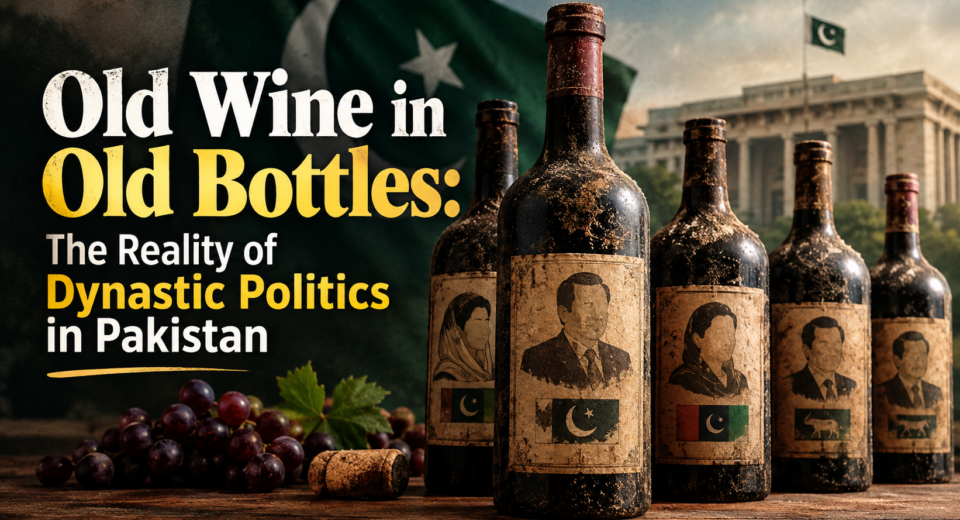
Old Wine in Old Bottles: The Reality of Dynastic Politics in Pakistan
Every election season, Pakistan’s ticket lists tell a familiar story. Alongside fresh names sit sons, daughters, brothers and wives of people who held the same seats before them. That habit is what people mean by dynastic politics in Pakistan: political power passed from one family member to another, across generations, usually with a party’s approval. The pattern exists in many countries. In Pakistan it has a particular shape, because it grew up alongside long spells of military influence, patronage-based voting and parties that rarely hold real internal contests. This article traces where it came from, which families matter, how it works at election time, and what supporters and critics say about it. Where a claim rests on one report or one analyst, the text says so. What “Old Wine in Old Bottles” Means The English idiom is “old wine in new bottles,” meaning something old sold as if it were new. Critics of Pakistani politics tend to say the packaging doesn’t change either. In this reading, the wine is the political family itself: its name, its local following and its network of relatives, landholders, clients and supporters. The bottle is the structure that carries it, meaning parties built around one household, tickets handed out by leaders, voters who expect jobs and favours in return for loyalty, and an establishment that has often dealt with one family or another. What changes is the label, which is a new generation stepping into an old role. That is one interpretation, and not everyone accepts it. Supporters argue that family names are often the only thing holding a party together in a country where parties have been banned, split and pressured. Both views are covered below. The Express Tribune used the same phrase as the headline of its January 2024 report on family candidates in Sindh, and this article credits that report in the Sindh section and in the Sources list. How Political Families Took Root The roots go back before 1947. In Punjab, the Unionist Party of leaders such as Sir Sikandar Hayat Khan and Khizar Hayat Tiwana drew strength from large landholders. In Sindh, the Bhuttos of Larkana were already prominent, and Sir Shahnawaz Bhutto, father of Zulfikar Ali Bhutto, served as a senior minister in the princely state of Junagadh. Analyst Raza Ahmad Rumi notes that a limited number of families have dominated Pakistan’s legislatures since 1947, mostly from rural landowning and tribal backgrounds. He adds that the main change in the twenty-first century has been the widening of this circle to include families from urban, religious and military backgrounds. In his account, clan, tribe, caste and biradari play a large part in electoral contests and are tied to clientelism. The military has also had a role. One academic paper argues that military rulers have sought to co-opt powerful political families to legitimise their own rule. The Ayub Khan era (1958 to 1969) shows how this can work in practice: his son Gohar Ayub Khan and grandson Omar Ayub Khan both went on to careers in politics, and Omar Ayub was the PTI’s nominee for prime minister during the 2024 government-formation talks. Land reforms in 1959 and 1972 were meant to loosen the hold of big landowners. Historians generally say their effect was limited, and rural influence continued to convert into votes. The modern political dynasties took shape in the 1960s to 1980s. Zulfikar Ali Bhutto founded the PPP in 1967 and was hanged in April 1979 under Zia-ul-Haq’s government. Nawaz Sharif rose during the same era, serving as Punjab’s chief minister from 1985 to 1990 before becoming prime minister three times. Through the 1990s, he and Benazir Bhutto alternated in power. Old Wine: The Families That Keep Returning The Bhutto-Zardari family Benazir Bhutto became prime minister in 1988 and again in 1993. After her assassination in December 2007, the PPP’s leadership passed to her son Bilawal, then a teenager, with her husband Asif Ali Zardari as co-chairman. Rumi describes the succession as having been set out in a handwritten will. He also cites Gazdar’s view that the Bhuttos combine a popular following with a legacy of martyrdom, drawn from the deaths of several family members. Zardari served as president from 2008 to 2013 and returned to the office in March 2024. His daughter Aseefa Bhutto-Zardari entered parliament a few weeks later. Dawn reported that eleven candidates filed papers for the NA-207 by-election, the returning officer rejected seven, and the remaining three withdrew on the last day, leaving her elected unopposed. The same report noted that the PTI accused police of detaining an independent candidate to give her a walkover. That is the PTI’s allegation, and I have not seen an independent finding on it. The PTI also described the outcome as “selection” when she took her oath. Tribune India counted the president, three members of the National Assembly and two members of the Sindh Assembly from Zardari’s extended family, and reported that the family now had more legislators than the Sharifs. The Sharifs hold plenty of office as well, with Shehbaz as prime minister and Maryam Nawaz as chief minister of Punjab. The Sharif family The Sharifs are an industrial family from Lahore. The Supreme Court disqualified Nawaz Sharif in the Panama Papers case in July 2017. His younger brother Shehbaz has led the party and government since then, serving as prime minister from April 2022 to August 2023 and again from March 2024. Maryam Nawaz became Punjab’s first female chief minister in February 2024. A Dawn commentary at the time said her selection followed the dynastic pattern of Pakistani politics while also being a first for women. Her cousin Hamza Shehbaz served briefly as chief minister in 2022. Media commentary has often speculated about rivalry between the two branches of the family, but that is commentary rather than something either has confirmed. Families beyond the two biggest names In Punjab, the Chaudhrys of Gujrat rose through Chaudhry Zahoor Elahi. His son Shujaat Hussain was briefly prime minister in