
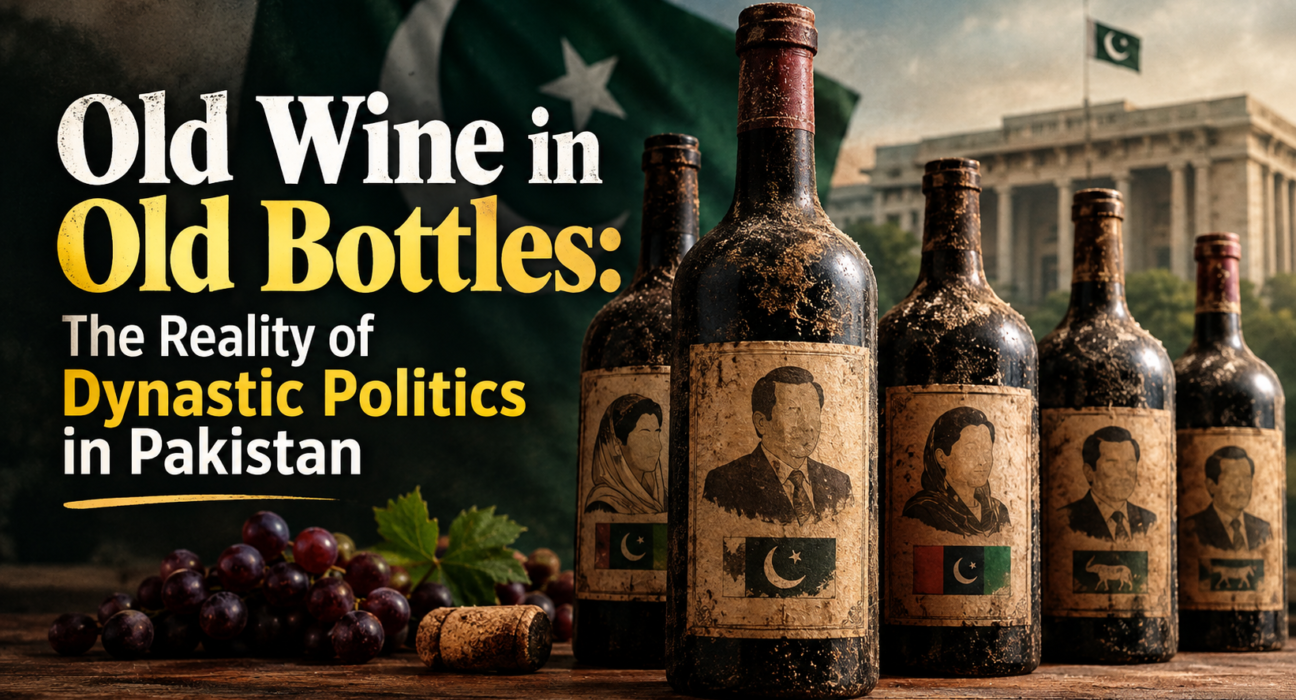
Every election season, Pakistan’s ticket lists tell a familiar story. Alongside fresh names sit sons, daughters, brothers and wives of people who held the same seats before them. That habit is what people mean by dynastic politics in Pakistan: political power passed from one family member to another, across generations, usually with a party’s approval.
The pattern exists in many countries. In Pakistan it has a particular shape, because it grew up alongside long spells of military influence, patronage-based voting and parties that rarely hold real internal contests. This article traces where it came from, which families matter, how it works at election time, and what supporters and critics say about it. Where a claim rests on one report or one analyst, the text says so.
What “Old Wine in Old Bottles” Means
The English idiom is “old wine in new bottles,” meaning something old sold as if it were new. Critics of Pakistani politics tend to say the packaging doesn’t change either.
In this reading, the wine is the political family itself: its name, its local following and its network of relatives, landholders, clients and supporters. The bottle is the structure that carries it, meaning parties built around one household, tickets handed out by leaders, voters who expect jobs and favours in return for loyalty, and an establishment that has often dealt with one family or another. What changes is the label, which is a new generation stepping into an old role.
That is one interpretation, and not everyone accepts it. Supporters argue that family names are often the only thing holding a party together in a country where parties have been banned, split and pressured. Both views are covered below.
The Express Tribune used the same phrase as the headline of its January 2024 report on family candidates in Sindh, and this article credits that report in the Sindh section and in the Sources list.
How Political Families Took Root
The roots go back before 1947. In Punjab, the Unionist Party of leaders such as Sir Sikandar Hayat Khan and Khizar Hayat Tiwana drew strength from large landholders. In Sindh, the Bhuttos of Larkana were already prominent, and Sir Shahnawaz Bhutto, father of Zulfikar Ali Bhutto, served as a senior minister in the princely state of Junagadh.
Analyst Raza Ahmad Rumi notes that a limited number of families have dominated Pakistan’s legislatures since 1947, mostly from rural landowning and tribal backgrounds. He adds that the main change in the twenty-first century has been the widening of this circle to include families from urban, religious and military backgrounds. In his account, clan, tribe, caste and biradari play a large part in electoral contests and are tied to clientelism.
The military has also had a role. One academic paper argues that military rulers have sought to co-opt powerful political families to legitimise their own rule. The Ayub Khan era (1958 to 1969) shows how this can work in practice: his son Gohar Ayub Khan and grandson Omar Ayub Khan both went on to careers in politics, and Omar Ayub was the PTI’s nominee for prime minister during the 2024 government-formation talks.
Land reforms in 1959 and 1972 were meant to loosen the hold of big landowners. Historians generally say their effect was limited, and rural influence continued to convert into votes.
The modern political dynasties took shape in the 1960s to 1980s. Zulfikar Ali Bhutto founded the PPP in 1967 and was hanged in April 1979 under Zia-ul-Haq’s government. Nawaz Sharif rose during the same era, serving as Punjab’s chief minister from 1985 to 1990 before becoming prime minister three times. Through the 1990s, he and Benazir Bhutto alternated in power.
Old Wine: The Families That Keep Returning
The Bhutto-Zardari family
Benazir Bhutto became prime minister in 1988 and again in 1993. After her assassination in December 2007, the PPP’s leadership passed to her son Bilawal, then a teenager, with her husband Asif Ali Zardari as co-chairman. Rumi describes the succession as having been set out in a handwritten will. He also cites Gazdar’s view that the Bhuttos combine a popular following with a legacy of martyrdom, drawn from the deaths of several family members.
Zardari served as president from 2008 to 2013 and returned to the office in March 2024. His daughter Aseefa Bhutto-Zardari entered parliament a few weeks later.
Dawn reported that eleven candidates filed papers for the NA-207 by-election, the returning officer rejected seven, and the remaining three withdrew on the last day, leaving her elected unopposed. The same report noted that the PTI accused police of detaining an independent candidate to give her a walkover. That is the PTI’s allegation, and I have not seen an independent finding on it. The PTI also described the outcome as “selection” when she took her oath.
Tribune India counted the president, three members of the National Assembly and two members of the Sindh Assembly from Zardari’s extended family, and reported that the family now had more legislators than the Sharifs. The Sharifs hold plenty of office as well, with Shehbaz as prime minister and Maryam Nawaz as chief minister of Punjab.
The Sharif family
The Sharifs are an industrial family from Lahore. The Supreme Court disqualified Nawaz Sharif in the Panama Papers case in July 2017. His younger brother Shehbaz has led the party and government since then, serving as prime minister from April 2022 to August 2023 and again from March 2024.
Maryam Nawaz became Punjab’s first female chief minister in February 2024. A Dawn commentary at the time said her selection followed the dynastic pattern of Pakistani politics while also being a first for women. Her cousin Hamza Shehbaz served briefly as chief minister in 2022. Media commentary has often speculated about rivalry between the two branches of the family, but that is commentary rather than something either has confirmed.
Families beyond the two biggest names
In Punjab, the Chaudhrys of Gujrat rose through Chaudhry Zahoor Elahi. His son Shujaat Hussain was briefly prime minister in 2004, and his nephew Pervaiz Elahi was chief minister twice. In Multan, the Gilanis and Qureshis have been in politics for generations, with Yousuf Raza Gilani serving as prime minister from 2008 to 2012.
In Khyber Pakhtunkhwa, the Awami National Party’s leadership has run from Abdul Ghaffar Khan to Wali Khan to Asfandyar Wali Khan. Fazlur Rehman of the JUI-F is the son of Mufti Mahmood, a former chief minister of the province.
Balochistan shows how a family can matter more than any single party. Arab News reported that in 2024 one Raisani family member contested a Quetta National Assembly seat as an independent, his elder brother contested a Mastung provincial seat for the JUI-F, and a nephew contested a National Assembly seat for the PPP.
| Family | Main party link | Base | Examples |
| Bhutto-Zardari | PPP | Sindh | Zulfikar, Benazir, Asif Ali Zardari, Bilawal, Aseefa |
| Sharif | PML-N | Punjab | Nawaz, Shehbaz, Maryam, Hamza |
| Chaudhrys of Gujrat | PML-Q and others | Punjab | Zahoor Elahi, Shujaat, Pervaiz Elahi |
| Wali Khan family | ANP | Khyber Pakhtunkhwa | Ghaffar Khan, Wali, Asfandyar |
| Ayub Khan family | Various, later PTI | Hazara / KP | Ayub, Gohar Ayub, Omar Ayub |
Dynastic Politics in Sindh
Sindh is where the pattern is easiest to see. Ahead of the 2024 vote, Arab News reported that several candidates from the Bhutto, Zardari, Shirazi, Mirza and Shah families were contesting, and analysts described dynastic politics in the province as a “reality”. Sindh’s chief minister, Syed Murad Ali Shah, is himself the son of an earlier chief minister, Syed Abdullah Ali Shah.
Credit to The Express Tribune: The paper’s report Old wine in old bottles, published on 16 January 2024, went through the candidate lists in Sindh. It reported that the PPP’s list included Bilawal Bhutto-Zardari, Asif Ali Zardari, Faryal Talpur and Azra Pechuho, and that the Pir Pagara-led Grand Democratic Alliance handed tickets to three members of the Mirza family of Badin and to relatives of Pir Pagara. That was the list as it stood in mid-January, and some candidates ended up on different seats in the final results.
The PPP’s hold on rural Sindh does not rest on family names alone. Local landlords, pirs and tribal leaders bring their own voters, and the party rewards them with tickets and government jobs. Karachi is different, and there the MQM-P, Jamaat-e-Islami and PTI compete for influence.
Old Bottles: How the System Keeps Families in Place
Parties in Pakistan tend to give tickets to candidates who can win on local strength, often called “electables.” Such a candidate brings a biradari, a network of patronage and the resources to run a campaign. When they retire or die, the seat often passes to a son, wife or brother, because the network is attached to the family rather than to the party.
The Bertelsmann Stiftung’s 2026 country report describes entrenched elites as having close connections to the state and extracting rents through their influence on the political process, which it says has left the state largely unable to carry out structural reforms.
The law asks parties to hold internal elections. In January 2024 the Supreme Court upheld the Election Commission’s decision that stripped the PTI of its electoral symbol over disputes about its intra-party polls. That episode shows how seriously the courts can treat the rule, and also how contested it is in practice.
The 2024 Election as a Test Case
The February 2024 election gave a mixed picture. Nawaz Sharif won his Lahore seat, NA-130, by about 59,000 votes, but in Mansehra’s NA-15 a PTI-backed independent, Shahzada Gustasap Khan, got 105,249 votes to his 80,382. Those were unofficial results, and Sharif challenged the outcome before the Election Commission, which dismissed his plea. A famous name does not guarantee a win.
Yet the government that formed afterwards was assembled by two of the country’s best-known political families. PTI has not been free of family politics either. An Asia News Network column notes that while Imran Khan is not a dynast, his party included scions of influential families.
What Research Says
Some academic work puts numbers on the debate. A study in the Pakistan Development Review (2022) reports that dynastic legislators made up more than half of elected politicians in the 2002, 2008 and 2013 elections. The same study found that constituencies won by dynasts did worse than those won by non-dynasts on local economic development and public services. Separate research on Punjab by the Economic Development and Institutions programme found that where a dynast narrowly beat a non-dynast, more households had out-of-school children and lower asset ownership.
These are a few studies rather than settled findings, and their methods can be debated.
The Case For and Against
Supporters of political families make several arguments:
- Voters choose them at the ballot box, and the same families can be voted out, as in Mansehra.
- In Balochistan, Lashkari Raisani told Arab News that dynastic politics exists everywhere, from the Kennedys in the US to the Gandhis in India, and that in parliamentary politics the vote is what counts.
- A recognisable family at the top can hold a party together when parties are repeatedly banned or pressured.
- For some women, family support has been the practical route into politics. LUMS sociologist Nida Kirmani told Al Jazeera that many women in powerful positions hold them partly because of family background, and that changing this would need change in the political system and in patriarchy itself.
Critics raise different concerns:
- The Asia News Network column argues that dynastic politics weakens institutions and the idea of meritocracy.
- Candidates without a famous surname find it harder to get tickets, funding and attention.
- Parties centred on one family tend to have thin internal democracy.
- The research above points to weaker development outcomes in dynast-held constituencies.
Democracy, Participation and Representation
None of this means Pakistani elections are meaningless. Voters have removed governments and, in 2024, backed candidates who defied expectations. But dynastic politics narrows who gets to lead. A young person with ideas and no family network faces a steep climb, and a party that does not develop leaders internally will keep returning to the same handful of families.
The fixes most often suggested are structural. Regular local government elections would give new politicians a place to prove themselves, and enforced intra-party polls would make leadership contests real. Neither has happened consistently.
Common Questions
Why is dynastic politics so common in Pakistan?
Several things overlap: landholding and tribal influence, patronage-based voting, weak party organisations, and long periods when the military limited party development. Families became the most stable form of political organisation because parties themselves were repeatedly disrupted.
Do political families always win elections?
No. The Mansehra result in 2024 shows a three-time former prime minister losing a seat.
Is the PTI free of dynastic politics?
Imran Khan’s family members have not held party office, but the PTI has included members of established political families, so it is more accurate to say it has a different leadership structure than to say it is free of family politics.
How many lawmakers come from political families?
The Pakistan Development Review study found more than half of elected politicians in the 2002, 2008 and 2013 elections. I did not find an equally solid figure for later elections.
What This Means for Pakistan
The Bhuttos and Sharifs now share power, and a new generation is stepping forward on both sides. That is the old wine in old bottles: different faces, similar arrangements. Whether it changes will depend less on speeches than on whether parties hold real internal elections, local governments function, and candidates without a surname can reach the ballot. Until then, a family name will remain one of the strongest predictors of who holds power in Pakistan.
Sources and Credits
- The Express Tribune, Old wine in old bottles, 16 January 2024
- Dawn, Aseefa Bhutto-Zardari elected unopposed
- Dawn, Good examples
- Business Recorder, Aseefa launches her political career
- Arab News, In Pakistan’s Sindh, shadow of dynastic politics looms large
- Arab News, No break from politics of dynasties in Balochistan
- Al Jazeera, Nawaz’s daughter is Pakistan’s first female provincial chief minister
- The Tribune (India), Zardaris supersede Sharifs with most legislators from same family
- ARY News, NA-15: Nawaz loses against PTI-backed independent
- Deccan Herald / PTI, Poll body dismisses Nawaz Sharif’s plea
- Asia News Network, Dynastic politics undermines institutions and the very notion of meritocracy, 5 November 2024
- Raza Ahmad Rumi, Dynasties and clientelism in Pakistan, Seminar
- Bertelsmann Stiftung, BTI 2026 Country Report: Pakistan
- Rehman, Ahmad and Nasir, Political Dynasties and Local Economic Development in Pakistan, Pakistan Development Review, 2022
- EDI, Do political dynasties hinder development? Evidence from Pakistan
- Pakistan Social Sciences Review, Dynastic politics study
Fpr more Information Please Visit ProPakistan.pk