
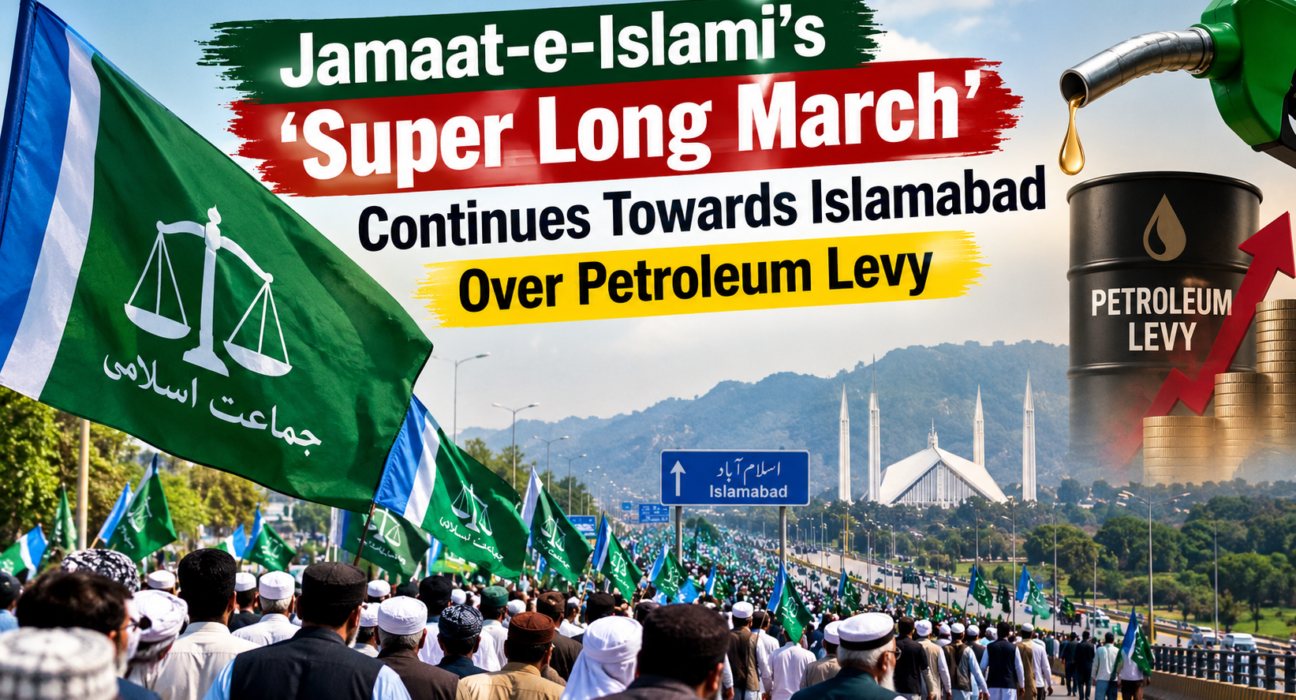
Pakistan is watching a massive political moment unfold right now. Jamaat-e-Islami (JI), one of the country’s oldest religio-political parties, has launched what it calls the “Super Long March.” Thousands of workers, families, and supporters are moving toward Islamabad from every corner of the country. Their demand is simple: scrap the petroleum levy completely.
If you’ve been following the news lately, you’ve probably seen headlines about trains packed with protestors, sealed roads in the capital, and tense talks between the government and JI leaders. This article breaks down everything happening, why it matters to you, and what could come next.
What Is the Super Long March All About?
The Super Long March is a nationwide protest movement led by JI chief Hafiz Naeem-ur-Rehman. It’s not a sudden decision. JI has been holding sit-ins and rallies across Pakistan for more than a month, pushing back against rising fuel prices. When talks with the government kept falling apart, the party decided it was time to bring the protest straight to the capital’s doorstep.
The march isn’t happening from just one city. Caravans are converging from Karachi, Peshawar, Quetta, Lahore, and smaller towns in between. Some groups are traveling by train, others by road, but they all share the same destination and the same goal: forcing the government to remove the petroleum levy for good.
Jamaat-e-Islami’s Super Long March Continues Towards Islamabad Over Petroleum Levy
This phrase has become one of the most searched topics in Pakistan this week, and for good reason. People want real-time updates on where the march stands, whether it’s peaceful, and how the government plans to respond. As of now, the march is very much active. Caravans from Karachi already departed on the Rahman Baba Express, while groups from Khyber Pakhtunkhwa set off from the historic Bab-e-Khyber monument. Multiple convoys are expected to meet in Multan and Lahore before making their final push toward Islamabad later this week.
What makes this different from past JI protests is the scale. This isn’t a single city sit-in anymore. It’s a coordinated, multi-province mobilization, and that’s exactly why it’s dominating news cycles across the country.
Why the Petroleum Levy Has Sparked Nationwide Anger
To understand why so many people are joining this march, you need to understand what the petroleum levy actually is. It’s a tax the government adds directly to petrol and diesel prices. Unlike other taxes, this one goes straight into federal revenue, and it’s become one of the government’s biggest income sources in recent years.
The problem is timing. Fuel prices were already climbing because of global tension, including conflict involving Iran and repeated attacks linked to the Houthis near Saudi Arabia. Add a heavy government levy on top of that, and everyday people end up paying much more just to fill their tanks or run their motorcycles.
How Much Are People Paying in Taxes?
Right now, the government charges roughly Rs114 per liter in taxes on petrol and around Rs100 per liter on diesel. For a country where a large chunk of the population relies on motorcycles and public transport, that’s a heavy burden. Transport costs go up, food prices follow, and household budgets get squeezed from every direction.
The Route: How the Long March Is Moving Across Pakistan
JI didn’t just wing this protest. They released a detailed schedule weeks in advance, which shows just how organized this movement really is.
Karachi to Multan by Train
The Karachi caravan left from Karachi Cantt Station on the Rahman Baba Express. Supporters were welcomed at stops including Hyderabad, Tando Adam, Nawabshah, and Rohri, with a large public gathering held in Sukkur. From there, the group switched to the Shalimar Express, heading toward Multan with a planned stop in Ghotki along the way.
Khyber Pakhtunkhwa Joins In
At the same time, another wave of protestors launched their journey from Bab-e-Khyber near Jamrud. Led by JI’s Khyber Pakhtunkhwa leadership, this group is moving through northern Punjab, aiming to link up with other caravans as they close in on Islamabad.
Eventually, all these separate marches are expected to merge, with the final convergence point being the capital itself, likely around September 23 or 24.
Who Is Leading This Movement?
Hafiz Naeem-ur-Rehman, the current JI Emir, is the face of this entire campaign. He’s been vocal at every stop, telling crowds that this isn’t about politics or personal gain. According to him, the movement exists purely to represent ordinary citizens struggling with inflation and rising living costs.
He’s also taken aim at other government policies during his speeches, including the country’s monetary policy and its agreements with independent power producers, commonly known as IPPs. Rehman has argued that a simple reduction in the interest rate could save the country as much money as the petroleum levy generates, questioning why the burden always falls on regular citizens instead.
Government’s Response and Ongoing Negotiations
The government hasn’t been silent through all of this. In fact, there have already been multiple rounds of talks between JI representatives and government officials.
Talks That Have Failed So Far
Despite several meetings, both sides have struggled to find common ground. The government’s main defense has been its commitments to the International Monetary Fund, arguing that removing the levy entirely could jeopardize the country’s financial agreements. JI hasn’t accepted that explanation, insisting that the government has other ways to cut costs without taxing fuel so heavily.
A Possible One-Year Suspension?
Interestingly, there are now reports suggesting the government might offer a compromise. One proposal on the table involves suspending the petroleum levy for a full year, along with a broader relief package aimed at easing public frustration. However, this offer still needs approval from JI’s internal technical committee before anything becomes official, so nothing is confirmed just yet.
Breaking Down the Petroleum Levy: A Quick Snapshot
Here’s a simple table to help you visualize exactly what’s being charged and why it’s causing so much frustration.
| Fuel Type | Levy Charged Per Liter | Impact on Common Buyer |
| Petrol | Rs114 | Higher transport and travel costs |
| Diesel | Rs100 | Increased cost of goods transport, indirectly raising food prices |
| Overall Fuel Basket | Varies with global oil prices | Combined effect worsens household inflation |
Impact on Common Citizens and the Economy
Let’s be honest, most people aren’t following this march because they care about politics. They’re following it because they’re tired of paying more every time they go to the pump. When fuel prices rise, everything else follows. Bus fares go up. Delivery costs go up. Even basic groceries become more expensive because transport companies pass their costs onto consumers.
JI has specifically criticized the government’s fuel relief scheme, saying its eligibility rules leave out a huge number of motorcycle users, who make up a large share of Pakistan’s daily commuters. Those who do qualify reportedly receive around Rs500 a week, an amount many say barely makes a dent in their monthly expenses.
Security Measures in Islamabad
As the march edges closer to the capital, authorities have taken serious security steps. Shipping containers have been placed around Islamabad’s Red Zone, the area that houses key government buildings, courts, and several foreign embassies. Police officials have been reviewing law-and-order plans to prevent the situation from escalating once protestors arrive.
This kind of heavy security response shows just how seriously the government is treating this protest. It’s not being dismissed as a minor demonstration. Officials clearly understand the potential size and energy behind this movement.
Public Reaction and Political Support
Public reaction has been mixed but largely sympathetic to the core demand, even among people who don’t usually support JI politically. Rising fuel costs affect everyone, regardless of political affiliation, and that’s part of why this movement has picked up so much traction.
At the same time, some critics argue that removing the levy entirely could create bigger financial problems down the road, especially with Pakistan’s ongoing commitments to international lenders. It’s a genuine trade-off, and both sides of the argument have valid points worth considering.
March Timeline at a Glance
Super Long March Schedule Overview
| Date | Location/Event |
| Sept 20 | Departure from Karachi and Bab-e-Khyber |
| Sept 21 | Arrival in Multan |
| Sept 22 | Movement toward Lahore via road |
| Sept 23–24 | Expected convergence in Islamabad |
What Happens Next?
Right now, everything depends on whether JI’s technical committee accepts the government’s proposed one-year suspension. If they do, the march could end peacefully with both sides claiming a partial win. If they reject it, JI has made it clear that the protest will grow bigger and louder, with Rehman even hinting that continued resistance from the government could turn this into a full-blown movement against it.
Either way, the coming days will be crucial. Islamabad is bracing for a large crowd, negotiations are still ongoing, and millions of Pakistanis are watching closely to see who blinks first.
The Super Long March isn’t just another political headline. It reflects a much bigger frustration people across Pakistan share about the cost of living. Whether you support JI or not, it’s hard to ignore the real pain rising fuel prices have caused for regular families.
As this situation develops, staying informed matters. Keep an eye on official updates as talks continue, because the outcome of this march could shape fuel pricing policy in Pakistan for a long time to come.
For more updates and in-depth coverage on Pakistan’s current affairs, visit Thrive Digital Word.