

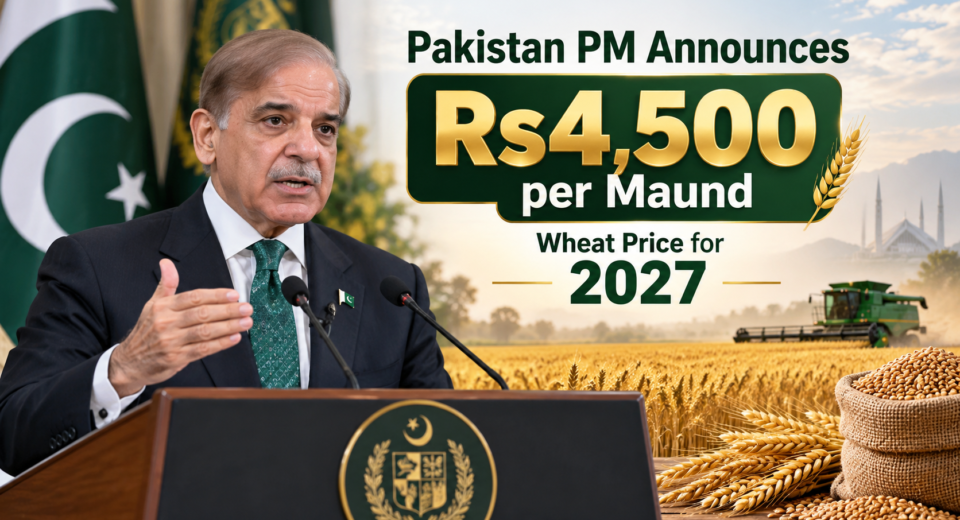
Pakistan PM Announces Rs4,500 Wheat Price Per Maund for 2027
Wheat is more than a crop in Pakistan. It is the flour in your roti, the income of millions of farming families, and a big piece of the country’s food security. So when the Prime Minister names a new wheat price, people pay attention, from the village farmer to the shopkeeper in the city. On Friday, October 23, 2026, Prime Minister Shehbaz Sharif set the illustrative price for wheat at Rs4,500 per maund for 2027, raising the procurement price set last year by Rs1,000. In this guide, I’ll walk you through what was announced, what it means, who gains, who worries, and what to watch next. I’ll keep it simple and honest, because this topic affects real kitchens and real fields. Pakistan PM Announces Rs4,500 Wheat Price Per Maund for 2027 Let’s start with the facts. The Prime Minister’s Office said the decision aims to support farmers and encourage more wheat sowing in the coming season. The Rs4,500 per maund price has so far been described only as a proposed or indicative price. That detail matters, and I’ll come back to it later. The Key Numbers at a Glance Here is the short version: That is a jump of roughly 29 percent in one year. For a crop that farmers sell by the maund, it is a big move. Who Was Involved in the Decision The announcement did not come out of nowhere. The statement said the proposal had been made with input from President Asif Ali Zardari and PML-N leader Nawaz Sharif, after consultations with the chief ministers of Punjab and Sindh. The Prime Minister also thanked Punjab Chief Minister Maryam Nawaz and Sindh Chief Minister Murad Ali Shah for their help. This is a good sign in one way. Punjab grows most of Pakistan’s wheat, and Sindh is also a major producer. When both provinces sit at the table, the final price has a better chance of working across the country. What a Maund Means and Why It Matters If you are new to farm markets, the word “maund” might sound old-fashioned. It is still the everyday unit that farmers, traders, and flour mills use across Pakistan. One Maund Equals 40 Kilograms A maund is 40 kg. So when you hear Rs4,500 per maund, think of it as Rs4,500 for a 40 kg bag of wheat. That works out to about Rs112 per kilogram at the farm gate. Why the Unit Is Still Used Pakistan officially uses the metric system, but grain markets run on habit and trust. Farmers talk in maunds, mandi traders quote in maunds, and government announcements follow the same style. Using the same unit keeps everyone on the same page, so nobody gets confused during a sale. How Rs4,500 Compares With Last Year Numbers become clearer when you put them side by side. Here is a simple comparison. Table 1: Wheat Price Comparison Item Price per Maund (40 kg) 2025-26 procurement price Rs3,500 2027 indicative price Rs4,500 Increase Rs1,000 Farmer group demand Rs5,000 Gap between offer and demand Rs500 A Big Step Up Last October, the government approved a wheat policy under which it would procure wheat from farmers at Rs3,500 per maund. Many growers felt that rate did not cover their costs. A Kisan Ittehad leader even said the cost of growing wheat had climbed to between Rs4,000 and Rs4,500 per maund. So the new figure at least matches the cost level farmers were talking about. Still Below What Farmers Asked For Farmers wanted more. Last month, the Pakistan Kissan Ittehad demanded a Rs5,000 per 40 kg support price for wheat, warning that farmers may not sow wheat if the government delays announcing crop policies. The gap is Rs500, or about 10 percent. Not huge, but enough to start a debate. Why the Government Raised the Price Governments don’t raise prices by Rs1,000 for fun. Several pressures pushed this decision. Rising Cost of Growing Wheat Fertilizer, diesel, electricity for tube wells, seed, and labor have all become more expensive. The Prime Minister said the increase was meant to support growers facing higher production costs, rising petroleum prices, and inflation. If the sale price stays flat while costs rise, a farmer’s profit shrinks fast. At some point, growing wheat stops making sense, and farmers switch to other crops. Too Much Dependence on Imports The government also pointed to imports. Pakistan has had to import wheat over the past two years, as the prime minister noted. Importing wheat costs foreign exchange, and it leaves the country open to global price swings. If farmers grow more at home, Pakistan relies less on other countries to feed its people. Encouraging More Sowing The simplest goal is to get more wheat in the ground. A good price announced early gives farmers confidence before sowing time. When growers feel safe, they plant more acres, and bigger harvests help keep flour prices calmer later. What Farmers Are Saying Farmers are not one voice, but a few themes keep coming up. Relief Mixed With Caution Many growers will welcome a Rs1,000 jump. After a few hard seasons, it feels like someone finally listened. Still, farmers have heard big promises before. Their main worry is simple: will the price they see on paper be the price they get in the mandi. The Rs5,000 Demand Kissan Ittehad had asked for Rs5,000. Their warning was blunt: if policies come late or prices stay low, farmers may skip wheat. The new announcement lands between last year’s price and that demand, so it may calm some tension without ending the talk. Expect farmer groups to keep pushing for a better deal while they plan their sowing. What an Indicative Price Really Means This is the part many headlines skip, so let’s slow down. Indicative Is Not the Same as Guaranteed The word “indicative” or “illustrative” means the figure points the way, but it may not be a binding rule. The announcement described Rs4,500 per maund as an illustrative price and did not clarify whether it