
Reporting current as of October 13–14, 2026. Details are still developing, and I note below where sources disagree.
Early on Tuesday morning, October 13, 2026, a passenger train left its tracks near Multan in Pakistan’s Punjab province. Families who were asleep in their seats woke up to a violent jolt, screaming, and twisted metal. Some reports say four people died and others say five or six, and the number of injured is still being updated. I’ll go through what we know, what we don’t know yet, and why this keeps happening on Pakistan’s rail network.
What Happened: Multan Train Derailment: Five Killed in Railway Accident Explained
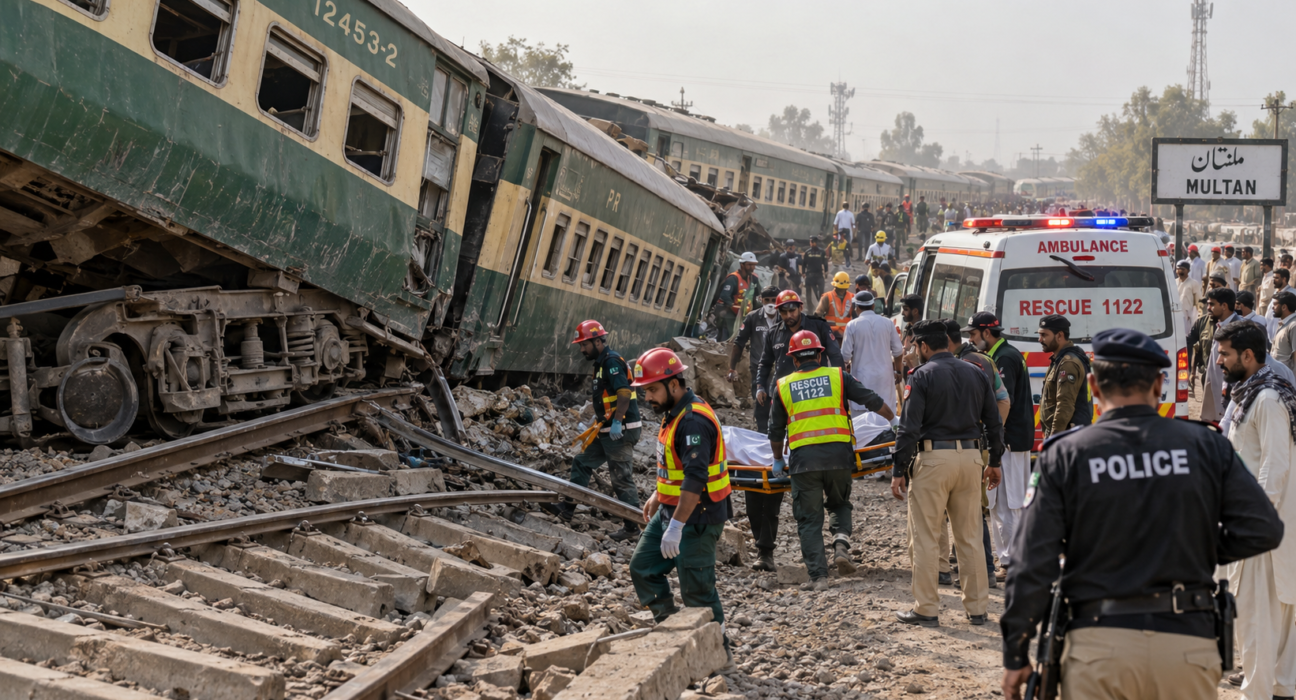
The Rehman Baba Express was traveling from Karachi to Peshawar when it derailed in the early morning hours. Reports place the accident near Sher Shah railway station, in the Multan district of Punjab. Local media said it happened at around 5:15 am, and Punjab’s emergency service said it received the call at 5:21 am.
Several coaches left the track and overturned. According to one report, all 14 coaches of the train derailed. Passengers were trapped inside the damaged carriages, and some had to be pulled out by rescue workers.
Here is the part that confuses many readers. Early reports said four people had died. Later reports raised the number to five, and one outlet reported six. This is normal in the first hours of a disaster, because rescuers are still working and hospitals are still counting. I use “five killed” as the headline figure because several reports settled on it, but please treat the toll as provisional.
The Train and Its Route
The Rehman Baba Express is a long-distance passenger service that links Karachi in the south with Peshawar in the northwest. It passes through many major cities, and Multan sits near the middle of that journey. A long route like this means the train usually carries a large crowd. One report said more than 500 passengers were on board.
The Moment of the Derailment
The train’s driver, Rizwan Abbas, told local media that the train was moving at about 100 kilometers per hour. He said he felt a sudden jolt as the train passed through the Sher Shah station area. He then applied the emergency brakes to stop the train.
Think about what that means for a moment. A heavy passenger train at that speed carries enormous force. When the wheels lose their grip on the rails, the coaches can twist, tip, and slam into each other in seconds.
Rescue Operation and Emergency Response
Rescue teams reached the scene quickly. Farooq Ahmed, a spokesman for Punjab’s emergency services, said 11 ambulances and 30 rescue workers were sent to the site. Local people also rushed to help, which is common in Pakistan. Neighbors, farmers, and passersby often reach a crash site before the official teams do.
Pulling Passengers From the Wreckage
Trained rescuers used cutting tools to open crushed doors and bent windows. Injured passengers were carried out on stretchers and loaded into ambulances. A journalist from AFP saw the body of one victim still inside a carriage, which shows how hard the early hours were.
Rescue work after a derailment is slow and risky. Rescuers must avoid shifting the wreckage while they search for people still alive. In the dark, or just after dawn, this is even harder.
Hospitals Take in the Injured
The injured were taken to Nishtar Hospital in Multan, one of the largest hospitals in the region. Medical teams began treating people right away. Reports gave different injury figures, ranging from about 17 in the earliest reports to more than 40 later in the day. Some outlets said around 30, and one rescue worker put the figure at 25 early on.
These numbers differ because they were reported at different times. As more people were brought in and counted, the figure grew. Pakistan Railways’ chief executive, Muhammad Hafeezullah, was quoted as saying more than 40 people were injured.
Casualty Figures and Why the Reports Differ
Many readers search for one clear number and get frustrated when each news site gives a different one. The table below shows how the reports varied on the same day.
| Source Type | Reported Deaths | Reported Injuries |
| Early AFP report | 4 | 17 (rescue worker said 25) |
| Railways Minister, citing regional director | 4 | Not stated |
| Geo News (via regional outlet) | 6 | 30 |
| Pakistan Railways CEO | Not stated | 40+ |
| Later summary reports | 5 | 41 |
A death toll can change for several reasons. A badly injured person may die in hospital hours later. Teams may also find another victim trapped deep inside the wreckage. Sometimes an early count is simply wrong because of the chaos at the scene.
How to Read Early Reports Wisely
I suggest you follow a simple rule. Trust official statements from rail authorities and hospitals first. Treat social media videos with caution, because many are old clips from earlier accidents. Check the date and the place before you share anything.
Timeline of the Accident
A clear timeline helps you follow the order of events. The times below come from the reports I found, and they may be adjusted as officials release more details.
Timeline of Key Events on October 13, 2026
| Time (Approx.) | Event |
| Around 5:15 am | The Rehman Baba Express derails near Sher Shah, Multan |
| 5:21 am | Punjab emergency services receive the call |
| Early morning | Ambulances and rescue workers reach the site |
| Morning | Injured passengers reach Nishtar Hospital |
| Later in the day | The President and Prime Minister issue statements |
| Later in the day | Railways Minister orders an investigation |
Official Reaction and Government Response
Top leaders reacted within hours. President Asif Ali Zardari expressed his concern and offered condolences to the families of the dead. He prayed for the quick recovery of the injured. He also asked officials to give affected passengers every possible facility and called for a transparent investigation into the cause.
Prime Minister Shehbaz Sharif took notice of the accident as well. His office said he told the relevant authorities to speed up rescue work and make sure the injured received medical help. You can read the official statements on the Radio Pakistan report about the Rehman Baba Express derailment.
Railways Minister Orders an Inquiry
Railways Minister Hanif Abbasi confirmed the deaths and directed officials to investigate. He also visited the scene, according to one report. An inquiry is the standard step after every serious accident, but many Pakistanis want more than a report. They want to see real changes afterward.
What Caused the Derailment So Far
Let me be very clear here. The official cause has not been confirmed. Anyone who tells you they know the exact reason right now is guessing.
That said, a few early pieces of information are worth knowing.
A Possible Coach Fault
One report says an initial inquiry by Pakistan Railways pointed toward a fault in a passenger coach. This is only an early finding. Final reports often take weeks, and sometimes the first theory changes after experts study the wreckage and the track.
A Passenger’s Claim About Repairs
One report said a passenger claimed that nuts and bolts on the train’s ninth coach had been repaired at Rohri before the accident. Nobody has proven this claim. I mention it only because it may be something investigators check, and you should not treat it as a fact.
Track, Signals, and Human Factors
In rail accidents, investigators usually look at four areas. These are the condition of the rails, the state of the train’s wheels and coaches, the signal system, and the actions of the crew. Each of these can play a role. A weak weld in a rail, a cracked wheel, a loose part, or a wrong signal can all lead to a crash.
The driver’s account suggests the train was running at a normal speed, since he gave a figure of 100 kilometers per hour. Whether that speed was safe for that exact stretch of track is something the inquiry will have to decide.
Pakistan’s Railway System Under Pressure
To understand why this accident hurts so much, you need the bigger picture. Pakistan’s railway network is huge. It covers nearly 7,500 kilometers of track and carries more than 80 million passengers every year, according to AFP’s background reporting.
Much of the system is very old. Some tracks, junctions, and bridges date back more than 150 years, from the colonial era. Modernization work is underway as part of the China-Pakistan Economic Corridor, but it takes years and a lot of money, and many old sections remain in use in the meantime. You can see the wider context in the ANI report on the Multan derailment.
A Pattern of Recent Incidents
Local reports say Pakistan has seen several derailments over the past year. This raises worries about weak maintenance of both the trains and the infrastructure. Because of this, people are now asking whether each accident is an isolated event or a sign of a deeper problem.
Why Railways Matter So Much
For millions of families, the train is the only affordable way to travel long distances. Bus tickets cost more, and flights are out of reach for most people. That means when the railway is unsafe, ordinary working families pay the highest price.
Looking Back: Earlier Train Accidents in Pakistan
This is not the first time the Multan region has seen a deadly rail accident. History shows us a sad pattern.
The 2016 Multan Collision
In September 2016, a passenger train hit the back of a freight train near the town of Sher Khan in the Multan area. News reports at the time said around five to six people were killed and more than 100 were injured. Investigators early on pointed to the passenger train driver, who reportedly missed a red signal.
The 2021 Ghotki Crash
In June 2021, one of the worst recent accidents took place in Sindh. An express train derailed onto the opposite track, and a second express train hit it about a minute later. At least 65 people died and about 150 were hurt, according to reference sources. The derailment was linked to a failed welding joint.
The Worst Disaster on Record
In 1990, a packed passenger train plowed into a standing freight train in southern Pakistan and killed 210 people. It remains the deadliest rail disaster in the country’s history. These events show how many lives are at stake when safety fails.
Impact on Passengers and Train Services
An accident like this affects far more people than those on the train. Rail traffic on the Karachi–Peshawar route was disrupted while crews cleared the wreckage and checked the tracks. Travelers using services through Multan were advised to check directly with Pakistan Railways for updated times and alternative plans.
Delays and Changed Travel Plans
If you had a ticket for this route, expect delays. Trains behind the derailed one may be held, rerouted, or canceled. Repair crews first need to lift the damaged coaches, then inspect the rails, and then rebuild any damaged track.
Families Waiting for News
Think also about the families of the passengers. In the first hours, phone lines get busy and information is scarce. Many relatives rushed to Nishtar Hospital to search for loved ones. For these families, the waiting is often the hardest part.
Safety Lessons and What Needs to Change
Every accident leaves lessons, but lessons only matter if someone acts on them. Based on the patterns seen in past reports, these are the areas that experts and passengers usually point to.
Better Track Inspection
Regular and careful track checks can find cracks, weak joints, and worn rails before they cause harm. Modern tools such as ultrasonic testing can detect hidden flaws inside metal. This costs money, but it costs far less than lives.
Stronger Checks on Coaches and Wheels
Before a long journey, each coach should go through a full mechanical check. Wheels, axles, couplings, and bolts all need attention. If a repair is done on the way, as the passenger claimed, it should be documented and double-checked.
Modern Signals and Train Control
Newer signaling systems can warn drivers about danger and even slow a train automatically. Many countries use these systems to cut the risk of human error. Pakistan is working on upgrades, but progress must speed up.
Honest and Public Inquiry Reports
Finally, the results of every investigation should be shared openly. When people can read the findings, they can hold officials responsible. A report that stays hidden in a drawer helps no one.
Tips for Train Travelers in Pakistan
You cannot control the condition of the railway, but you can take a few smart steps to protect yourself and your family.
Before You Travel
Check the latest train status with Pakistan Railways before you leave home. Keep your phone charged and save the contact numbers of a family member. Carry a small bag with water, basic first aid supplies, and your ID.
During the Journey
Know where the exits are in your coach. Keep heavy bags on the floor or in a secure place, because loose luggage can become dangerous in a sudden stop. If you travel with children, keep them close and seated.
If an Accident Happens
Stay as calm as you can. Protect your head, and wait for the movement to stop before you try to leave. Help others only if you can do so safely, and wait for rescuers if someone is badly hurt, because moving an injured person the wrong way can make things worse.
How This Story May Develop
News stories like this continue for days and weeks. Here are the developments to watch for, based on how past accidents unfolded.
The Final Death and Injury Count
Hospitals will confirm their numbers, and the official toll may rise or settle. Keep in mind that the final figure may differ from the early reports I described above.
The Inquiry Findings
The investigation committee will study the wreckage, the rails, and the train’s records. Its findings will tell us whether the cause was a coach fault, a track defect, or something else. Until then, I recommend avoiding rumors.
Possible Changes in Policy
After major accidents, governments sometimes announce new safety steps, compensation for victims, or staff changes. Whether that happens here is something only time will show. Readers and passengers will be watching closely.
The Rehman Baba Express derailment near Multan is another painful reminder of how fragile railway safety can be. At least five people lost their lives, according to several reports, and dozens more were hurt. Behind every number is a family that is grieving or waiting by a hospital bed.
What we know so far is limited. The train was traveling from Karachi to Peshawar, it left the tracks near Sher Shah in the early morning, and rescuers rushed the injured to Nishtar Hospital. Leaders from the President to the Railways Minister promised action and an inquiry. The real cause is still unknown, and early theories, such as a coach fault, need proper confirmation.
What matters most now is that the investigation is honest, the findings are made public, and real changes follow. Pakistan’s railway carries tens of millions of people every year, and they deserve a safe journey. I’ll leave you with this thought: until safety becomes the first priority, every ticket sold carries a risk that no traveler should have to accept.