

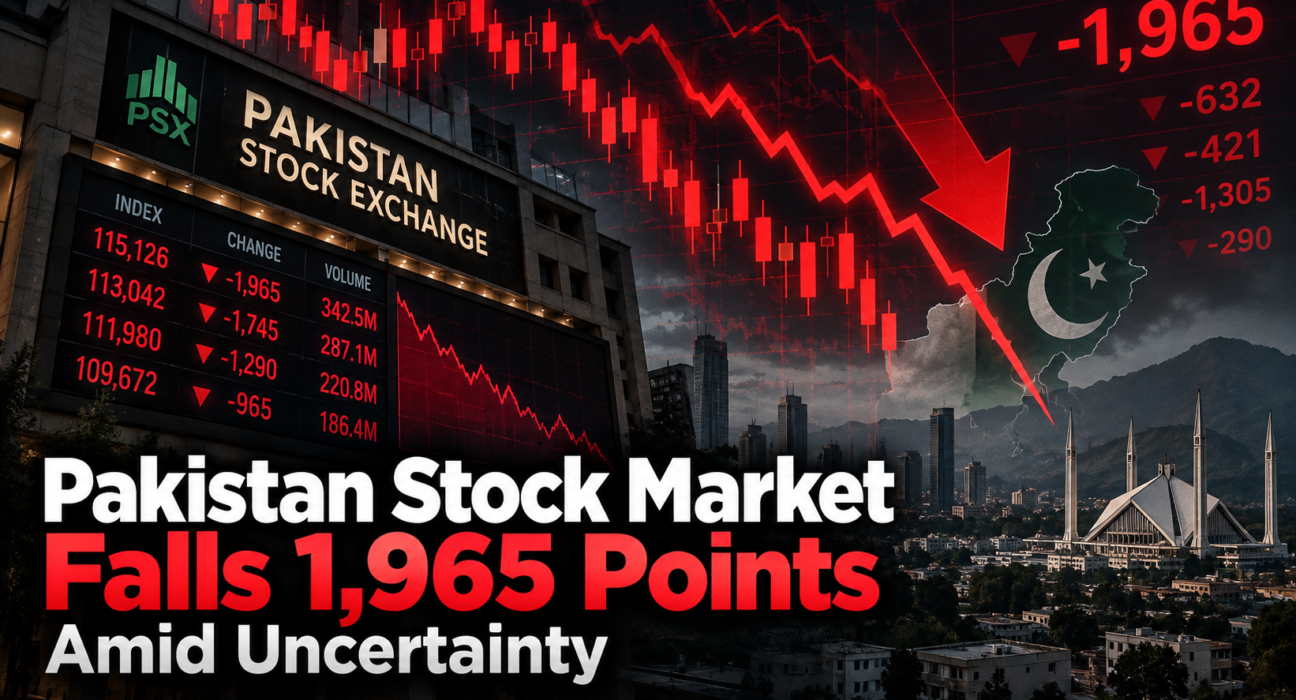
If you checked your trading app and felt your stomach drop, you’re not alone. The Pakistan Stock Exchange (PSX) took another hit, with the KSE-100 index sliding 1,965 points as uncertainty weighed on investors. For anyone with money in the market, a drop that size feels scary. But panic rarely helps. Let’s break down what is going on, why it matters, and what smart investors usually do when the market turns red.
What Happened at the Pakistan Stock Exchange?
The KSE-100 is the main benchmark of the PSX. It tracks 100 of the biggest and most active companies, so it works like a thermometer for the whole market. When it falls by almost 2,000 points in a single move, it tells us that sellers outnumbered buyers by a wide margin.
These drops usually come in waves. A few big stocks fall first, then nervous investors rush to sell, and the slide speeds up. Sometimes the index recovers a bit before the closing bell. Other times it stays near the day’s low.
This fall is also not a one-off. The market has been shaky for weeks. On 5 October 2026, the KSE-100 dropped 2,288 points, or 1.36 percent, and closed at 165,867.32. You can read the full report. A few days later, on 8 October, the index fell another 1,138.50 points to settle at 167,441.91. So the latest decline adds to a pattern of nervous trading.
A Look at Recent Market Sessions
Numbers tell the story better than words. Here is a quick snapshot of some recent big down days on the PSX.
| Date | Points Lost | Closing Level |
| 14 September 2026 | 2,541 | 167,970.66 |
| 5 October 2026 | 2,288 | 165,867.32 |
| 8 October 2026 | 1,138 | 167,441.91 |
Notice something interesting? The index keeps hovering in the 165,000 to 168,000 zone. It falls, bounces, and falls again. That tells us investors are unsure which way to go, and uncertainty is exactly what markets hate the most.
Why Is Uncertainty Hurting the Market?
Stock markets run on confidence. When people feel sure about the future, they buy. When they feel unsure, they sell or sit on the sidelines. Right now, several worries are mixing together.
Global Oil and Geopolitical Tension
Pakistan imports a lot of oil, so energy prices matter to us. In recent weeks, news reports have pointed to supply fears in the Middle East and strikes affecting oil routes. When global oil prices jump, it can push up our import bill, strain the rupee, and raise costs for businesses. Investors dislike all three.
Economic and Policy Questions
Pakistan’s economy is still in a careful balancing phase. Questions about taxes, energy prices, and the IMF program keep investors alert. Even rumors can move prices. If traders think a new tax or a policy shift is coming, many prefer to book profits first and ask questions later.
Profit-Taking After a Big Run
Over the past couple of years, the KSE-100 has climbed a long way. To put it in perspective, back in June 2022 the index closed near 41,051 points. Today it trades above 165,000. After a climb like that, many investors simply want to lock in gains. When enough of them sell on the same day, the index drops fast.
Leverage and Margin Pressure
Many traders borrow money to buy shares. When prices fall, brokers ask them to add more cash or sell their holdings. That forced selling can push the market down even further. It is one reason a normal dip can turn into a sharp fall.
Which Sectors Usually Feel the Pressure?
When the KSE-100 loses nearly 2,000 points, it is usually because a handful of heavy stocks fell together. In Pakistan, the index leans on a few big sectors.
- Oil and gas: Companies like OGDC and PPL carry a lot of weight in the index.
- Banks: They are among the largest names on the board, so their moves matter.
- Fertilizer and cement: These stocks are popular with investors, so heavy selling here moves the index.
- Energy and refineries: These are sensitive to oil price news and government decisions.
Because a few big companies carry so much weight, a sharp fall in just those stocks can drag the whole index down, even if some smaller shares hold steady. On past big down days, the number of losing stocks has often been far larger than the gainers. On 2 September 2026, for example, 356 companies closed lower while only 113 ended higher. That shows how broad a selloff can get.
How Are Investors Reacting?
Reactions vary a lot. Let’s look at the three common types of investors.
The Panic Sellers
These investors see red numbers and rush to exit. Sadly, this is how many people lock in losses right at the bottom. Selling out of fear often feels safe in the moment, but it can hurt later if the market bounces back.
The Patient Holders
Long-term investors usually stay calm. They know markets go up and down. They look at company profits, dividends, and business strength rather than one day’s movement.
The Bargain Hunters
Some see a fall as a sale. If a strong company’s share price drops for market reasons rather than business reasons, they may buy slowly. But smart bargain hunters don’t rush in with all their money at once. They buy in small steps.
Is This a Crash or Just a Correction?
This is the big question. Let’s keep it simple.
A correction is a normal pullback after a strong rise. It is healthy and usually short. A crash is a deep, fast collapse that often comes with a real economic crisis.
Based on the data we have, the recent moves look more like a rough, choppy correction than a collapse. The index is falling by around one percent on bad days, not ten. It also keeps finding support in the same general range. That said, nobody can predict the market perfectly. If bad news piles up, such as sharper oil prices, a weaker rupee, or a policy surprise, the pressure could grow. So watch the news, but don’t assume the worst.
Smart Tips for Investors During a Falling Market
Here are some practical steps that experienced investors often follow. These are general ideas, not personal financial advice.
1. Don’t Panic
Take a breath before you press the sell button. Ask yourself: has anything changed about the company I own, or is it just market mood?
2. Review Your Goals
Are you investing for five years or five days? Your time frame decides how much a short fall should matter. Long-term money can usually ride out bumps. Short-term money needs more care.
3. Spread Your Risk
Putting all your savings into one stock or one sector is risky. Diversification means holding different types of assets so one bad day doesn’t hurt too much.
4. Avoid Borrowed Money
Trading with borrowed funds can turn a small dip into a big loss. If you can’t afford to lose it, don’t gamble with it.
5. Buy in Small Steps
Instead of investing everything at once, try investing a fixed amount every month. This habit smooths out your buying price over time.
6. Use Trusted Sources
Rumors spread fast on social media during a fall. Stick to official data and reliable news. You can check live market information and official announcements directly .
What to Watch in the Coming Days
If you want to follow where the market may go next, keep an eye on these things.
- Oil prices: Big jumps usually hurt sentiment in Pakistan.
- The rupee: A stable currency calms investors. A falling one does the opposite.
- Government and IMF news: Any clear signal about taxes, budgets, or funding can move the market.
- Company results: Strong earnings can lift individual stocks even in a weak market.
- Trading volumes: If volumes rise during a fall, selling pressure may be strong. If volumes shrink, the move may be running out of steam.
What Does This Mean for Everyday Pakistanis?
You may think the stock market only matters to traders. But it reflects the mood of the economy. A shaky market can slow down new investment, affect company plans, and shake public confidence. On the flip side, a steady market can support jobs and growth.
Many more Pakistanis have also started investing in recent years, so market swings now touch more households than before. That makes financial awareness more important than ever. Learning the basics, such as what an index is, why prices move, and how to manage risk, can protect your savings.
A 1,965-point fall is a big number, and it’s natural to feel worried. But the stock market has always moved in cycles of fear and confidence. The best defense is knowledge, patience, and a clear plan. Keep your money spread out, avoid borrowing to trade, follow trusted sources, and don’t let one red day make your decisions for you.