

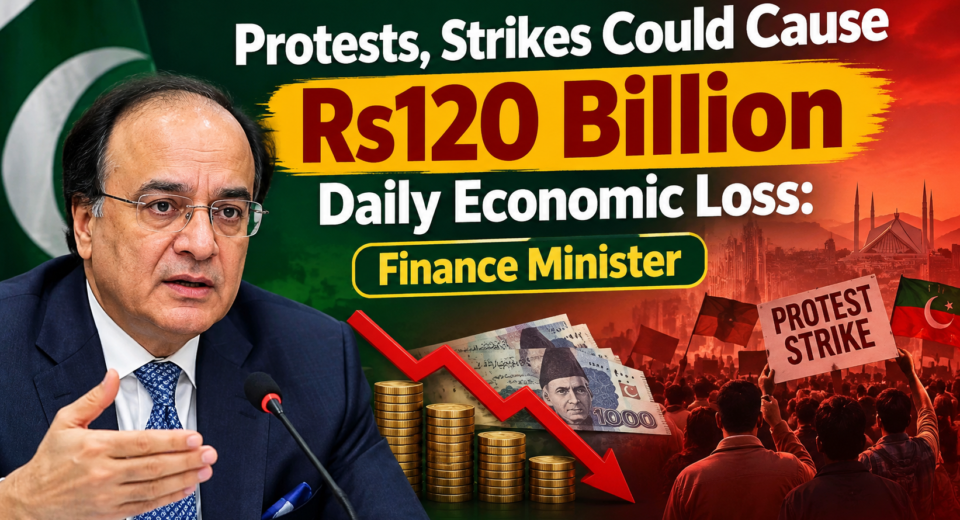
Protests, Strikes Could Cause Rs120 Billion Daily Economic Loss: Finance Minister
Imagine losing Rs120 billion every single day. That is the number Pakistan’s Finance Minister has put in front of the public. Muhammad Aurangzeb warned on Sunday that long marches, sit-ins and strikes could cost the economy around Rs120 billion a day. He said this while the country is trying to move from simple stability toward real growth. In this article, I’ll walk you through what he said, where the number comes from, and who might feel the pain first. I’ll keep it simple and skip the jargon. What Did the Finance Minister Say? The message was recorded and shown on TV. It came ahead of the PTI’s planned protest march to Islamabad on September 27, which the government has vowed to stop. Jamaat-e-Islami also began its own march toward Islamabad the same day, to push the government to end the fuel levy. Aurangzeb called the possible damage “self-inflicted pain.” He said calls for marches, strikes and sit-ins were hard to understand, because economic stability had been won through difficult decisions. He also said keeping the economy growing is a shared job, and he urged everyone to settle their issues through dialogue. Where Does the Rs120 Billion Figure Come From? A big number like this raises a fair question: who did the math? The minister said the Planning Commission studied earlier protests and the current situation, and estimated a loss of Rs120 billion per day. The estimate is split across three areas. Here is the breakdown as reported: Table 1: Estimated Daily Loss by Area Area Estimated Daily Loss Services sector Around Rs86 billion Industrial sector About Rs25 billion Government revenue Roughly Rs17 billion Overall daily impact Around Rs120 billion Did you spot something odd? If you add the three parts, you get Rs128 billion, not Rs120 billion. The reports I read don’t explain the gap. One possible reason is that lost government revenue overlaps with the sector losses. When business slows, tax collection falls too. Either way, treat the figure as a rough estimate, not an exact bill. Why the Services Sector Takes the Biggest Hit Services carry the largest share of the loss, and that makes sense. The minister said the services sector would bear the biggest impact, including financial services, communications, retail, transport, wholesale and hospitality. Think about how these businesses work. A shop needs customers to walk in. A truck needs open roads. A hotel needs guests who can reach it. A bank branch needs staff who can get to work. When marches and sit-ins block roads or push people to stay home, all of this slows down at once. Nobody sends a bill for that lost work. It just disappears. What Happens to Exports and the IT Sector? Exports are another worry. The minister shared several numbers to show what is at stake: Table 2: Export and IT Numbers Mentioned by the Minister Indicator What Was Reported Average daily goods exports Nearly $90 million Worst-case export drop during strikes Up to half of daily exports IT exports and services projection Expected to rise from $4.6 billion to $5.5 billion IT exports in the first two months of the fiscal year Around $811 million IT damage in past worst-case situations Up to 80%, mainly linked to internet disruption The IT numbers deserve extra attention. The minister cautioned that disruptions to internet connectivity could be extremely damaging to IT exports. Software houses, freelancers, and call centers can’t work without a stable connection. If the internet slows down or goes off, the money stops flowing that same day. Foreign clients also notice, and they may take their projects elsewhere. The Economy Was Just Starting to Recover The timing matters to the government. The minister pointed to several good signs. The State Bank of Pakistan’s reserves reached $21.4 billion, while total liquid foreign exchange reserves were around $26.8 billion in the week ended September 11. He also said the country was recording a current account surplus, and remittances kept growing. At the same time, the outside world is not making things easy. Developments in the Middle East are pushing up freight and insurance costs and disrupting supply chains. Higher oil prices add more pressure. So the government’s message is simple. The economy is finally getting steadier, and internal disruption could undo that progress just when the outside world is already making trade harder. Who Is Protesting, and Why? To be fair to everyone, let’s look at the other side. The groups planning marches are not all asking for the same thing. Three groups announced long marches in Islamabad. Jamaat-e-Islami wants the petroleum development levy removed, Kissan Ittehad wants relief for farmers, and the PTI is calling for the release of its founder, Imran Khan. The PTI also says it wants to rally people for the supremacy of the Constitution. These are very different issues. Fuel costs and farm relief touch daily life directly. The PTI’s demands are political. It’s also worth remembering that the Rs120 billion estimate comes from the government’s own planning team. Not everyone will accept it, and reasonable people can disagree about how big the real cost would be. Still, most people agree that long shutdowns hurt business in some way. The real debate is about how to raise demands without paying too high a price. Who Really Pays the Price? Big numbers can feel far away, so let’s bring this home. The minister warned that losses from sit-ins and protests would eventually hit ordinary people, especially the poor. He said daily-wage workers would bear the immediate effects, and small retailers and businesses would also struggle. Picture a rickshaw driver or a street vendor. If roads are blocked for three days, they don’t get paid for three days. They can’t send a bill to anyone. Rent, school fees, and food costs don’t pause. For families living day to day, a shutdown is not a headline. It’s an empty dinner table. Small shopkeepers face a similar problem. They may lose sales when markets close, and perishable stock