
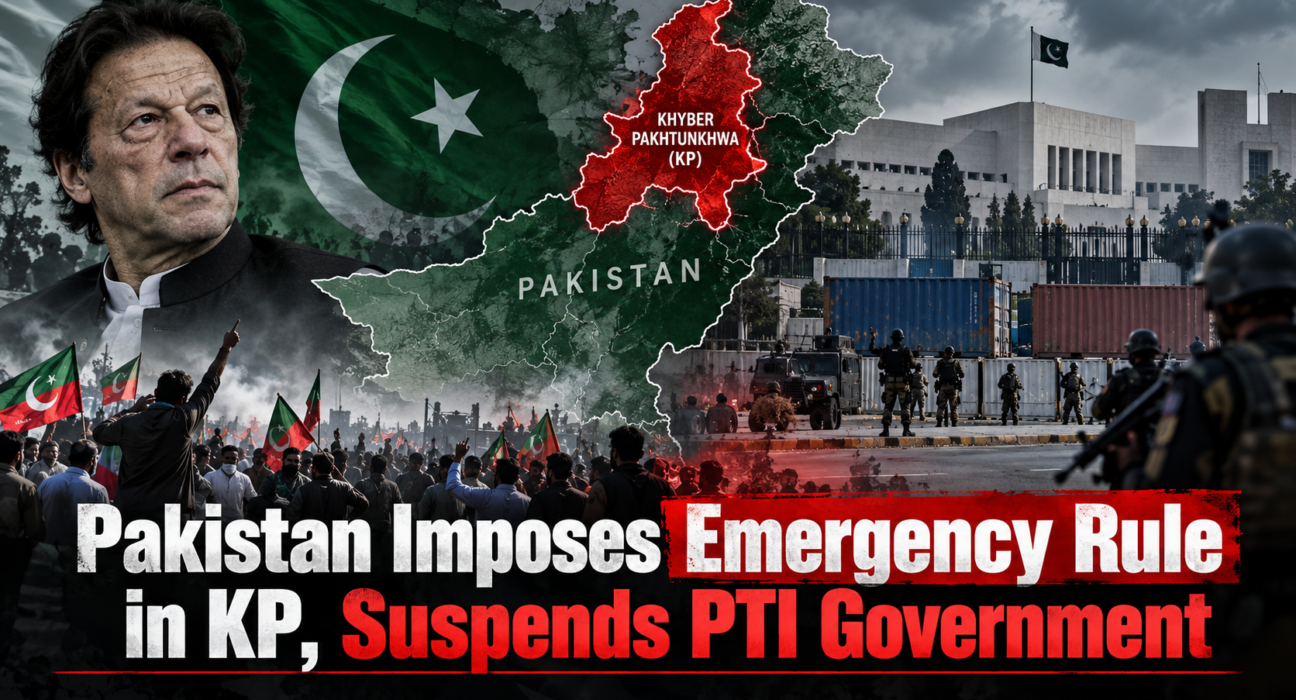
Big political news has hit Pakistan, and it is spreading fast. On Sunday, the President imposed an emergency and governor’s rule in Khyber Pakhtunkhwa (KP), suspending the provincial government led by Imran Khan’s PTI. The decision has stirred debate across the country and beyond.
In this article, I break the story down in plain words. I explain what happened, why the federal government says it acted, how PTI is responding, and what it may mean for people living in KP. Facts are still coming in, so I stick to what trusted news outlets have reported so far.
Pakistan Imposes Emergency Rule in KP, Suspends PTI Government: The Quick Story
Here is the short version. President Asif Ali Zardari declared a state of emergency in Khyber Pakhtunkhwa and suspended the provincial government led by PTI, the party of jailed former Prime Minister Imran Khan. The move came as tensions between the federal government in Islamabad and PTI were already very high.
The timing matters a lot. It came days before PTI supporters were set to march on Islamabad to demand Khan’s release. So the story is about more than law and order. It is also about power, politics, and street protest.
You can read a detailed news report on the suspension at Al Jazeera, which covered the story as it broke.
Key Facts at a Glance
- The emergency covers Khyber Pakhtunkhwa, a province that borders Afghanistan.
- The elected PTI-led provincial government has been suspended.
- Executive power now moves to the governor.
- The federal government blames weak action against militancy.
- PTI says the move is political and undemocratic.
What Emergency Rule and Governor’s Rule Actually Mean
Many readers hear these terms and feel lost, so let me keep it simple. In Pakistan, provinces are run by an elected chief minister and a cabinet. The governor is a federal appointee, and the role is mostly ceremonial. Under governor’s rule, this changes.
How Power Shifts During Emergency Rule
Executive authority passes to the governor, who acts for the federal government. In everyday words, the elected team in Peshawar steps aside, and the federal system steers the province instead. The provincial cabinet cannot make key decisions while the order stays in force.
What the Constitution Says
Pakistan’s constitution allows federal authorities to take over some or all functions of a provincial government during an emergency. So the tool exists in law. The real argument is whether it was needed here, and whether it was used fairly.
How Long Will It Last
Reports say the emergency rule is meant to run for an initial six months. Such orders can often be reviewed or changed, so the timeline may shift. Watch for official updates, because this part of the story can move quickly.
Timeline of Events: How We Got Here
Big decisions rarely come out of nowhere. This one followed months of friction. Reports say the dispute built up over counterterrorism operations, security policy, and engagement with Afghanistan.
Table 1: Simple Timeline of the KP Emergency
| Stage | What Happened |
| Months before | Friction grew between Islamabad and the PTI-led KP government over security policy |
| Before the order | The federal Cabinet accused the province of “deliberate disengagement from the fight against terrorism” and recommended emergency rule |
| Sunday | The President declared the emergency and suspended the provincial government |
| Hours later | Reports said the chief minister and a PTI provincial leader were taken into custody |
| Coming days | PTI supporters plan a march on Islamabad |
This timeline will keep growing. I recommend checking live news before you share any detail as final.
Why the Federal Government Says It Acted
Islamabad has given its reasons. The language is strong, so I want to explain it carefully and fairly. These are claims by the federal side, and PTI rejects them.
The Counterterrorism Argument
The federal government cited the provincial administration’s alleged failure to tackle Islamist militancy in the province. KP has faced serious violence for years because of its location and history. Federal leaders say a stronger and more united response is needed.
The Law and Order Claim
Islamabad says law and order has worsened in the province and that the provincial government failed to act against terrorism. The government also pointed to talks that did not work out. In its view, the elected team in Peshawar was not playing its part.
The Information Minister’s Statement
Information Minister Attaullah Tarar defended the move and accused the PTI-led provincial government of maintaining links with terrorist groups. That is a very serious charge. It is important to remember that PTI denies it. Both PTI and Afghanistan’s Taliban government have rejected the federal accusations about sympathizing with or sheltering militants linked to the TTP.
Army Support for Civil Authorities
The federal government also authorised the deployment of Pakistan Army troops and assets in KP to assist civilian authorities. The government presents this as part of its security response. Critics, however, worry about the growing role of security forces in politics.
How PTI Is Responding
PTI did not accept the decision quietly. The party calls it a political move, not a security one. PTI says the step is political.
The Mandate Argument
PTI leaders say the party won a real public mandate. One PTI voice claimed the KP government was the only administration with a genuine popular mandate after the February 2024 parliamentary elections, which PTI alleges were rigged. That is PTI’s view, and it is part of why the emergency feels so heated.
The “Undemocratic” Label
PTI has called the measure undemocratic. The party argues that voters chose its team, so a federal order should not remove it. For many supporters, this feels personal, and that feeling is driving the plan to protest.
The Reported Detentions: Sohail Afridi and Others
One of the most talked-about parts of the story is the reported arrest of the chief minister. Soon after the emergency was announced, reports said Chief Minister Sohail Afridi and PTI provincial president Junaid Akbar were taken into custody.
The KP Information Minister, Shafi Jan, claimed the chief minister had been taken into custody. Because details come from different sides, I treat this as a “reported” matter. Please wait for official confirmation before you repeat it as settled fact.
For a second trusted report with more background, see Business Standard’s coverage.
The Planned March on Islamabad
The emergency did not happen in a quiet week. The party is preparing to march on Islamabad to demand Khan’s release. This makes the next few days very sensitive.
Security Around the Capital
The announcement came amid heightened security in KP and Islamabad, with police detaining several PTI supporters overnight and deploying extra forces to prevent unrest. Expect roadblocks, checkpoints, and heavy police presence in key areas. If you live or travel there, plan your routes with extra time.
Why the March Matters
A large march can put real pressure on any government. It also carries risk, because crowds, tension, and strong emotions can mix badly. I hope all sides stay calm and avoid violence.
Mobile and Internet Slowdowns
Another detail has caught attention. Dawn, citing sources in the telecom sector, reported that mobile networks and internet services were slowed or suspended in selected areas of some cities.
What This Means for You
If your internet feels slow, it could be a local slowdown. Students, freelancers, and online sellers feel this the most. Download key files in advance, and keep some offline backup for work.
How Ordinary People in KP May Be Affected
Politics can feel far away until it touches your day. Here is how this situation may reach regular families.
Daily Life and Movement
Extra security can mean delays on roads and at checkpoints. Markets may open late or close early on tense days. It is wise to avoid crowded protest areas.
Business and Online Work
Small shops, transporters, and online workers depend on steady days. Internet disruptions and unrest can hurt income fast. If you run a business, keep your plans flexible this week.
Public Services
Government offices still need to work, but decision making may change hands. Some projects may slow down while the new setup settles in. Keep your documents and receipts safe, just in case.
The Political and Legal Debate
This story is not only about one province. It raises a bigger question about how federal and provincial power should work together. Everyone has an opinion, and I want to show you both sides fairly.
The Federal View
Supporters of the move say security comes first. They argue that a province facing militancy needs strong coordination. In their view, the constitution gives the center this tool for exactly such a time.
The Opposition View
Critics say removing an elected government is a heavy step that should be rare. They fear it weakens trust in elections and sets a risky example. They also say the timing, just before a protest march, looks political.
Why This Debate Matters
How Pakistan handles this moment may shape future relations between the center and the provinces. Whichever side you support, this is a test of the system. Courts, parliament, and public opinion may all play a part in what comes next.
Lessons From Past Emergencies in Pakistan
This is not the first time Pakistan has used the word “emergency.” In November 2007, then-President Pervez Musharraf declared a nationwide emergency, and it caused a major political storm. Historians still study it today.
The 2026 case is different in an important way. It applies to one province, not the whole country. It also rests on a stated security reason, and the main argument is about how far federal power should go in a province.
Past events show one clear lesson. Strong steps in politics can deepen divisions if people feel unheard. for courts usually help calm things down.
What Could Happen Next
Nobody can predict the exact path. Still, I can lay out the main possibilities in a simple way.
Table 2: Possible Paths Forward
| Scenario | What It Could Look Like |
| Court review | Legal challenges arise and courts examine the order |
| Talks and deal | Both sides open dialogue and ease tensions |
| Street pressure | Protests grow and the standoff continues |
| Long emergency | The federal setup stays for the full period |
Watch These Signs
- Official statements from the President, the Prime Minister, and the governor
- Court filings and decisions
- The size and mood of the Islamabad march
- Any change to the reported detentions
These signs will tell you much more than rumors on social media.
How to Follow This Story Safely and Smartly
When big news breaks, false posts spread faster than facts. Here are simple habits that keep you informed and calm.
Check More Than One Source
Read at least two trusted outlets before you believe a claim. If only one site reports something dramatic, wait. Real news usually appears in several places.
Separate Facts From Claims
Notice words like “reportedly” and “claimed.” They tell you the news is not fully confirmed. Treat government statements and party statements as claims until proof arrives.
Be Careful With Videos and Screenshots
Old videos often come back during new events. Before you share a clip, check the date and place. A single wrong share can spread fear for no reason.
Stay Respectful
People feel strongly about this topic, and that is normal. You can disagree without insulting anyone. Calm talk helps families and communities stay together.
To sum up, Pakistan has declared an emergency in KP and handed power to the governor. The federal side says it is about terrorism and weak cooperation. PTI says it is about politics and a stolen mandate. Both sides will keep making their case in the days ahead.
What matters most now is safety, truth, and peaceful conduct. I will keep my view simple: people in KP deserve security, a working government, and a voice. Stay informed, double-check what you read, and look after yourself and your loved ones.
This article reflects news reports available at the time of writing. Because the situation is changing quickly, please check official statements and trusted news outlets for the latest details.Open talks, fair rules, and respect