

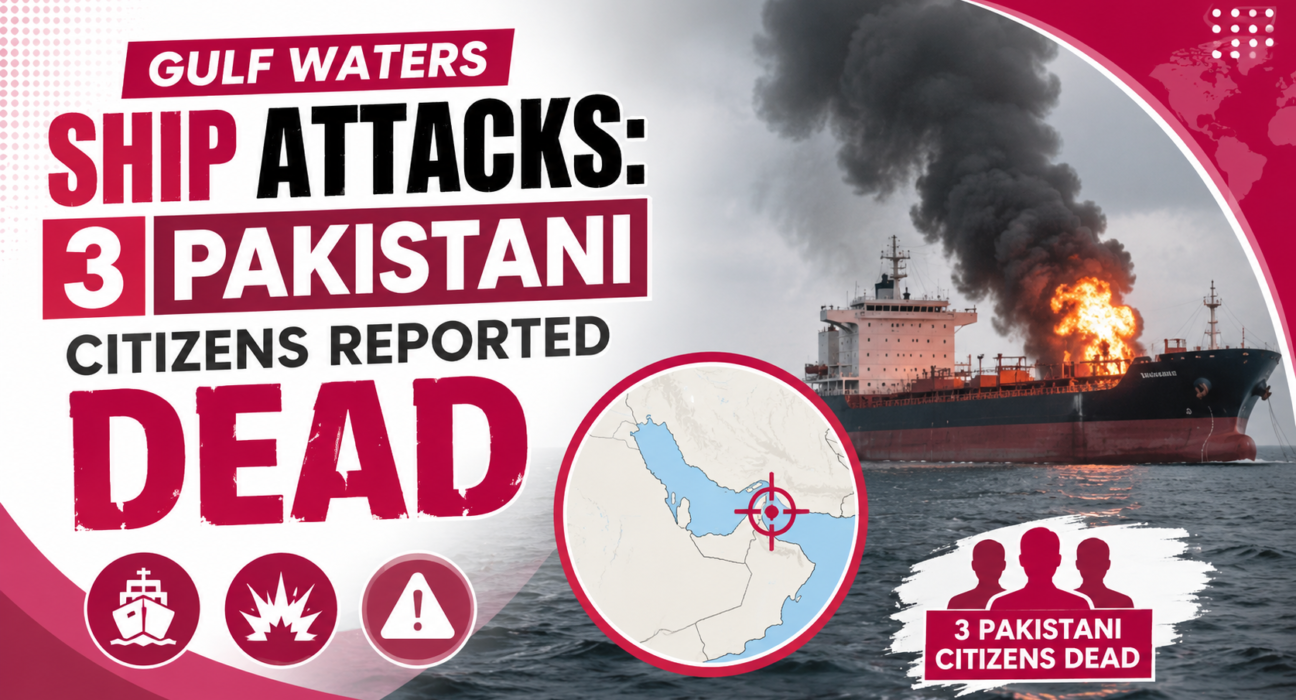
If you’ve been following the news out of the Middle East this week, you’ve probably seen the headlines about another commercial ship coming under fire in the Red Sea. It’s a heartbreaking story, and honestly, one that hits close to home for a lot of Pakistani families right now. Three Pakistani nationals have lost their lives after their vessel was struck near the Bab al-Mandeb Strait, one of the busiest and most dangerous maritime corridors on the planet.
Here’s what we know so far. The vessel, identified as the Tihamah and flying a Yemeni flag, was reportedly carrying food supplies when it came under attack while sailing through the strait. Yemen’s coast guard says the ship was hit not once but multiple times, first by an initial strike that set it ablaze, and then again while rescue teams were trying to reach the crew. That second strike is what’s really drawing international outrage, because it appears rescuers were deliberately targeted too.
Pakistan’s Deputy Prime Minister and Foreign Minister, Ishaq Dar, confirmed the tragedy in a post on social media, saying three Pakistani nationals had died and one more was injured. He didn’t hold back in his response either, calling it a clear violation of international law and a direct threat to the safety of maritime navigation. The Foreign Ministry says it’s now working closely with Saudi authorities and Yemen’s internationally recognized government to sort out the details and, just as importantly, to bring the bodies of the deceased back home.
The attack has been attributed to the Houthi movement, also known as Ansarullah, which has ramped up its campaign against shipping in the region following the collapse of a years-long truce in Yemen’s civil war. This isn’t an isolated event either. Just a day before the Tihamah incident, another Houthi strike on a cargo vessel further south reportedly killed several more crew members, underlining just how volatile these waters have become.
Why This Keeps Happening
The Red Sea and the wider Gulf region have basically turned into a minefield for commercial shipping over the past couple of years. Traffic through the Bab el-Mandeb Strait has dropped by more than half compared to before this wave of attacks started, and shipping companies are increasingly rerouting vessels around Africa entirely, even though that adds weeks to delivery times and drives up costs.
For everyday Pakistanis, this isn’t just a geopolitical footnote. Thousands of Pakistani sailors work on commercial vessels that regularly pass through these waters, so incidents like this one hit particularly hard back home.
| Incident Detail | Information |
|---|---|
| Vessel Name | Tihamah (Yemeni-flagged) |
| Location | Bab al-Mandeb Strait, Red Sea |
| Cargo | Food supplies |
| Pakistani Fatalities | 3 |
| Pakistani Injured | 1 |
| Attributed To | Houthi forces (Ansarullah) |
Recent Pakistani Casualties Linked to Regional Conflict
| Date | Location | Outcome |
|---|---|---|
| Feb 28 | Iranian missile interception | 1 Pakistani killed |
| Mar 8 | Dubai (Al Barsha) | 1 Pakistani killed |
| Mar 17 | Abu Dhabi (Bani Yas) | 1 Pakistani killed |
| August 2026 | Bab al-Mandeb Strait | 3 Pakistani killed, 1 injured |
What Happens Next
Right now, the focus is on repatriation and getting answers. Pakistan’s embassy in Riyadh has been directed to coordinate closely with local authorities to bring the victims’ remains home and support the injured survivor. Beyond that, there’s growing pressure on the international community to do something about the safety of commercial shipping lanes before more lives are lost.
It’s a grim reminder that global trade routes aren’t just lines on a map. Real people, often far from home and just trying to earn a living, are the ones paying the price when conflicts spill over into international waters.