
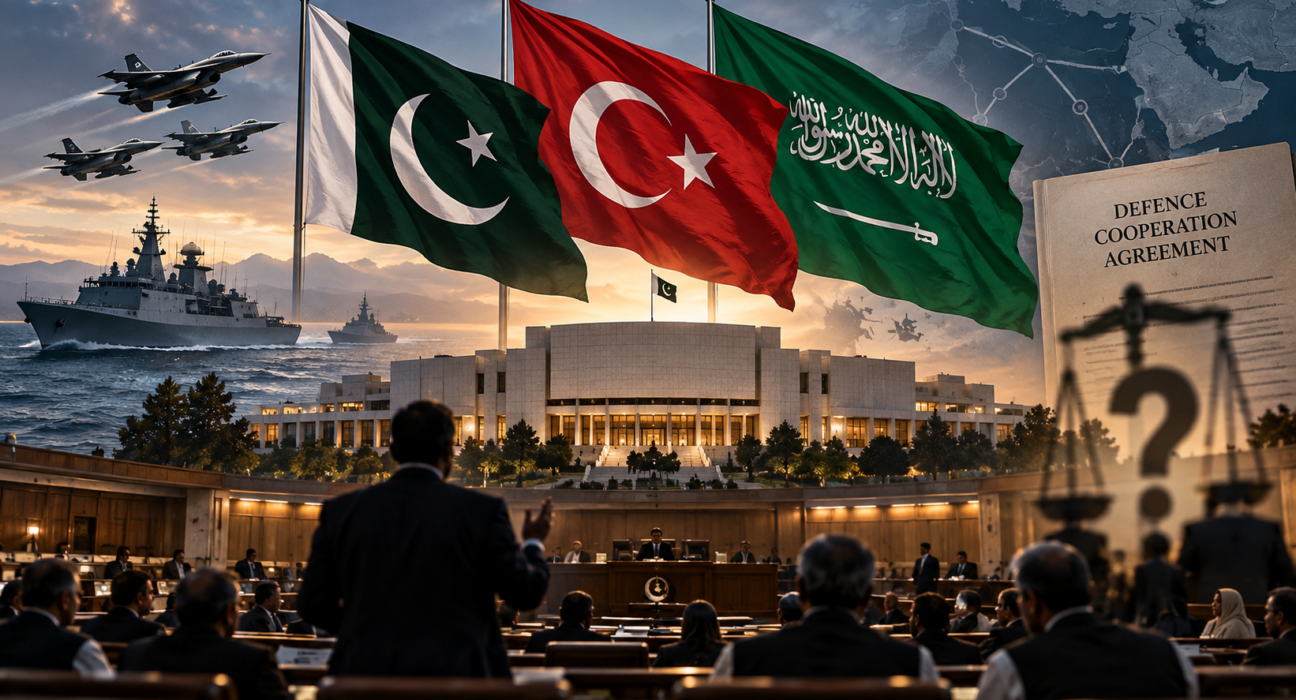
When three major Muslim-majority powers sign a defence deal, the whole world pays attention. When that deal starts moving into action before every parliament has voted on it, people start looking closely at the rules. That is exactly where things stand today with the Mecca Joint Defence Agreement, the military pact between Pakistan, Turkey and Saudi Arabia.
I have followed this story closely, and I want to walk you through it in plain words. You will see what the pact says, how fast it has moved, and why lawmakers, legal experts and ordinary citizens are asking for clarity on parliamentary approval. I will also lay out the arguments from both sides, so you can make up your own mind. Everything here rests on public reporting up to mid-October 2026, and the situation is changing quickly.
What the Mecca Joint Defence Agreement Actually Says
How the Pact Was Signed
Saudi Arabia, Turkey and Pakistan signed the Mecca Joint Defence Agreement on 7 August 2026. Reuters reported that the three countries promised to treat an armed attack on any one of them as an attack on all three. If that sounds like NATO’s Article 5, you are not far off. Several outlets used the same comparison.
Still, the full text has not been made public. One report said the deal lacks a direct clause that forces automatic collective defence. So we have two possible readings. One is a strong mutual defence promise. The other is a softer cooperation framework that leaves each country free to choose its own response. That gap is a big reason people want parliaments involved.
From Signing to a Named Alliance
On 31 August 2026, top officials met in Istanbul for the first committee meeting under the deal. The three countries announced a formal name, the Mecca Defence Alliance. Foreign ministers, defence ministers and military chiefs from all three sides sat in the same room. Pakistan’s Foreign Ministry added that the pact stays open to other states.
Later, the allies agreed to set up a secretariat in Saudi Arabia and to work together on defence technology and joint production. In simple terms, this is more than a one-page promise. It is turning into a real institution, with offices, regular meetings and shared plans.
Pakistan-Turkey-Saudi Defence Pact Raises Questions Over Parliamentary Approval
This is the line many readers are typing into Google right now, and it points to a simple gap. Signing a treaty is usually the job of the government. Making it fully binding is often the job of parliament, at least in countries with strong legislative checks. When those two steps happen weeks or months apart, there is a stretch of time where the alliance exists on paper and in the field, yet lawmakers have not had their say.
That stretch is where we are now. Turkey’s parliament has not yet ratified the agreement. Pakistan’s parliament has not been reported to vote on it either. Meanwhile, the allies have already agreed to move forces and capabilities toward Saudi Arabia. Officials say this will happen subject to each country’s national laws, which sounds sensible, but it also leaves a big question about who decides what those laws allow.
Think of it like a family signing a lease. The signatures matter, but nobody should move the furniture in before everyone has read the contract. Critics say the pact is a bit like that. Supporters say the roof is already leaking, so the furniture has to move now. Both sides have a point, and I will cover each one below.
How the Pact Moved From Paper to Action
The speed of events surprised many analysts. In less than two months, the pact went from a signing ceremony to an activated deterrence plan. Here is a quick timeline based on public reports.
| Date | What Happened |
| 7 August 2026 | Saudi Arabia, Turkey and Pakistan sign the Mecca Joint Defence Agreement |
| 31 August 2026 | First committee meeting in Istanbul; the Mecca Defence Alliance name is announced |
| Early September 2026 | Houthi missiles are fired toward Saudi Arabia; Pakistan’s defence minister says spillover could trigger the pact |
| 25 September 2026 | Turkey’s parliament speaker says the pact should go for ratification from October |
| 2 October 2026 | Pakistan’s foreign minister says the pact has no offensive agenda |
| 5 October 2026 | Emergency meeting in Riyadh activates collective deterrence measures |
| 8 October 2026 | Turkey’s foreign minister says work to send the deal to parliament is complete |
The Riyadh Emergency Meeting
The turning point came on 5 October 2026. After a barrage of attacks claimed by Yemen’s Houthi group, the alliance’s Strategic Political and Defence Committee met in Riyadh. The joint statement said the members would move immediately to put collective defence measures in place and ensure rapid deployment in the kingdom. They also condemned attempts to target Mecca and Medina.
Pakistan’s defence minister, Khawaja Asif, said soon after that Pakistani forces were already playing a part. Pakistan has not shared how many troops are in Saudi Arabia. That lack of detail is one of the main reasons the debate on legislative oversight has grown louder.
Why Turkey’s Parliament Holds the Key
Article 92 and the Power to Send Troops
Turkey’s rules are fairly clear. Under Article 92 of the Turkish constitution, the authority to send troops abroad rests with parliament. An analyst quoted by Al Jazeera pointed out that parliament has not yet ratified the Mecca pact. In other words, Ankara cannot fully commit forces under this alliance until lawmakers sign off.
Turkey’s parliament speaker, Numan Kurtulmus, said the same thing in plain terms. International agreements need parliamentary approval to take effect, and the meetings held so far were preparatory. He also said he expected the pact to reach the parliamentary agenda after the chamber returns in October.
What Ankara Is Telling the Public
Turkey’s foreign minister, Hakan Fidan, said on 8 October that the work needed to send the agreement to parliament had reached its conclusion. He also tried to calm fears about the pact’s purpose. He called it a defensive arrangement and said Turkey would not send troops into another country’s territory to carry out an attack.
Until the vote happens, Turkey’s help for Saudi Arabia stays bilateral. That means Ankara can still sell equipment and share technical know-how, but the full alliance is not yet legally in force on the Turkish side. For readers following the legislative process, this is the cleanest example of how parliamentary approval works in practice.
Pakistan’s Parliament and the Debate at Home
The Press Briefing That Raised Eyebrows
The picture in Pakistan is less tidy. According to news reports, Deputy Prime Minister and Foreign Minister Ishaq Dar walked out of a press briefing after a reporter asked whether parliamentary approval would be sought before Pakistani forces take part in combat operations against the Houthis. The moment spread quickly online, and legal experts and opposition leaders have since called for more openness.
To be fair, Dar has been clear about the pact’s tone. At a news conference in Islamabad on 2 October, he said it has no offensive agenda. He also said Pakistan would honour its commitments. Still, a general promise is not the same as a detailed plan, and critics want to see the plan.
The Shadow of 2015
Pakistanis remember what happened last time Saudi Arabia asked for help in Yemen. In April 2015, Riyadh asked for fighter jets, ground troops and naval ships. The government sent the question to a joint session of parliament, and lawmakers unanimously voted for neutrality in the Yemen conflict. At the same time, they promised to stand with Saudi Arabia if its territory or the holy sites were threatened.
That history matters today. It shows Pakistan has a tradition of taking big military questions to parliament. It also shows that lawmakers can support Saudi security without joining a foreign war. Many commentators now ask the government to follow the same path again, or at least to explain why this case is different.
Long Defence Ties With Riyadh
On the other hand, Pakistan and Saudi Arabia have worked together for decades. Pakistan has trained Saudi military personnel since 1967, and a 1982 agreement formalised the deputation of Pakistani troops to the kingdom. A bilateral Strategic Mutual Defence Agreement followed in September 2025. So the new pact builds on a long, deep relationship rather than starting from zero.
Saudi Arabia’s Security Needs
It helps to see the pact through Riyadh’s eyes. Saudi Arabia has faced missile and drone attacks, and the allies have condemned strikes on cities and on civilian and economic sites. The kingdom wants a strong deterrent, which simply means a force that makes an attacker think twice.
An analyst quoted by Al Jazeera described the goal this way: Saudi Arabia is trying to turn the Mecca pact from a political declaration into a working deterrent. That explains the push for rapid deployment, the new secretariat and the talk of joint defence production.
Saudi Arabia does not face the same parliamentary hurdle. Decisions on defence rest with the royal government, and the Shura Council plays an advisory role. So the real pressure points are in Ankara and Islamabad, where elected lawmakers expect to weigh in. If you want a deeper look at how Turkey’s process works, the Hurriyet Daily News report on the foreign minister’s remarks is a good place to start: Saudi-Pakistan pact set for Turkish parliament.
The Case for Moving Fast
Let me give you the strongest version of the government side, because it deserves a fair hearing.
Speed Can Protect Lives
Supporters argue that a deterrent only works if it is credible and quick. If attacks on Saudi cities continue, waiting weeks for a parliamentary calendar could weaken the message to aggressors. In this view, early deployment of air defence, drones and communication systems is a safety measure, not an act of war.
Defensive Moves Differ From Offensive Ones
Officials from both Turkey and Pakistan stress that the pact is defensive. Defending a partner’s territory from missiles, they argue, is not the same as invading another country. Some also note that deployments are described as subject to national laws, which they read as a built-in safety valve.
Existing Ties Already Cover Much of This
Because Pakistan has had troops and trainers in Saudi Arabia for decades, supporters say current moves are an extension of long-standing practice. They see no need for a fresh vote on something the country has done for years.
The Case for Parliamentary Approval
Now the other side, which is just as serious.
Democratic Oversight Is the Whole Point
Critics say that sending soldiers into harm’s way is one of the biggest choices a state can make. In a democracy, they argue, that choice should not rest with a few ministers and generals. Parliamentary approval gives the public a voice and makes leaders explain their goals.
Legal Clarity Protects Everyone
Without a clear vote, nobody knows exactly what troops can and cannot do. Can they fire at Houthi positions inside Yemen, or only intercept missiles over Saudi soil. A public debate would set boundaries, or red lines, before a crisis forces rushed decisions. One analyst warned that Pakistan needs to draw its red lines carefully so its troops do not get pulled into a wider conflict.
Public Trust Is at Stake
Transparency also builds trust. When families do not know where their soldiers are or why, rumours spread. A parliamentary process, even a closed-door one, shows respect for citizens and for the constitution.
How the Three Countries Compare
The table below sums up the position of each country based on current reporting. Remember that some facts, such as troop numbers and the pact’s full text, remain undisclosed.
Table 2: Approval and Oversight Across the Three Countries
| Country | Who Holds Formal Power | Current Approval Status | Public Message |
| Turkey | Parliament decides on sending troops abroad under Article 92 | Ratification bill expected soon after parliament resumes | Pact is defensive; no attack on another country’s land |
| Pakistan | Government leads, with a history of taking big questions to parliament, as in 2015 | No parliamentary vote on the pact reported so far | No offensive agenda; commitments will be honoured |
| Saudi Arabia | Royal government, with an advisory Shura Council | No parliamentary step required | Needs a real deterrent against attacks on the kingdom |
Looking at the table, you can see why attention falls on Ankara and Islamabad. One has a clear legal path that is already moving. The other has a strong tradition of debate but few public details about the current plan.
The Iran and Houthi Factor
No discussion of this pact is complete without the wider regional picture. The alliance grew out of a tense period that includes the war involving Iran, and the Houthi attacks on Saudi Arabia came soon after the signing.
Is the Pact Aimed at Iran
Turkey says no. Speaker Kurtulmus said the agreement does not target any specific country. He added that Iran could even join one day, turning the pact into a wider arrangement for the Muslim world. He described its main goal as protecting regional states amid conflicts and what he called Israel’s hostile policies.
Quiet Diplomacy Alongside Defence
Pakistan’s foreign minister said he briefed Tehran on the pact and on how Pakistan would honour it. He also said Iran suggested a political track with the Houthis, an idea the alliance planned to discuss in Riyadh. Dar added that more than six countries want to join, though he did not name them. This mix of deterrence and diplomacy shows the allies want to look strong without closing every door.
For a broader explainer on what the Riyadh decisions mean for Pakistan, you can read Al Jazeera’s analysis here: Pakistan and Turkiye join Saudi deterrence against Houthis.
What This Means for People and Regional Stability
Defence pacts can feel far away, but they touch daily life. Troop deployments cost money. Alliances can pull countries into disputes they did not start. At the same time, a strong deterrent can prevent a larger war, which saves lives and keeps trade routes and markets calmer.
For Pakistani readers, the key points are transparency and limits. Citizens want to know the size of any deployment, the rules for using force, and how long it will last. For Turkish readers, the coming parliamentary vote will act as a public test of the pact. Lawmakers will likely debate costs, risks and the risk of entanglement in Yemen.
For the wider Middle East, the pact adds a new security bloc to an already crowded map. If more countries join, it could become a major platform for defence cooperation. If it stumbles over legal or political disputes, it could look more like a symbol than a shield. Much depends on how openly the three governments handle the next few weeks.
What to Watch Next
Several developments will show where this story is heading. Keep an eye on these.
The Turkish Vote
The ratification bill is expected to reach parliament soon. Watch how the opposition reacts, whether any amendments appear, and how quickly the vote is scheduled. A smooth approval would give the alliance a firm legal base on the Turkish side.
Pakistan’s Disclosure and Debate
Watch for any statement from Pakistan’s government on troop numbers, rules of engagement and whether a joint session of parliament will be called. Even a briefing to a parliamentary committee would signal a move toward more oversight.
New Members and the Published Text
If other countries join, the pact’s reach and legal weight will grow. Also watch for any release of the agreement’s full text. Publishing it would end much of the guesswork about whether the pact forces collective defence or only guides it.
The Mecca Joint Defence Agreement is a major step in regional security, and it is moving faster than many expected. Supporters see a needed shield against real attacks. Critics see a gap between military action and democratic approval. Both views come from real concerns, and neither side can ignore the other for long.
What stands out is how much the outcome now depends on process. Turkey has a clear constitutional path and is moving toward a vote. Pakistan has a proud record of taking tough questions to its parliament, and many people want that habit to continue. Saudi Arabia, meanwhile, wants results on the ground.
If you follow only one thing in the coming weeks, follow the parliamentary steps. They will show whether this alliance rests on solid legal ground, and whether the public will see it as a shared national decision or a leadership decision alone. I will keep watching the details, and I suggest you do the same.