

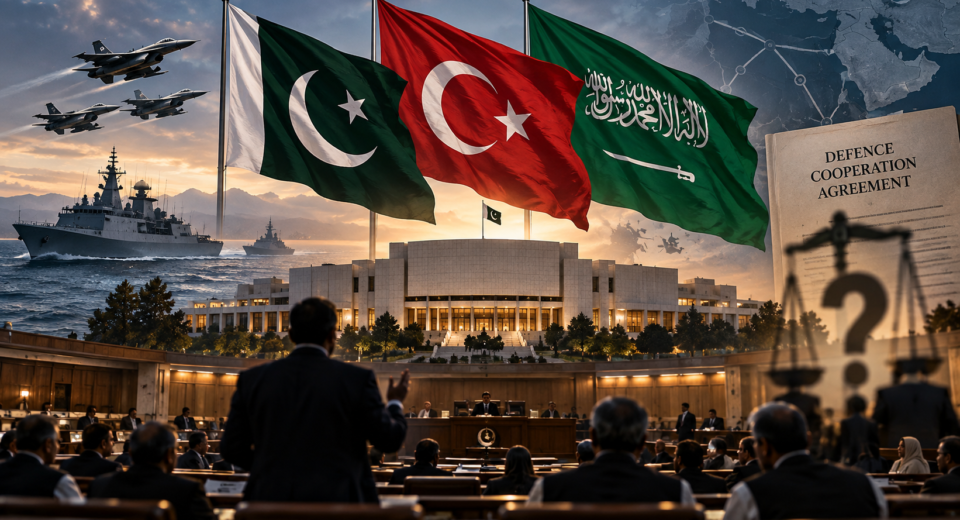
Pakistan-Turkey-Saudi Defence Pact Raises Questions Over Parliamentary Approval
When three major Muslim-majority powers sign a defence deal, the whole world pays attention. When that deal starts moving into action before every parliament has voted on it, people start looking closely at the rules. That is exactly where things stand today with the Mecca Joint Defence Agreement, the military pact between Pakistan, Turkey and Saudi Arabia. I have followed this story closely, and I want to walk you through it in plain words. You will see what the pact says, how fast it has moved, and why lawmakers, legal experts and ordinary citizens are asking for clarity on parliamentary approval. I will also lay out the arguments from both sides, so you can make up your own mind. Everything here rests on public reporting up to mid-October 2026, and the situation is changing quickly. What the Mecca Joint Defence Agreement Actually Says How the Pact Was Signed Saudi Arabia, Turkey and Pakistan signed the Mecca Joint Defence Agreement on 7 August 2026. Reuters reported that the three countries promised to treat an armed attack on any one of them as an attack on all three. If that sounds like NATO’s Article 5, you are not far off. Several outlets used the same comparison. Still, the full text has not been made public. One report said the deal lacks a direct clause that forces automatic collective defence. So we have two possible readings. One is a strong mutual defence promise. The other is a softer cooperation framework that leaves each country free to choose its own response. That gap is a big reason people want parliaments involved. From Signing to a Named Alliance On 31 August 2026, top officials met in Istanbul for the first committee meeting under the deal. The three countries announced a formal name, the Mecca Defence Alliance. Foreign ministers, defence ministers and military chiefs from all three sides sat in the same room. Pakistan’s Foreign Ministry added that the pact stays open to other states. Later, the allies agreed to set up a secretariat in Saudi Arabia and to work together on defence technology and joint production. In simple terms, this is more than a one-page promise. It is turning into a real institution, with offices, regular meetings and shared plans. Pakistan-Turkey-Saudi Defence Pact Raises Questions Over Parliamentary Approval This is the line many readers are typing into Google right now, and it points to a simple gap. Signing a treaty is usually the job of the government. Making it fully binding is often the job of parliament, at least in countries with strong legislative checks. When those two steps happen weeks or months apart, there is a stretch of time where the alliance exists on paper and in the field, yet lawmakers have not had their say. That stretch is where we are now. Turkey’s parliament has not yet ratified the agreement. Pakistan’s parliament has not been reported to vote on it either. Meanwhile, the allies have already agreed to move forces and capabilities toward Saudi Arabia. Officials say this will happen subject to each country’s national laws, which sounds sensible, but it also leaves a big question about who decides what those laws allow. Think of it like a family signing a lease. The signatures matter, but nobody should move the furniture in before everyone has read the contract. Critics say the pact is a bit like that. Supporters say the roof is already leaking, so the furniture has to move now. Both sides have a point, and I will cover each one below. How the Pact Moved From Paper to Action The speed of events surprised many analysts. In less than two months, the pact went from a signing ceremony to an activated deterrence plan. Here is a quick timeline based on public reports. Date What Happened 7 August 2026 Saudi Arabia, Turkey and Pakistan sign the Mecca Joint Defence Agreement 31 August 2026 First committee meeting in Istanbul; the Mecca Defence Alliance name is announced Early September 2026 Houthi missiles are fired toward Saudi Arabia; Pakistan’s defence minister says spillover could trigger the pact 25 September 2026 Turkey’s parliament speaker says the pact should go for ratification from October 2 October 2026 Pakistan’s foreign minister says the pact has no offensive agenda 5 October 2026 Emergency meeting in Riyadh activates collective deterrence measures 8 October 2026 Turkey’s foreign minister says work to send the deal to parliament is complete The Riyadh Emergency Meeting The turning point came on 5 October 2026. After a barrage of attacks claimed by Yemen’s Houthi group, the alliance’s Strategic Political and Defence Committee met in Riyadh. The joint statement said the members would move immediately to put collective defence measures in place and ensure rapid deployment in the kingdom. They also condemned attempts to target Mecca and Medina. Pakistan’s defence minister, Khawaja Asif, said soon after that Pakistani forces were already playing a part. Pakistan has not shared how many troops are in Saudi Arabia. That lack of detail is one of the main reasons the debate on legislative oversight has grown louder. Why Turkey’s Parliament Holds the Key Article 92 and the Power to Send Troops Turkey’s rules are fairly clear. Under Article 92 of the Turkish constitution, the authority to send troops abroad rests with parliament. An analyst quoted by Al Jazeera pointed out that parliament has not yet ratified the Mecca pact. In other words, Ankara cannot fully commit forces under this alliance until lawmakers sign off. Turkey’s parliament speaker, Numan Kurtulmus, said the same thing in plain terms. International agreements need parliamentary approval to take effect, and the meetings held so far were preparatory. He also said he expected the pact to reach the parliamentary agenda after the chamber returns in October. What Ankara Is Telling the Public Turkey’s foreign minister, Hakan Fidan, said on 8 October that the work needed to send the agreement to parliament had reached its conclusion. He also tried to calm fears about the pact’s purpose. He