

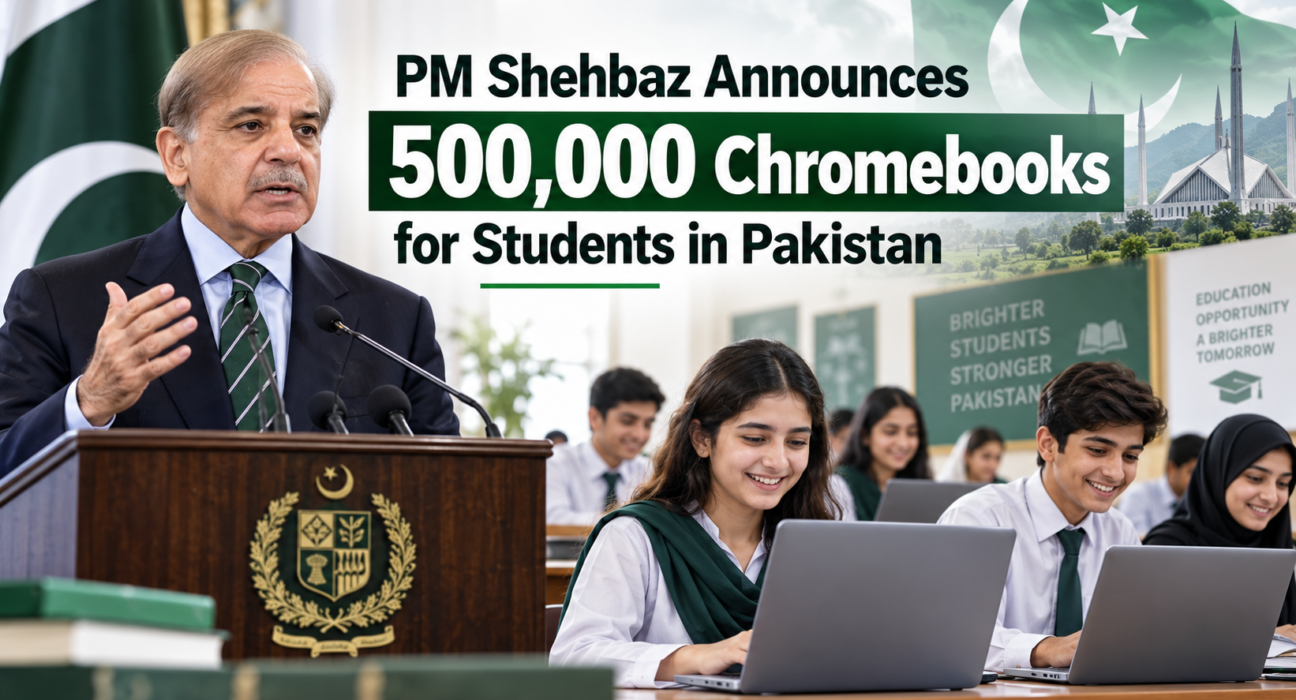
You may have seen the headline about half a million Chromebooks coming to Pakistan’s students and wondered what it really means. Is it a giveaway, a factory plan, or both? Here is the short version. The 500,000 figure comes from a partnership between Google and the Government of Pakistan to build Chromebooks inside the country. Prime Minister Shehbaz Sharif welcomed the plan in public, received the first locally made device, and later the government announced a separate scheme to hand out 700,000 Chromebooks to students.
I have pieced the story together from public news reports so you get a clear picture without the confusion. I will tell you what has been officially stated, what is still unclear, and what it could mean for students, parents, and teachers. Think of this as a friendly guide, not a press release.
Quick Overview of the Chromebook Plan
Pakistan has been pushing hard to bring technology into classrooms. The Chromebook plan is one of the biggest pieces of that push. Here is how the main events line up, based on news coverage.
Key Events at a Glance
| Date | What Happened |
| March 2023 | PM Shehbaz distributed Chromebooks to students at the launch of the TeleSchool Pakistan app and a Google for Education programme |
| June 2024 | Google for Education met the PM and agreed to support local assembly of over 500,000 Chromebooks by 2026 |
| September 2024 | Google’s Asia Pacific president presented the first locally made Chromebook to the PM in Islamabad |
| December 2025 | The PM Youth Programme chairman announced 700,000 Chromebooks for students nationwide |
The table shows that this is not one single announcement. It is a story that has grown over more than two years. Each step built on the one before it.
PM Shehbaz Announces 500,000 Chromebooks for Students in Pakistan: The Story Behind the Headline
Let me clear up the headline, because this is where most people get mixed up. The 500,000 number is tied to production. Google and its partners said they would set up local assembly of more than half a million Chromebooks. That is a plan to make devices in Pakistan, which then helps the government and schools buy them at lower prices.
The June 2024 Meeting in Islamabad
In June 2024, the prime minister met a high-level team from Google for Education in Islamabad. According to Arab News, the team was led by its managing director, Kevin Kells. The state media reported that Google, working with its country partner Tech Valley, would help set up local assembly of over 500,000 Chromebooks by 2026. The same report said the partnership would also give students and teachers access to digital tools and resources.
The report also mentioned that an Australian manufacturer, Allied, would build an assembly line in Pakistan. The idea was simple. If the devices are put together at home, they cost less than imported ones. That makes them far more realistic for public schools.
The September 2024 Ceremony
A few months later, the plan became something you could actually hold in your hands. At a ceremony in Islamabad, Google’s Asia Pacific president, Scott Beaumont, presented the first locally made Chromebook to the prime minister. The PM said that federal and provincial governments should use every possible resource to educate and empower young people. He also spoke about making government work paperless and digital, so that corruption could be reduced.
That moment mattered because it moved the plan from paper to a real product. It showed that local assembly was not just talk.
What Is a Chromebook and Why Does It Suit Pakistani Classrooms
If you have never used one, a Chromebook is a laptop that runs Google’s Chrome OS instead of Windows. It is built around the internet, the Chrome browser, and Google’s online tools. Reports describe Chromebooks as more cost effective than regular laptops, which is a big reason they are popular with schools around the world.
Lower Cost for Tight Budgets
Price is the first thing families and schools think about. A standard laptop can be too expensive for a public school with hundreds of students. Chromebooks usually need less powerful hardware, so they can be sold for less. When the assembly happens locally, the savings can grow even more because shipping and some import costs come down.
Simple, Fast, and Safe to Use
Chromebooks start quickly and are easy to learn. A ten-year-old can often figure out the basics in a single afternoon. They also update themselves in the background and have built-in protection against many viruses. For a teacher managing a full classroom, that means fewer broken machines and less time spent on repairs.
Made for Online Learning
Chromebooks work smoothly with Google Classroom, Google Docs, Google Meet, and other free education tools. Students can write assignments, join live lessons, and share work with teachers from one device. For a country that wants to grow digital learning, this is a practical match.
Why Local Assembly in Pakistan Is a Big Deal
Many people focus on the number of devices. I think the more interesting part is where they are made. A reported goal of the partnership was to help Pakistan’s manufacturing industry grow and attract more technology investment. Let me break down why that matters.
Better Chances of Lower Prices
Imported electronics get hit by shipping costs, currency swings, and taxes. When assembly happens inside Pakistan, some of those problems shrink. Lower prices do not happen automatically, but local production gives the government more room to negotiate and plan large orders.
Jobs and Technical Skills
An assembly line needs workers, supervisors, testers, and logistics teams. Even if the first jobs are modest, they teach valuable skills. Over time, workers who learn on an assembly line can move into repair, quality control, and more advanced electronics work.
A Signal to Investors
When a global company chooses to build products in a country, other companies notice. The prime minister has said he wants to raise IT exports to $25 billion over the next five years and described that target as achievable. Whether or not that goal is met, a visible project like local Chromebook assembly sends a message that Pakistan wants to be a serious player in technology.
The Bigger Picture: Out-of-School Children and the Education Emergency
Chromebooks are not the only thing on the education agenda. Reports from the time of the 2024 Google meeting noted that the prime minister had just declared an education emergency. The reason was a hard number. Pakistan has around 26 million children who are not in school, which is among the highest figures in the world.
A laptop cannot fix that problem by itself. A child who cannot reach a classroom will not benefit from a device meant for the classroom. Still, digital tools can help in other ways. The reports said the Google partnership would focus on out-of-school children too, through digital learning resources that reach students where traditional schools are hard to build or staff.
I think this is the right way to look at the Chromebook plan. It is one tool in a larger toolbox. Teachers, school buildings, safe transport, and affordable fees still matter. Devices work best when they support those basics rather than replace them.
From 500,000 to 700,000: The Latest on Distribution
Now to the part many readers are searching for. In December 2025, Dunya News reported that the government confirmed 700,000 Google Chromebooks would be given to students under the Prime Minister’s Youth Programme. The announcement came from the programme’s chairman, Rana Mashhood Ahmad Khan. So the distribution target is higher than the 500,000 production figure.
Here is a simple way to compare the two numbers.
Chromebook Programme at a Glance
| Detail | 500,000 Plan | 700,000 Plan |
| Main idea | Local assembly of Chromebooks | Distribution to students |
| Who is involved | Google, Tech Valley, assembly partner, government | Prime Minister’s Youth Programme |
| Reported timeline | By 2026 | Phased rollout |
| Main goal | Lower costs and local manufacturing | Wider student access |
I want to be upfront about one thing. These are two related but separate announcements. If you see a post claiming that the prime minister is handing out exactly 500,000 free Chromebooks, treat the wording with care and check the original reports.
Who May Receive a Chromebook
According to the December 2025 report, the programme is meant to cover students in public schools, colleges, and universities. It said distribution would happen across all provinces, including Azad Jammu and Kashmir and Gilgit-Baltistan. The final rules had not yet been released at that time. The report said priority was expected to go to students in government institutions, merit-based and need-based candidates, and institutions that are ready for digital learning.
Since the full rules were still pending when that report came out, please do not rely on social media posts or paid “registration” offers. Wait for official announcements.
Phased Rollout and Tracking
The government plans to hand out the devices in phases. The reason given is fairness and transparency. A national tracking system is also expected to check how the Chromebooks are used and what effect they have on learning. That is a good sign, because many technology programmes in many countries have failed when devices were handed out and then forgotten.
How Chromebooks Fit Into Earlier PM Laptop Schemes
This is not the first time Shehbaz Sharif has pushed laptops for students. He often talks about his time as chief minister of Punjab, when hundreds of thousands of laptops were given to students on merit. He has called it his mission to give young people the tools to move ahead in their fields.
Since then, the federal government has run its own laptop programmes. In July 2023, the prime minister launched the National Laptop Scheme for talented students in Khyber Pakhtunkhwa, and he said that one million laptops had been distributed so far under the scheme. In August 2025, he announced another 100,000 free laptops for talented students, again strictly on merit.
So what makes the Chromebook plan different from those programmes? There are a few differences worth noting.
- Device type: Laptops under the older schemes were usually regular Windows machines. Chromebooks are lighter and simpler.
- Target group: The 700,000 plan covers school students as well as college and university students, based on the reports.
- Manufacturing link: The Chromebook plan is tied to local assembly, which is a bigger industrial goal.
- Tracking: The new plan talks about a national system to follow device use.
None of this means one approach is better than the other. Merit-based laptops reward top students. A wider Chromebook rollout aims to reach more students, including those who are not at the top of their class.
Benefits Students Can Expect
Let me move from policy to real life. If the plan works as described, what could change for a student in Pakistan.
Learning Beyond the Textbook
Many public school students rely on a single set of books for the whole year. A Chromebook opens the door to video lessons, practice quizzes, digital libraries, and language tools. A student in a small town can watch the same science lesson as a student in a big city.
Help for Rural and Remote Students
The December 2025 report said the programme is expected to narrow the gap between urban and rural education. That is a big hope. Students in remote areas often have fewer teachers and fewer resources. A device loaded with learning material can fill some of that gap, especially if lessons can be used offline.
Digital Skills for the Job Market
Typing, searching safely, building a simple presentation, and writing a clean document are skills that employers want. Students who use a Chromebook every day pick these up naturally. Those skills help with freelancing, office jobs, and online work later in life.
A Boost for Teachers
Teachers can share homework, collect assignments, and give feedback without piles of paper. They can also build lessons with videos and images. The prime minister has previously said that teacher training in the country is not up to the mark, which shows why training has to go hand in hand with the devices.
Challenges That Still Need Attention
I like the direction of this plan, but I also believe in being honest. Several hurdles could slow things down, and the programme will only succeed if they are handled well.
Internet Access
Chromebooks are built for the web. In areas with weak or expensive internet, they are less useful. The government will need to think about connectivity, offline tools, and low-cost data packages. Without that, a student may end up with a device that sits unused.
Electricity and Charging
Power cuts are a daily fact of life in many places. Schools and homes need a way to charge devices. Solar chargers, power banks, or charging carts in classrooms could help, but they cost money too.
Teacher Training
A device is only as good as the person guiding its use. Teachers need practical training, not just a one-day workshop. They need time to learn the tools and plan lessons around them.
Fair Selection
Whenever free devices are offered, people worry about favoritism. Clear eligibility rules, open lists, and an easy way to report problems will protect trust. The planned tracking system could help here, as long as it is used properly.
Repairs and Long-Term Support
A Chromebook can last several years, but only with proper care. Schools will need repair points, spare parts, and a plan for replacing broken units. Local assembly may help here, since a local partner can support service and spare parts more easily than an overseas seller.
Practical Tips for Students and Parents
If your child may be in line for a Chromebook, a little preparation goes a long way. Here are simple steps I would take.
- Follow only official sources. Watch the Prime Minister’s Youth Programme announcements and your school or university notice board. Never pay anyone for a “guaranteed” device.
- Keep documents ready. Student ID, result cards, and a CNIC or B-Form are often needed for government schemes. Having them organized saves stress later.
- Create a Google account early. A simple, safe email address with a strong password makes setup easier on day one.
- Learn the basics together. Parents do not need to be tech experts. Sit with your child and explore Google Docs, Classroom, and search safely.
- Set screen rules. A Chromebook is a learning tool. Agree on study hours, and keep entertainment limits clear.
- Protect the device. Use a padded bag, avoid heavy loads on the screen, and keep liquids away.
How Teachers and Schools Can Prepare
Schools that plan ahead will get much more out of the devices. A few ideas can make a real difference.
- Check your power and internet. Even a basic Wi-Fi setup and a few charging points can change how smoothly a class runs.
- Start with a small pilot. Try Chromebooks in one or two classes first, learn what works, and then expand.
- Choose a few simple tools. Do not try to use every app at once. Google Classroom for assignments and Docs for writing are enough to start.
- Teach digital safety. Students should understand passwords, fake links, and respectful online behavior.
- Share what works. Teachers who find good lesson ideas should swap them with colleagues. Peer learning is often faster than formal training.
What to Watch Next
The story is still moving, so a few things deserve your attention in the coming months.
First, watch for the final eligibility rules for the 700,000 devices. Those details will decide who benefits and how quickly. Second, watch the pace of local assembly. The original target was 500,000 devices by 2026, and progress against that goal will show how serious the industrial plan is. Third, watch for results from the national tracking system. If the government shares data on usage and learning outcomes, we will finally see whether the devices help students learn better.
I could not confirm every detail of the latest rollout from the sources I found, so I recommend checking official government channels and trusted news outlets for the newest updates before you act on any claim.