

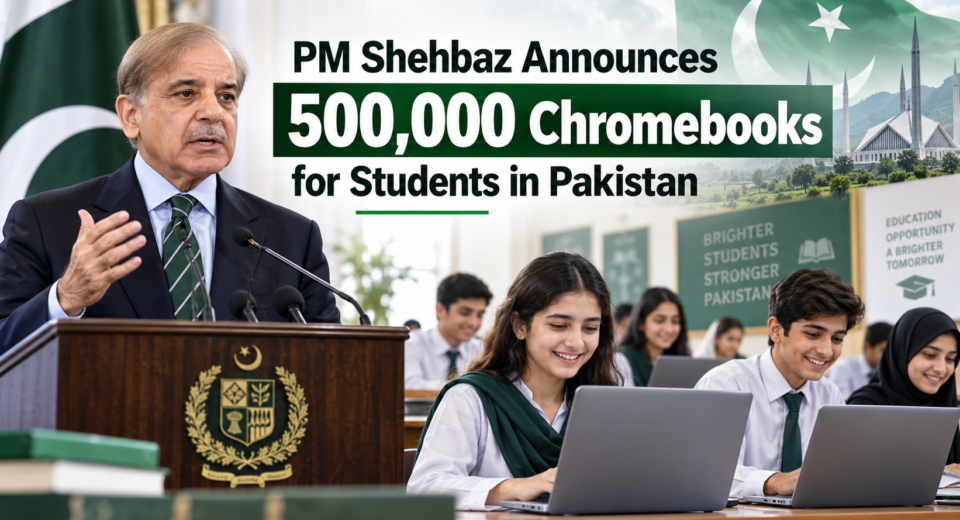
PM Shehbaz Announces 500,000 Chromebooks for Students in Pakistan
You may have seen the headline about half a million Chromebooks coming to Pakistan’s students and wondered what it really means. Is it a giveaway, a factory plan, or both? Here is the short version. The 500,000 figure comes from a partnership between Google and the Government of Pakistan to build Chromebooks inside the country. Prime Minister Shehbaz Sharif welcomed the plan in public, received the first locally made device, and later the government announced a separate scheme to hand out 700,000 Chromebooks to students. I have pieced the story together from public news reports so you get a clear picture without the confusion. I will tell you what has been officially stated, what is still unclear, and what it could mean for students, parents, and teachers. Think of this as a friendly guide, not a press release. Quick Overview of the Chromebook Plan Pakistan has been pushing hard to bring technology into classrooms. The Chromebook plan is one of the biggest pieces of that push. Here is how the main events line up, based on news coverage. Key Events at a Glance Date What Happened March 2023 PM Shehbaz distributed Chromebooks to students at the launch of the TeleSchool Pakistan app and a Google for Education programme June 2024 Google for Education met the PM and agreed to support local assembly of over 500,000 Chromebooks by 2026 September 2024 Google’s Asia Pacific president presented the first locally made Chromebook to the PM in Islamabad December 2025 The PM Youth Programme chairman announced 700,000 Chromebooks for students nationwide The table shows that this is not one single announcement. It is a story that has grown over more than two years. Each step built on the one before it. PM Shehbaz Announces 500,000 Chromebooks for Students in Pakistan: The Story Behind the Headline Let me clear up the headline, because this is where most people get mixed up. The 500,000 number is tied to production. Google and its partners said they would set up local assembly of more than half a million Chromebooks. That is a plan to make devices in Pakistan, which then helps the government and schools buy them at lower prices. The June 2024 Meeting in Islamabad In June 2024, the prime minister met a high-level team from Google for Education in Islamabad. According to Arab News, the team was led by its managing director, Kevin Kells. The state media reported that Google, working with its country partner Tech Valley, would help set up local assembly of over 500,000 Chromebooks by 2026. The same report said the partnership would also give students and teachers access to digital tools and resources. The report also mentioned that an Australian manufacturer, Allied, would build an assembly line in Pakistan. The idea was simple. If the devices are put together at home, they cost less than imported ones. That makes them far more realistic for public schools. The September 2024 Ceremony A few months later, the plan became something you could actually hold in your hands. At a ceremony in Islamabad, Google’s Asia Pacific president, Scott Beaumont, presented the first locally made Chromebook to the prime minister. The PM said that federal and provincial governments should use every possible resource to educate and empower young people. He also spoke about making government work paperless and digital, so that corruption could be reduced. That moment mattered because it moved the plan from paper to a real product. It showed that local assembly was not just talk. What Is a Chromebook and Why Does It Suit Pakistani Classrooms If you have never used one, a Chromebook is a laptop that runs Google’s Chrome OS instead of Windows. It is built around the internet, the Chrome browser, and Google’s online tools. Reports describe Chromebooks as more cost effective than regular laptops, which is a big reason they are popular with schools around the world. Lower Cost for Tight Budgets Price is the first thing families and schools think about. A standard laptop can be too expensive for a public school with hundreds of students. Chromebooks usually need less powerful hardware, so they can be sold for less. When the assembly happens locally, the savings can grow even more because shipping and some import costs come down. Simple, Fast, and Safe to Use Chromebooks start quickly and are easy to learn. A ten-year-old can often figure out the basics in a single afternoon. They also update themselves in the background and have built-in protection against many viruses. For a teacher managing a full classroom, that means fewer broken machines and less time spent on repairs. Made for Online Learning Chromebooks work smoothly with Google Classroom, Google Docs, Google Meet, and other free education tools. Students can write assignments, join live lessons, and share work with teachers from one device. For a country that wants to grow digital learning, this is a practical match. Why Local Assembly in Pakistan Is a Big Deal Many people focus on the number of devices. I think the more interesting part is where they are made. A reported goal of the partnership was to help Pakistan’s manufacturing industry grow and attract more technology investment. Let me break down why that matters. Better Chances of Lower Prices Imported electronics get hit by shipping costs, currency swings, and taxes. When assembly happens inside Pakistan, some of those problems shrink. Lower prices do not happen automatically, but local production gives the government more room to negotiate and plan large orders. Jobs and Technical Skills An assembly line needs workers, supervisors, testers, and logistics teams. Even if the first jobs are modest, they teach valuable skills. Over time, workers who learn on an assembly line can move into repair, quality control, and more advanced electronics work. A Signal to Investors When a global company chooses to build products in a country, other companies notice. The prime minister has said he wants to raise IT exports to $25 billion over the next five years and