
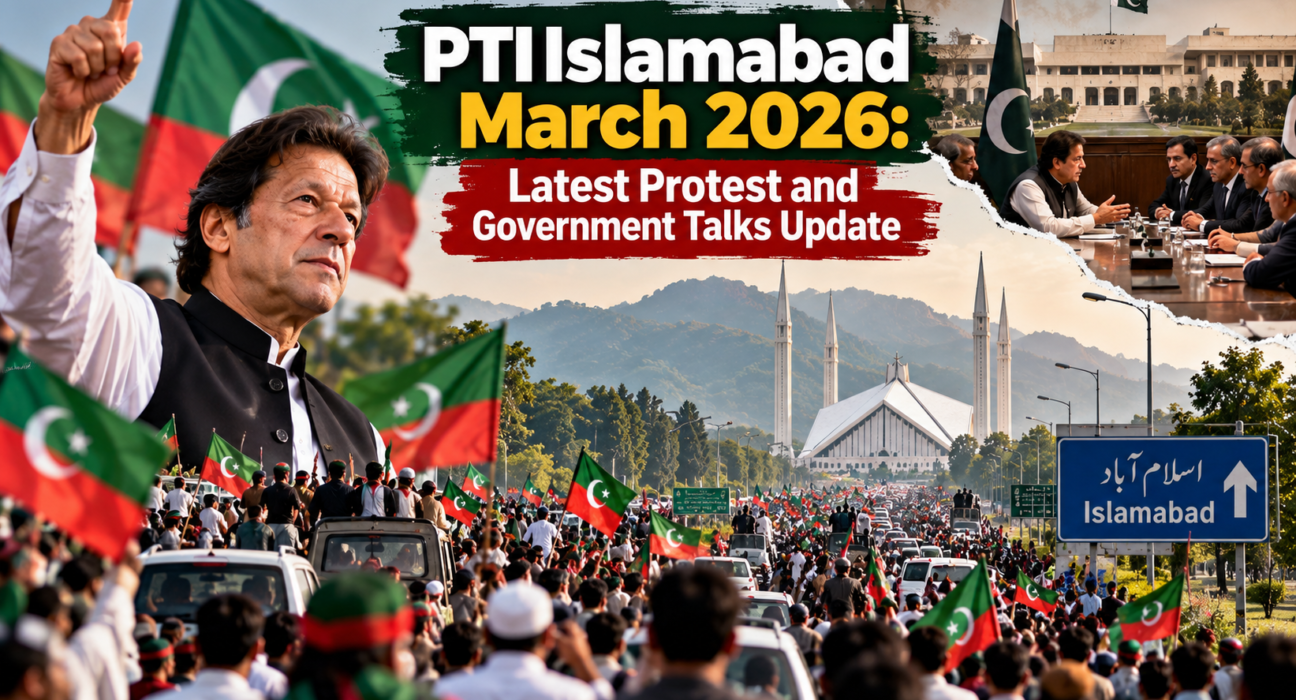
PTI Islamabad March 2026: Latest Protest and Government Talks Update
Pakistan’s political situation entered a new phase on October 4, 2026, as Pakistan Tehreek-e-Insaf (PTI) began the first phase of its long march after negotiations with the federal government ended without an agreement.
The PTI Islamabad March 2026 has become one of the country’s most closely watched political developments, with attention focused on the protest route, government response, failed negotiations, security concerns, and what PTI plans to do next.
The first phase began from Gandi Chowk in Lakki Marwat, Khyber Pakhtunkhwa, with KP Chief Minister Sohail Afridi leading party workers. However, reports indicate that PTI’s next course of action will develop in phases, making it important to distinguish between the march already underway and any later movement toward Islamabad.
This article explains the latest confirmed developments, why government-PTI talks failed, what both sides are saying, and what could happen next.
PTI Islamabad March 2026: What Is the Latest Update?
PTI launched the first phase of its long march on Sunday, October 4, after lengthy negotiations between the opposition and the federal government failed to produce a breakthrough.
According to the latest reporting from Dawn, the march was set to begin from Lakki Marwat, with different groups of party supporters expected to join as the movement progressed.
The protest had already created significant political pressure before it started because government and opposition representatives spent several rounds trying to reach an agreement that could prevent or postpone the march.
Those efforts ultimately failed.
The situation therefore moved from negotiations back toward political mobilisation, although the exact shape and timing of later phases remain important developments to watch.
PTI Begins First Phase From Lakki Marwat
The first phase of the PTI long march began from Gandi Chowk, Lakki Marwat.
Supporters from areas including Bannu, Dera Ismail Khan, North Waziristan, South Waziristan, Tank and Lakki Marwat were expected to participate in the initial stage.
KP Chief Minister Sohail Afridi is playing a central role in the protest and has been leading the mobilisation from Khyber Pakhtunkhwa.
The political strategy appears to involve bringing together groups from different parts of the province before decisions on subsequent stages are implemented.
This phased approach is particularly important for readers following the PTI Islamabad protest latest update, because the start of the march does not necessarily mean all participating groups will immediately enter Islamabad.
What Happened in Government-PTI Talks?
Before the protest began, representatives from the federal government and opposition held negotiations in an attempt to reduce political tensions and find a possible way forward.
The first formal round took place on October 2 at the National Assembly Speaker’s chamber.
National Assembly Speaker Sardar Ayaz Sadiq played a facilitating role in the dialogue.
The talks initially provided some hope that the two sides might reach an understanding. However, subsequent discussions continued for hours without resolving the major disagreements.
By early October 4, negotiations had reached a deadlock.
Both sides later offered different explanations for why the process failed.
Why Did the Government-PTI Talks Fail?
The disagreement was not based on a single issue.
One of the most important points concerned counterterrorism policy in Khyber Pakhtunkhwa.
PTI representatives argued that major counterterrorism measures in the province should involve consultation and coordination between the federal government, the KP government, political parties and other stakeholders.
Government representatives presented a different assessment of the negotiations and questioned whether the provincial government was prepared to provide the level of cooperation expected on security matters.
Another major issue concerned opposition demands related to PTI founder Imran Khan, including access and meetings.
These disagreements prevented both sides from producing a mutually acceptable final agreement.
What Is the Government Saying About the Failed Talks?
Interior Minister Mohsin Naqvi said the negotiations had collapsed and blamed the KP leadership for the breakdown.
Government representatives have maintained that national security and counterterrorism cannot be compromised during political negotiations.
Information Minister Attaullah Tarar and other federal ministers have also publicly criticised PTI’s position following the breakdown of talks.
The government side argues that cooperation between federal and provincial authorities is essential for addressing security challenges in Khyber Pakhtunkhwa.
PTI disputes the government’s description of why negotiations failed.
What Does PTI Say About the Deadlock?
PTI has presented a different account.
Party Secretary General Salman Akram Raja said the central disagreement involved the approach toward counterterrorism operations and decisions in Khyber Pakhtunkhwa.
PTI’s position is that counterterrorism measures affecting the province should be developed through consultation and agreement rather than through unilateral decisions.
Party leaders have also continued to raise issues concerning access to Imran Khan.
A detailed account of the competing positions was reported by Geo News, which noted that the negotiations ended without bridging differences over counterterrorism cooperation and access to the jailed PTI founder.
The competing statements show that there remains a substantial political gap between the two sides.
Is PTI Marching Directly to Islamabad?
This is one of the most important questions surrounding the story.
PTI has begun its long march, but reports on October 4 indicate a phased strategy.
The initial mobilisation started in Lakki Marwat, with participants expected to move through Khyber Pakhtunkhwa and gather with other groups.
Some reports have described the movement broadly as the Islamabad long march. However, reporting on the first phase indicates that the detailed plan for movement toward Islamabad is still developing.
For this reason, claims that protesters have already reached Islamabad or that a final Islamabad entry plan has been implemented should not be made without a confirmed update.
Readers should follow fresh reports because the situation can change quickly.
What Happens Next in the PTI Long March?
The next major development will be PTI’s decision about the following phase of the protest.
Chief Minister Sohail Afridi has indicated that further strategy will be announced as the march progresses, with Khairabad emerging as an important point in the next stage.
Political developments between now and then could still influence the protest.
Several possibilities remain open. The march could continue according to PTI’s phased strategy, political dialogue could restart, or both sides could modify their positions depending on developments.
At present, however, there is no confirmed breakthrough between the federal government and opposition.
Why Is the October 4 Protest Politically Important?
The PTI October 4 march matters because it comes during an already tense relationship between the federal government and PTI.
The dispute is not limited to a single protest.
It involves wider disagreements over political representation, the situation surrounding Imran Khan, governance in Khyber Pakhtunkhwa, counterterrorism policy and relations between the provincial and federal governments.
The protest therefore has consequences beyond the march itself.
How the government handles the demonstration, whether PTI changes its strategy, and whether negotiations resume could influence Pakistan’s political environment in the coming days.
Could Government-PTI Talks Resume?
A breakdown in negotiations does not necessarily mean dialogue is permanently over.
Both sides agreed to negotiations before the October 4 march, showing that political communication remains possible despite major disagreements.
However, any new round of talks would require progress on the issues that caused the latest deadlock.
The government and opposition would need to find common ground on security cooperation, the political demands raised by PTI and the conditions surrounding the protest.
Until officials confirm another meeting, reports suggesting that a new agreement has been reached should be treated cautiously.
Security and Public Movement Remain Important
Large political protests can affect roads, public transport, businesses and everyday travel.
Authorities have increased security preparations in response to the march, while the developing protest route could influence movement in different areas as the situation changes.
People travelling through areas connected with the protest should rely on official traffic and local administration updates rather than unverified social media posts.
Because political situations can change within hours, information about road closures, protest locations and transport disruptions should always be checked against the latest official notices.
What Should People Watch Next?
Several developments will determine what happens next in the PTI Islamabad March 2026.
The first is the progress of PTI’s march through Khyber Pakhtunkhwa and the announcement of its next phase.
The second is whether the federal government and opposition reopen negotiations.
The third is the government’s security and administrative response if the protest moves closer to Islamabad.
Another important issue will be whether either side changes its position on the disagreements that caused the latest talks to collapse.
These developments could determine whether political tensions increase or another attempt at dialogue becomes possible.
The PTI Islamabad March 2026 has entered a critical stage after government-opposition negotiations failed and PTI began the first phase of its protest from Khyber Pakhtunkhwa.
The immediate focus is now on how the march develops, what PTI announces for its next phase, how the federal government responds and whether political dialogue can resume.
For readers, the most important point is to separate confirmed developments from speculation. The talks have ended in deadlock and the first phase of the march has begun, but the protest strategy is still developing.
With Pakistan’s political situation changing rapidly, the coming days could determine whether the dispute moves toward renewed negotiations or a prolonged political confrontation.