

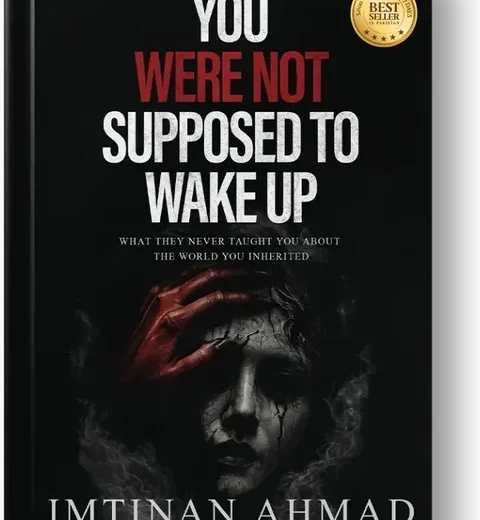
You Were Not Supposed to Wake Up by Imtinan Ahmad: Book Summary, Themes & the Author’s Journey
Most of us were handed a story about money, success and happiness long before we were old enough to question it. You Were Not Supposed to Wake Up: What They Never Taught You About the World You Inherited asks you to look at that story again, and to decide with open eyes what you will keep and what you will let go. This is the debut book of Imtinan Ahmad, an educator, speaker and founder of the Fikr Movement. Released in 2026, it has drawn attention for its bold title and a question that stays with you: who benefits from the version of the world you were raised in? In this guide, you will find a clear summary of the book, the story of the author’s journey from the marketing industry to years of Islamic study, a breakdown of all seven parts, and practical reflections you can use even before you open the first page. What Is You Were Not Supposed to Wake Up About? The book argues that the way most people spend their attention, handle money, define success and understand freedom is not accidental. According to the author, these habits come from a design, and he is careful to call it a design rather than a conspiracy. Across 30 chapters and 7 parts, he examines phones and social media, influencer culture, music, sexuality, the family, education, debt and banking, food, technology, media ownership and more. Every topic is read through one lens: that modern life has been engineered, piece by piece, to pull people away from remembering their Creator, and that waking up to this has a cost. The author is explicit that this is not a comfort read. It is written for people who already sense that something is off and want a framework to explain why. At its heart, though, the book is less about fear than about awareness. Its message is that once you can see the system, you can start to choose differently, and that is where the inspiration begins. About the Author: Who Is Imtinan Ahmad? Imtinan Ahmad holds an MSc in Marketing from the University of Manchester. According to his publisher’s description, he spent a decade trained in the science of influence and built an audience of millions by speaking the language of that system. His author page describes him as an educator and reformist with more than 3.5 million followers, a TEDx speaker, and a teacher for around 16 years, working where Islamic theology, modern psychology and entrepreneurship meet. This is his first book, and it reads as the result of a long personal search rather than a quick project. From Marketing to Meaning: A Journey of Awakening Few people walk away from a career that is working. Ahmad was trained to understand how attention, desire and behaviour are shaped, and he used that knowledge to build a large online following. Then, as the book’s description puts it, he stepped away from that world. What followed was about ten years of study across Islamic theology, psychology and philosophy, driven by one question: why did earlier generations seem to know a kind of stillness that many people today have traded for anxiety? The book is presented as the culmination of that decade, with the author turning his marketing-era training around to examine the system he once worked inside. There is something quietly inspiring in that arc. It shows that a person can change direction after success, and that the most useful knowledge is sometimes found by questioning what you already know. The Struggle and Courage Behind the Book The public record points to several real tensions behind this project: The takeaway is not that everyone should change careers. It is that asking honest questions about what feels normal can be the first step toward a more intentional life. Inside the Book: The Seven Parts at a Glance The table of contents is one of the most searched features of the book. Here is how it is organised. Part One: The Enemy Is Real. The opening chapter, “He Already Said Your Name,” sets the spiritual framing for everything that follows. Part Two: They Lied About You. Chapters on the smartphone, influencer culture, the decision-making rooms behind media, and the effect of sound and music on the body. Part Three: They Rewired Human Nature. Chapters on modern sexuality, the family, the classroom, the university degree and the sale of freedom. Part Four: They Lied About the World. Chapters on emptiness and the products sold to fill it, corporate accountability, media ownership, food, the history of modern banking and personal debt. Part Five: The Architecture of Control. Chapters on secretive networks, institutional containment of movements, symbols in the built environment, mind-control programmes, and big technology. Part Six: The War Is Spiritual. Chapters on counterfeit spirituality, children as targets, the climate narrative, and the idea that the plan was written down. Part Seven: The Endgame. Chapters on the end of ownership, surveillance and control, population narratives, and what the author calls the world being built for the Dajjal. Get This Book Easily: You Were Not Supposed to Wake Up Key Themes Explored in the Book Attention as the new currency The book treats the phone, social platforms and influencer culture as systems built to capture attention, and asks what that does to a person’s inner life and relationship with God. The invitation is simple: take your attention back. Debt, money and the idea of ownership Several chapters trace the history of modern banking, personal debt and the shift toward renting rather than owning. They ask what financial dependence does to freedom, and what a life of more independence could look like. Family, education and identity The author argues that the family and the classroom have been reshaped in ways that weaken traditional bonds and values. For many readers this becomes a prompt to strengthen the relationships and learning closest to home. Spiritual awareness and purpose The closing parts frame the whole argument as a spiritual