
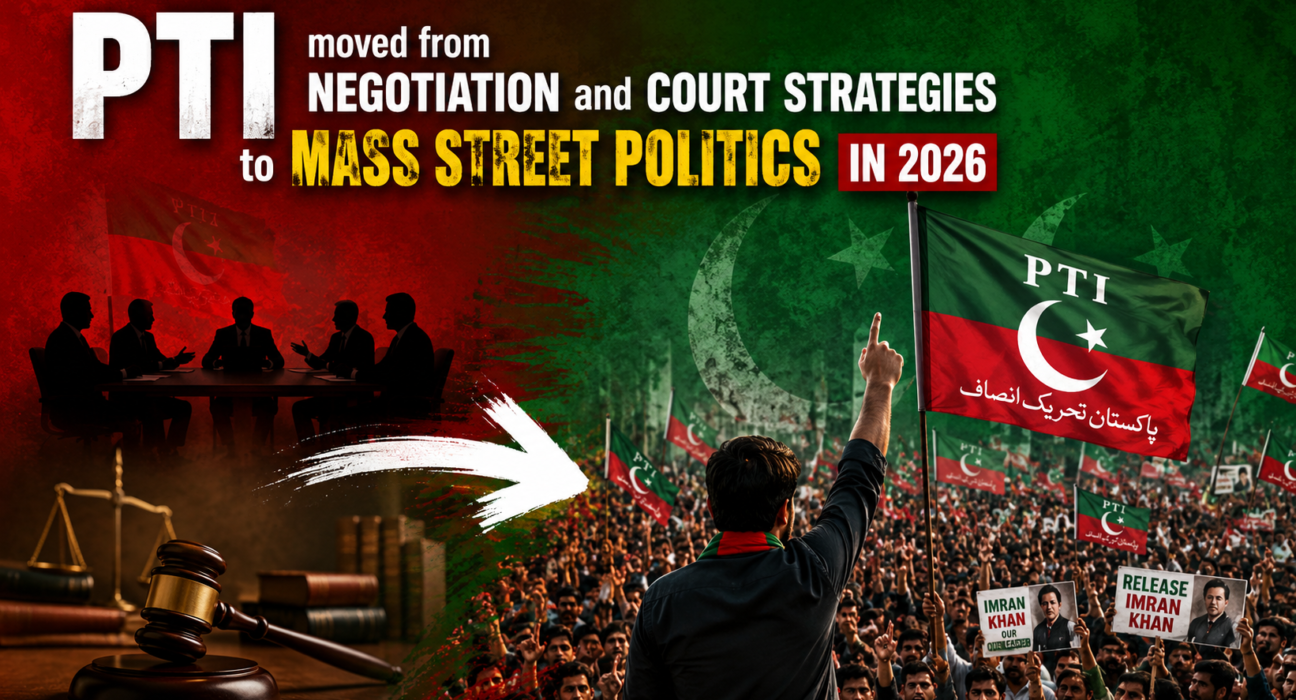
Pakistan’s political landscape has witnessed another major shift in 2026 as Pakistan Tehreek-e-Insaf (PTI) appears to have moved away from relying primarily on negotiations and legal battles, placing greater emphasis on public mobilization and street politics. The change reflects the party’s effort to reconnect with its supporters and maintain political relevance during a period of intense uncertainty. While negotiations and court proceedings continue to play a role, public rallies, protests, and demonstrations have increasingly become the center of PTI’s political strategy.
PTI’s Earlier Focus on Negotiations and Legal Challenges
Over the past few years, PTI invested considerable effort in pursuing legal remedies and political dialogue. Party leaders frequently challenged government decisions in the courts while also expressing willingness to engage in negotiations with political stakeholders. The objective was to secure political space through constitutional and institutional channels rather than prolonged public confrontations.
However, the outcomes of these approaches often proved slower than many supporters had expected. Legal proceedings moved through lengthy judicial processes, while political negotiations faced repeated obstacles. As a result, pressure mounted within the party to adopt a more visible and active political campaign.
Why PTI Shifted Toward Street Politics
Several political developments in 2026 have contributed to PTI’s increased focus on public demonstrations. The party has argued that large public gatherings provide an opportunity to directly communicate with supporters and demonstrate its political strength.
Street politics has historically played an important role in Pakistan’s democratic history. Political parties have frequently organized rallies, marches, and public meetings to highlight their positions and influence public opinion. PTI’s renewed emphasis on these methods reflects its belief that public engagement can shape the national political conversation more effectively than relying solely on courtroom proceedings.
Table 1: Comparison of PTI’s Political Strategy
| Political Approach | Earlier Strategy | 2026 Strategy |
| Primary Focus | Negotiations and legal petitions | Public rallies and demonstrations |
| Public Engagement | Limited public mobilization | Large-scale political gatherings |
| Legal Action | Central political tool | Continues alongside protests |
| Political Messaging | Institutional dialogue | Direct communication with supporters |
Table 2: Key Factors Behind PTI’s Strategic Shift
| Factor | Impact on Political Strategy |
| Slow legal proceedings | Encouraged greater emphasis on public mobilization. |
| Political uncertainty | Increased demand for visible political activity. |
| Supporter expectations | Created pressure for stronger grassroots engagement. |
| Media attention | Large rallies generated wider national discussion. |
| Political competition | Required PTI to maintain public visibility. |
Growing Public Mobilization
The increase in public gatherings has become one of the defining characteristics of PTI’s political campaign during 2026. Supporters have participated in rallies across different regions, while party leadership has continued to emphasize public outreach as an essential component of its strategy.
Political observers note that large demonstrations serve multiple purposes. They energize supporters, reinforce party organization, and provide opportunities for leadership to communicate policy positions directly to the public. At the same time, such activities can also increase political tensions if disagreements between political actors intensify.
Challenges Facing PTI
Although mass politics can strengthen public engagement, it also presents several challenges. Organizing nationwide demonstrations requires significant planning, resources, and coordination. Public gatherings may also lead to disruptions, security concerns, and heightened political polarization.
In addition, PTI must balance street activism with participation in Pakistan’s constitutional and legal processes. Most political analysts agree that sustainable political progress typically requires a combination of public support, institutional engagement, and adherence to democratic principles.
What This Means for Pakistan’s Political Future
PTI’s strategic shift highlights the evolving nature of Pakistan’s political environment. The party appears to be placing greater emphasis on demonstrating its public support while continuing to participate in legal and political processes where appropriate.
Whether this approach produces long-term political gains will depend on several factors, including public response, the broader political climate, institutional developments, and future electoral dynamics. Political strategies often evolve in response to changing circumstances, making flexibility an important factor for all major parties.
Conclusion
PTI’s move from negotiation and court-centered politics toward increased street mobilization marks one of the notable political developments of 2026. While legal proceedings and political dialogue remain part of the party’s overall approach, public demonstrations have become a more prominent feature of its strategy. As Pakistan’s political environment continues to evolve, the effectiveness of this shift will likely be judged by its ability to build public confidence, maintain peaceful democratic participation, and influence future political developments through constitutional means.