
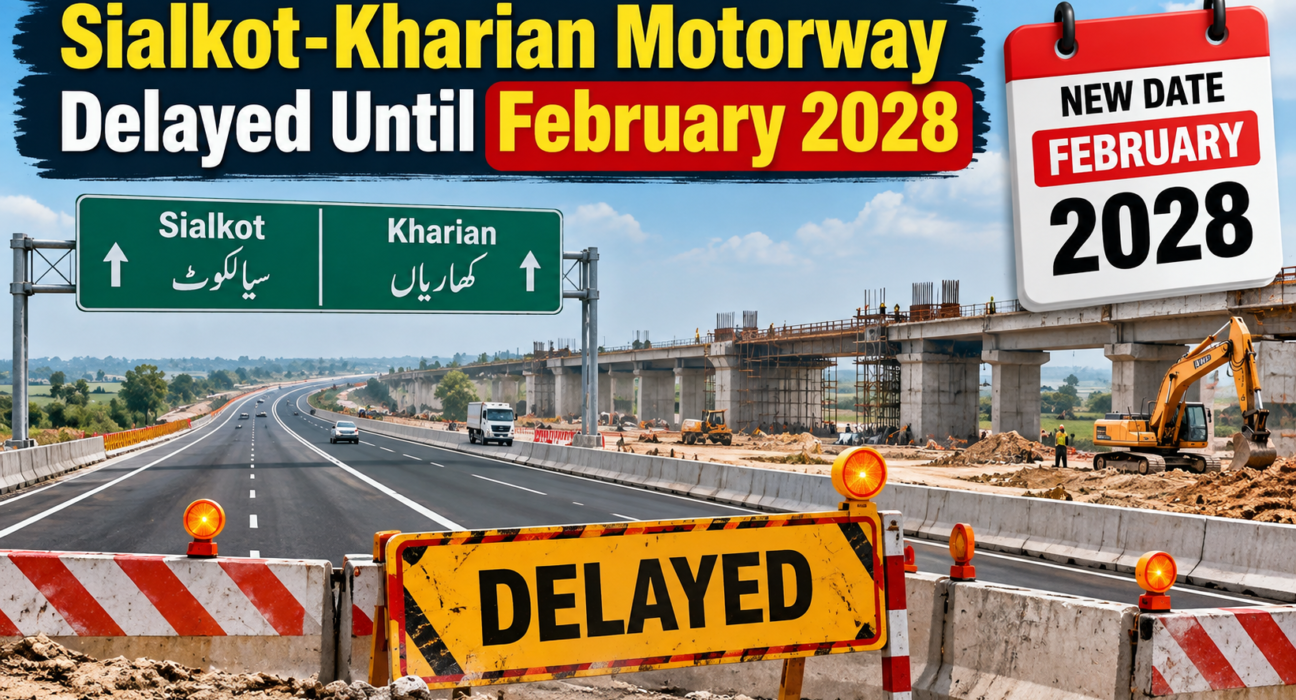
If you live in Sialkot, Gujrat, or Kharian, you have probably heard the news by now. The long-awaited M-12 motorway will not open on its old schedule. A new target date has been set, and it is later than many people hoped. In this article, I will walk you through what happened, why it happened, and what it means for you, your business, and your daily travel. I will keep things simple and stick to facts from official statements and trusted news reports. I wrote this to be useful, so you will not find confusing jargon here.
Sialkot-Kharian Motorway Delayed Until February 2028: What We Know So Far
Let me start with the headline. The 69-kilometer Sialkot (Sambrial)-Kharian Motorway, known as M-12, is behind schedule, with only about 20 percent of the work finished, according to details the federal government shared with the Punjab government. That is a small share of the work for a project that began years ago.
The New Deadline in Plain Words
The project was launched in October 2022 and was first supposed to be finished in September 2024. Sources now say the deadline has moved to February 2028. So we are talking about a gap of roughly three and a half years between the first promise and the new date. You can read the original report on ProPakistani if you want to see the source for yourself.
Where the Work Stands Today
Just a day before that report, the federal communications minister held a meeting with the National Highway Authority, or NHA. Officials told that meeting that 21 percent of the work on the Sambrial–Kharian Motorway had been completed so far. The numbers differ by a single point, but they tell the same story. The road is built only a little over one-fifth of the way. A lot of earthwork, bridge work, and paving still lies ahead.
Here is the good part. The minister did not accept the delay quietly. He pushed the NHA to work faster, and I will explain that in detail later in this article.
Quick Look at the M-12 Project
Before we go deeper, it helps to see the basic facts in one place. Think of this as your cheat sheet for the whole story.
Table 1: Key Facts About the M-12 Motorway
| Detail | Information |
| Official name | Sialkot (Sambrial)-Kharian Motorway, M-12 |
| Length | 69 kilometers |
| Lanes | Six-lane design |
| Major structure | 1,043-meter bridge over the River Chenab |
| Project cost | About Rs 89.739 billion |
| Work started | October 2022 |
| Original deadline | September 2024 |
| Revised deadline | February 2028 |
| Reported progress | Around 20 to 21 percent |
| Responsible body | National Highway Authority (NHA) |
The project involves a 69-kilometer, six-lane motorway and includes a 1,043-meter bridge over the River Chenab. That bridge is a big deal, and it has played a large role in the delays. I will come back to it in a moment.
How the Project Began: A Short Timeline
To understand the delay, you need to know where this road came from. The M-12 did not appear overnight. It is the middle piece of a much bigger plan to link Lahore with Rawalpindi through Sialkot and Kharian.
Table 2: M-12 Motorway Timeline at a Glance
| Year | What Happened |
| March 2020 | Lahore-Sialkot Motorway (M-11) opens to traffic |
| 2021 | Contract for M-12 awarded; project paperwork approved |
| October 2022 | Construction begins |
| 2024 | Design changed from four lanes to six lanes |
| September 2024 | Original completion target |
| August 2026 | Government approves financial guarantees |
| October 2026 | Minister orders faster progress and early finish |
| February 2028 | Revised completion target |
Here are a few extra details behind those dates. The NHA awarded the contract for the 69-kilometre M-12 project to a partnership of the Frontier Works Organization (FWO) and SMC Private Limited. Prime Minister Imran Khan later performed the groundbreaking, and the project was described as an important public-private partnership that would help both travelers and goods moving out of Sialkot’s industries.
So the plan looked solid on paper. The route was clear, the builders were chosen, and the ceremony was done. Then reality got in the way.
Why the Deadline Moved from September 2024 to February 2028
Big road projects rarely slip for just one reason, and M-12 is no exception. Based on official statements and news reports, three main problems stand out. Let me take them one by one.
Money Problems and Funding Gaps
Money is the first big issue. Sources told ProPakistani that a shortage of funds and slow processing of land notifications by the Sialkot and Gujrat district administrations have hurt construction.
The project follows a public-private partnership model. In simple terms, a private partner builds the road and the government backs the deal. That setup only works when the financing is locked in. When funds are tight, or when banks wait for guarantees, work slows down or stops. That is what appears to have happened here.
There is some hope on this front. The Economic Coordination Committee approved sovereign guarantees worth Rs 27.62 billion in August 2026 to help the project reach financial close. A sovereign guarantee is a promise from the government that lenders will be repaid. It gives banks the comfort they need to release money.
Land Acquisition Delays
The second problem is land. A motorway needs a long, continuous strip of land, and getting that land takes time. Officials must measure plots, notify owners, settle payments, and handle disputes.
The report says the Prime Minister’s Office has named faster land acquisition as a key requirement for finishing the motorway. That tells us the government itself sees land as a major roadblock. If a single stretch of land stays unavailable, the builder cannot move forward in that section, even if everything else is ready.
Design Changes Along the Way
The third problem is that the plan itself changed. A federal official explained that the project was delayed because of realignment after a hydraulic model study of the Chenab bridge, hyperinflation, and the switch from four lanes to six.
Those factors forced a renegotiation of the public-private partnership agreement, which delayed execution, and construction activity was halted with allocated funds held back. In plain words, the builders had to pause while the government and the private partner rewrote their deal. No road gets built while the contract is being reworked.
The Chenab Bridge and Alignment Changes
If you want to know why a motorway can be delayed, look at a river. The M-12 must cross the mighty Chenab, and that is not a simple task.
Engineers ran a model study to see how the new bridges would behave in the water. The study showed that the earlier alignment could potentially damage the Marala Headworks, Sialkot Airport, and the motorway bridges over the Chenab. That is a serious finding. Nobody wants a bridge that puts a major water structure or an airport at risk.
So the route was changed. The new bridges are planned beside the existing Shahbazpur Bridge near Jalalpur Jattan, and the motorway now passes close to Sialkot Airport. A new alignment means new surveys, new land plans, and new approvals. Each of those steps takes months.
I think this part of the story is easy to overlook. A delay caused by safety studies is not the same as a delay caused by carelessness. Still, the changes came late in the process, and that is why the cost and the calendar both took a hit.
Cost Jump: From Rs 22.5 Billion to Nearly Rs 90 Billion
Now let us talk about the price tag. This is where the story gets painful for taxpayers.
The project was first estimated at Rs 22.5 billion, but its revised cost rose to nearly Rs 82 billion, an increase of about 264 percent. Reports said the project stayed stuck in official files for four years, which pushed costs up. Moving from four lanes to six lanes, slow land acquisition, and delays in the hydraulic study for the Chenab bridge also added to the bill.
The latest reporting puts the figure even higher, at about Rs 89.739 billion. Numbers shift as plans get updated, so you may see slightly different totals in different reports. What matters is the direction. The cost has grown several times over since the first estimate.
Why does this happen so often with big projects Let me explain with a simple example. Imagine you plan to build a house and set a budget today. If you wait four years, then add a second floor, then change the foundation, your final bill will look nothing like the first one. Cement, steel, fuel, and labor all get more expensive with time. Inflation does the rest.
The lesson here is simple. Every year of delay makes a project costlier. That is why speed matters so much, and why the minister’s recent push deserves attention.
Government Response and the Push to Finish Early
The federal government has not stayed silent. In late October 2026, the communications minister took clear steps.
Federal Minister for Communications Abdul Aleem Khan directed the NHA to remove all illegal encroachments from its land and to complete the Sambrial-Kharian Motorway six months ahead of its scheduled 2028 completion. You can read the official wire report from APP for the full details.
He also told the NHA to speed up its internal processes for projects under the public-private partnership framework, and he said all relevant institutions must coordinate well and follow a proper plan. He stressed that the public deserves safe, comfortable, and high-quality travel facilities.
So where does that leave the date If the NHA hits the minister’s goal, the motorway could open around August 2027 instead of February 2028. That would be a real win. But I want to be honest with you. An order from the top is not the same as results on the ground. The early finish depends on money arriving on time, land being handed over, and the builder keeping a fast pace. Until those pieces fall into place, February 2028 remains the safer date to plan around.
A Sign of Stronger Oversight
One encouraging point is the tone of the directive. The minister linked the M-12 to wider work on national highways, including repairs and better rest areas. When top officials review a project in public meetings, it tends to get more attention and more resources. That does not guarantee success, but it helps.
What the Delay Means for Sialkot’s Exporters
Sialkot is famous around the world. Its factories make sports goods, surgical instruments, leather products, and clothing. Many of these goods travel to ports and airports, and every hour on the road costs money.
The Lahore-Sialkot motorway was described as a catalyst for development in the region, with the “golden export triangle” of Sialkot, Gujrat, and Gujranwala expected to benefit the most. The M-12 extends that benefit northward. Once the northern segments are complete, they would link the M-11 corridor with the Islamabad-Rawalpindi region and give exporters a more direct motorway route to the federal capital.
For a business owner, a delay of this size creates real problems. Here are a few ways it hits:
- Trucks keep using older, crowded roads, which raises fuel and repair costs.
- Delivery times stay longer and less predictable.
- Planning new warehouses or factories near the route becomes harder.
- Buyers abroad may lose patience if shipments run late.
I do not want to paint a gloomy picture, though. The motorway is still coming. Smart business owners can use the extra time to prepare, review their supply chains, and plan for the day the road opens. When it does, the savings in time and fuel should be significant.
Effect on Daily Travelers and Local Communities
Let us step away from factories for a moment and think about everyday people. A motorway is not only for big business. It changes life for families, students, workers, and patients too.
Right now, people in Gujrat, Kharian, and nearby towns rely heavily on GT Road and other busy routes. These roads are crowded with trucks, buses, rickshaws, and cars all sharing the same space. Accidents are common, and travel times swing wildly depending on traffic.
A six-lane controlled-access motorway would change that picture. Controlled access means vehicles can only enter and exit at set interchanges. That keeps traffic smoother and makes the road safer. Under the original plan, the motorway has five interchanges, located at Jalalpur Jattan, Pero Shah, Daulat Nagar, Guliana, and Kharian, mostly in rural areas.
The federal government has also agreed to extend a dedicated link road connecting Gujrat city with the motorway, which should help people in that industrial city reach the new road more easily.
There is another side to the story that deserves mention. Families whose land lies on the route have lived with uncertainty for years. When land notifications drag on, owners do not know when they will be paid or when they must move. Faster, fair handling of land cases would ease that stress. I believe this human side of the story gets too little attention in the news.
The Big Picture: M-11, M-12, and M-13 as One Corridor
The M-12 makes the most sense when you see it as one link in a longer chain. Picture three pieces of a puzzle.
The first piece is the Lahore-Sialkot Motorway, or M-11. It was finished and opened to traffic in March 2020. The second piece is our M-12 from Sambrial to Kharian. The third piece is the Kharian-Rawalpindi Motorway, or M-13. The M-13 is 117 kilometres long and has been restructured under directives from the Special Investment Facilitation Council issued in March 2025, upgrading it from four lanes to six.
When all three pieces are done, the benefits could be large. The government says the proposed route would create an alternative high-speed corridor between Lahore and Islamabad, and official reports describe it as a route that could cut the travel distance by about 100 kilometers. It could also reduce congestion on the busy M-2 motorway.
This is why a delay on the M-12 matters beyond Sialkot and Kharian. The middle piece holds the whole chain together. Until it is done, the Lahore-to-Islamabad shortcut cannot work as planned. The M-13 may be ready or nearly ready, but without the M-12, drivers cannot use the full route.
What Needs to Happen Next
So how can the project get back on track in a real, practical way Based on the problems we covered, here are the key steps. Think of them as a checklist for the months ahead.
Lock In the Funding
The sovereign guarantees approved in August 2026 are a big step, but guarantees must turn into actual cash flow. Banks must release money, and the builder must receive payments on time. Any gap here can stop machines on the ground. Regular reporting on funds released would help the public see what is really going on.
Speed Up Land Handover
Land is the most direct bottleneck. District administrations in Sialkot and Gujrat need to finish notifications quickly and clear any remaining disputes. The minister’s order to remove encroachments from NHA land is a step in this direction. Clean, ready land lets the contractor work on many sections at the same time instead of waiting turn by turn.
Keep a Clear Public Scorecard
I would love to see the NHA share simple progress updates every few months. A short public report showing percent complete, land cleared, and bridge progress would build trust. People can handle a delay much better when they get honest news. Silence, on the other hand, breeds rumors and frustration.
Protect Quality
Speed is good, but quality matters more. A motorway should last for decades. The push to finish six months early must not lead to weak materials or rushed bridge work. The Chenab bridge, in particular, needs careful engineering because of the river’s behavior. A road that opens early but needs repairs soon after is no bargain.
Let me wrap up with the main points. The M-12 motorway is a vital link between Sialkot and Kharian, and a key part of a future Lahore-to-Islamabad corridor. Its completion date has moved from September 2024 to February 2028 because of funding gaps, slow land acquisition, a new bridge alignment, and a switch to a bigger six-lane design. Costs have jumped far above the first estimate, and the work is only about one-fifth done.
Still, there are real reasons for cautious hope. The government approved financial guarantees. The minister has ordered stronger action and a finish six months earlier than scheduled. And the project has clear support at the highest levels. If funds flow, land is cleared, and the builder keeps a steady pace, the motorway could open sooner than the current deadline.
For now, my advice is simple. If you are a traveler, keep using your current routes and plan for the new road in 2028. If you run a business, use this time to prepare, because the savings will be real once the road opens. And if you live along the route, keep an eye on official notices about land and compensation. Stay informed through trusted sources, and check for updates as the work moves forward.
The delay is frustrating, no doubt. But a well-built motorway will serve this region for generations, and getting it right is worth the wait.