
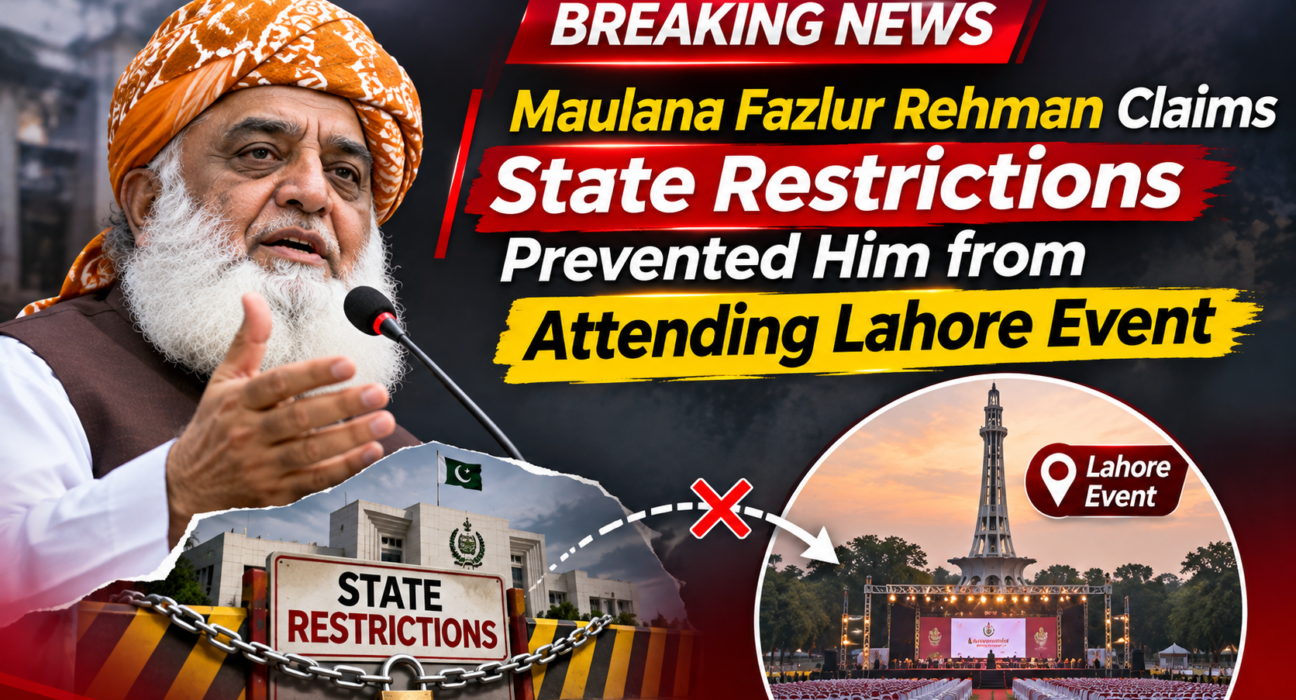
On Tuesday, November 24, 2026, a lawyers’ gathering in Lahore became the centre of a sharp political row. Jamiat Ulema-e-Islam-Fazl (JUI-F) chief Maulana Fazlur Rehman was due to speak at it. His party says he never reached the venue because police surrounded the house where he was staying.
The story has legal, political and constitutional sides. This article lays out what is known so far. It separates confirmed facts from claims, explains the rights involved, and looks at where the dispute may go next. The reporting here comes from Pakistani and regional outlets published on November 24, and the situation may change quickly.
Maulana Fazlur Rehman Claims State Restrictions Prevented Him from Attending Lahore Event
According to his party, Maulana Fazlur Rehman arrived in Lahore on Monday night. He was invited by the Lahore High Court Bar Association (LHCBA) to address lawyers at an all-parties conference the next day. Instead of leaving for the venue, the JUI-F says, he found Punjab police deployed in strength outside his residence. The party describes this as house arrest.
As The Express Tribune reported, JUI-F Senator Kamran Murtaza said no formal detention order was handed to the Maulana’s staff, even though they asked for one. Murtaza said political differences are one matter, but blocking a leader’s freedom of movement has no justification. He also said police told the party their presence was only meant to stop Fazlur Rehman from attending the event at the Lahore High Court. That is the party’s account of what officers said.
The same report says other leaders were due at the venue as well. PTI figures Barrister Gohar Ali Khan and Asad Qaiser were scheduled to speak. That detail matters because it shows the gathering was not a one-party show. It was a multi-party platform hosted by a bar association.
The phrase “claims state restrictions” is used deliberately. At the time of writing, the main source of the “house arrest” description is the JUI-F itself. News outlets attribute it to the party. Reports also noted that there was no immediate official response from Lahore police explaining the deployment. Readers should keep that gap in mind. The party’s version is detailed and consistent across outlets, but the official side had not given a full public explanation.
Timeline of Events
The sequence below is pieced together from reports published on November 24. Times are approximate where outlets did not give exact hours.
| Date / Time | Reported Event | Source of Claim |
| Week before Nov. 24 | Police and Federal Constabulary security for Fazlur Rehman and family reportedly withdrawn in Islamabad and Dera Ismail Khan | JUI-F statement, via PTI |
| Monday night, Nov. 23 | Fazlur Rehman arrives in Lahore | JUI-F |
| Late Monday night | JUI-F Punjab leaders allege party officials were arrested in raids | JUI-F Punjab General Secretary |
| Tuesday, Nov. 24, morning | Heavy police contingent and barriers appear outside his residence | JUI-F; multiple news reports |
| Tuesday, Nov. 24 | Planned address to lawyers at LHCBA event does not take place with him present | JUI-F; news reports |
| Tuesday, Nov. 24 | Petition filed in Lahore High Court seeking his “recovery” and an end to the cordon | Court petition, reported by Geo and others |
| Tuesday, Nov. 24 | Punjab government reportedly imposes Section 144 in Lahore over law and order | ARY News |
Who Is Maulana Fazlur Rehman and Why His Voice Matters
Maulana Fazlur Rehman is one of the most experienced politicians in Pakistan. He leads the JUI-F, a religious-political party with its strongest base in Khyber Pakhtunkhwa and Balochistan. He has served in parliament for decades and has held the role of opposition leader in the National Assembly in the past.
He is also known for street politics. In 2019, he led the Azadi March against the then government, a protest that moved across the country and ended in Islamabad. Later, he headed the Pakistan Democratic Movement (PDM), the opposition alliance that brought together parties with very different views. Those episodes show he can mobilise large crowds and bring rival parties to the same table.
That history explains why any move involving him draws attention. When a leader with this record is said to be blocked from a public event, people read it as more than a local policing matter. Supporters see an attack on a major party. Critics of the JUI-F may argue that authorities have a duty to manage security risks. Both sides agree on one thing: the stakes are political.
Recently, the Maulana has sharpened his criticism of the military establishment. PTI reporting says he has spoken against Army Chief Field Marshal Asim Munir on issues such as rare earth minerals and the imposition of governor’s rule in Khyber Pakhtunkhwa. Earlier in 2026, Daily Pakistan reported that the Punjab Assembly moved a resolution seeking action against him over remarks about the army. These facts do not prove why police acted on November 24, but they form the background that most commentators are using to read the event.
The Lahore High Court Bar Association Event
Bar associations hold a special place in Pakistani public life. Lawyers played a central role in the movement for judicial independence in 2007 and 2008. Since then, bar platforms have often hosted political leaders who want to speak on constitutional questions, court independence and civil liberties.
The event in question was described as an all-parties conference organised by the LHCBA. The petition filed in court said the JUI-F chief was scheduled to attend it. The party stresses that he was formally invited. That point is important to its argument. He was not planning a rally on the street. He was going to speak at an event hosted by a professional body of lawyers, inside a court complex setting.
For the party, this makes the alleged restriction harder to defend. A closed-door political meeting might raise one set of security concerns. A bar association gathering is different, since lawyers are the very people who study and defend constitutional rights. Hosting a leader there is a normal part of political and legal debate in Pakistan.
The presence of PTI leaders on the same programme also gives the event a wider meaning. It suggests that opposition voices from different parties were using the bar platform to speak at the same time. That is one reason why observers say the event drew official attention.
JUI-F’s Claims and Public Reaction
The party’s reaction was fast and strong. It issued statements on social media, held discussions with reporters, and went to court within hours. The language used by its leaders shows how seriously the party views the matter.
Allegations of Late-Night Raids
Daily Pakistan reported that JUI-F Punjab General Secretary Hafiz Naseer Ahmed Ahrar criticised the provincial government. He alleged that party officials were arrested during late-night raids before the police cordon around the Maulana’s residence went up. He called the developments unacceptable and urged the government to rethink its actions. He also described Fazlur Rehman as the party’s red line, meaning any move against him would be treated as crossing a limit.
These arrest claims have not been independently verified in the reports reviewed for this article. They are the party’s allegations. If the police or the Punjab government respond, the details will become clearer. For now, readers should treat them as claims awaiting confirmation or denial.
Reported Barriers and Residents’ Complaints
Several outlets described containers or barriers near the entrance of the housing society where the Maulana was staying. Daily Pakistan reported that residents also faced restrictions entering and leaving the area. Reports differ slightly on the exact location. The Pakistan Observer named Park View Society, while Dunya News mentioned the Chuhng area. These may refer to the same general neighbourhood or to different descriptions of it. The difference is minor, but it shows why careful readers should check updates as reporters add details.
If residents did face movement limits, that adds a second layer to the story. Even people with no link to politics may have been affected by the deployment. This can shape public opinion, since a restriction aimed at one leader that disrupts a whole neighbourhood draws more complaints.
The Withdrawal of Security Cover
Another detail from the PTI report deserves attention. The JUI-F said that, a week earlier, police and Federal Constabulary personnel who had been guarding Maulana Fazlur Rehman and his family were pulled back from their residences in Islamabad and Dera Ismail Khan. The party presents this as part of a pattern. First, security was withdrawn. Then, restrictions followed in Lahore.
The party has not offered proof that the two events are linked, and officials have not publicly confirmed the withdrawal in the reports reviewed. Still, the sequence is part of why party leaders say the pressure is deliberate. Security for senior political figures is normally decided on threat assessments. Any change to it, in either direction, tends to be read politically in Pakistan.
What Officials Have and Have Not Said
Pakistan Observer noted that, at the time it published, there was no immediate official response from Lahore police about the allegations or the reasons for the deployment. That is the key gap in the public record.
The only account of the police position in the reports reviewed comes through the JUI-F. According to Senator Murtaza, officers said their presence was aimed at preventing the Maulana from attending the Lahore High Court event. If true, that statement is significant. It would mean the deployment had a stated purpose tied to a specific event, rather than a general security task. But since it is relayed by the party, readers should wait for a direct statement from the authorities before treating it as settled.
In many similar cases in Pakistan, officials have cited security threats, law and order concerns, or the risk of public disorder to explain such measures. Whether that applies here is not yet known. Fair coverage requires saying so plainly. The official explanation, if one comes, deserves the same space as the party’s claims.
The Section 144 Order in Lahore
ARY News reported that on the same Tuesday, the Punjab government imposed Section 144 in Lahore, citing the prevailing law and order situation. Section 144 of the Code of Criminal Procedure lets authorities ban gatherings of a certain size and limit certain activities for a short period when they see a risk to public peace.
The report mentioned the order alongside the petition over the Maulana’s residence. It did not state that the order was issued because of him, and nothing in the reviewed coverage proves a direct link. Readers should not assume one. Still, the timing explains why many observers looked at the two developments together. A Section 144 order can be used to restrict public events, and it often becomes part of legal arguments when a political gathering is stopped.
The Petition in the Lahore High Court
Within hours of the alleged confinement, the JUI-F went to court. Geo News reported that a petition was filed in the Lahore High Court on Tuesday seeking the recovery of the JUI-F chief after police allegedly restricted his movement and stationed personnel outside his residence. Dunya News said the plea asked for an urgent hearing and an order for his recovery. Daily K2 named the petitioner’s lawyer as Advocate Abrar Hussain.
The petition states, according to the Express Tribune, that police were deployed around the residence and that he was confined inside without any legal order authorising detention or house arrest. This is the legal heart of the matter. The party is not only saying the restriction was unfair. It is saying there was no written authority behind it.
A petition for “recovery” is a form of habeas corpus plea. In Pakistan, such petitions ask a high court to order authorities to produce a person and explain the legal basis for holding him. Courts treat them seriously because liberty is at stake. In past cases, including petitions for other political figures, high courts have called officials to appear and explain.
What the Lahore High Court decides will matter. It may ask the Punjab government and police to submit a reply. It may ask whether any order exists. It may also decide that the issue has become moot once the event has passed. Each outcome would send a different signal to political parties watching the case.
Constitutional Rights at Stake
The dispute touches several basic rights in Pakistan’s Constitution. The JUI-F argues that these rights were not respected. Authorities, if they respond, will likely argue that reasonable restrictions apply in the name of public order. Both arguments rest on the same text, so it helps to look at what the Constitution says.
Article 15 protects the freedom of movement throughout Pakistan and the right to reside and settle anywhere, subject to reasonable restrictions imposed by law in the public interest. Article 16 protects the right to assemble peacefully, again subject to reasonable restrictions imposed by law. Article 17 protects freedom of association and the right to form political parties. Article 10 sets safeguards for people who are arrested or detained, including being told the grounds of arrest and being brought before a magistrate within 24 hours. Article 199 gives high courts the power to hear petitions challenging unlawful detention.
The words “subject to reasonable restrictions imposed by law” matter most. A restriction must have a legal basis, and it must be reasonable. The party’s central claim is that no legal order was shown to the Maulana’s staff. If that is correct, the argument that the restriction was “imposed by law” becomes difficult. If authorities can show a valid order, such as a preventive measure based on a specific threat, the legal debate shifts to whether it was reasonable.
Rights and Legal Tools at a Glance
The table below explains the main legal points in plain language. It is a general guide, not legal advice.
| Legal Provision | What It Covers | Why It Matters Here |
| Article 15 | Freedom of movement, subject to reasonable legal restrictions | Core of the JUI-F’s complaint about being kept inside |
| Article 16 | Right to peaceful assembly, subject to reasonable legal restrictions | Relates to attending and addressing a bar association event |
| Article 17 | Freedom of association and political activity | Links to the party’s right to operate and its leader’s role |
| Article 10 | Safeguards on arrest and detention, including production before a magistrate | Relevant to the claim that no detention order was shown |
| Article 199 | High court power to hear petitions against unlawful detention | Basis for the recovery petition filed in Lahore |
| Section 144, CrPC | Temporary ban on gatherings to prevent disorder | Reportedly imposed in Lahore the same day |
The Wider Political Context
To understand why this event has attracted so much attention, it helps to place it in the larger political picture of 2026. Several threads run through the coverage.
First, there is the Maulana’s public criticism of the military establishment. PTI reported that he has spoken against Field Marshal Asim Munir on the issues of rare earth minerals and governor’s rule in Khyber Pakhtunkhwa. Rare earth minerals have become a topic of public debate in Pakistan because of their economic and strategic value. Governor’s rule in a province is a serious step that opposition parties usually call a threat to elected government. A leader who speaks out on both subjects is stepping into sensitive ground.
Second, there is the earlier legal pressure on him. In July 2026, Daily Pakistan reported that the Maulana was summoned to court over remarks described as anti-army, and that a resolution had been moved in the Punjab Assembly seeking action against him. Those facts show that his relationship with parts of the state was already tense before November.
Third, there is the matter of the platform itself. The LHCBA event brought together leaders from more than one party. That includes figures from the PTI. For a government worried about opposition cooperation, a shared stage can look like a warning sign. For opposition parties, it is simply a lawful way to speak to the public.
None of this proves a motive for the police action. It explains why people on both sides read the event as political. Supporters of the JUI-F say it fits a pattern of pressure on a vocal critic. Supporters of strong security measures may say that leaders at high-profile events can face threats, and that authorities must act in advance. Both views deserve to be heard, and the court process is the proper place to test them.
How the Public Debate Is Taking Shape
The reaction so far falls into a few clear groups of argument. They are summarised here as general positions, not as quotes from particular parties beyond what has been reported.
Those who back the JUI-F’s complaint say that a senior leader invited by a respected professional body should be free to attend. They argue that if police needed to manage a threat, they could have provided escort and security rather than confinement. They also stress the lack of a written order, which they see as the clearest sign that the restriction lacked legal cover.
Those who defend the authorities’ right to act say that governments have a duty to protect public order. They point out that Section 144 orders and preventive measures are lawful tools when used within the law. They may add that political gatherings in tense times can lead to clashes, and that officials are entitled to judge the risk.
A third group simply calls for transparency. They want the authorities to state what order, if any, was used, who issued it, and for what reason. Lawyers’ bodies often take this line. The strength of the transparency argument is that it does not depend on taking a side in the political fight. Whatever the reason for the deployment, the public has a right to know the legal basis.
Why Bar Associations Often Take a Strong Stand
Lawyers’ groups in Pakistan have a record of speaking up when they believe a legal process has been bypassed. Their interest here is direct. The event was theirs, and a guest speaker was reportedly stopped from reaching it. Whatever the final facts, many bar members are likely to view the matter as an attack on their ability to host open debate.
What Could Happen Next
Several developments are possible in the coming days. None is certain, so readers should treat these as possibilities, not predictions.
The Lahore High Court may hear the petition and ask the Punjab government and police for a reply. The court may ask whether any detention or restriction order exists, and under which law it was made. If no order is produced, the court may direct that the restrictions end. If an order is produced, the court may review its legal basis.
The police or the Punjab government may issue a statement. A clear explanation would help settle the public debate. It could confirm or deny the arrests alleged by the JUI-F, and it could explain the reported containers and barriers.
The JUI-F may announce further steps. The party has used both street politics and legal action before. It might hold protests, call a meeting of its leadership, or seek support from other opposition parties. Its Punjab leadership has already warned against further restrictions on the party’s top leader.
The LHCBA may also respond. As the host of the event, it has its own interest in the outcome. A statement from the bar, or a resolution by its members, could add pressure for a clear legal explanation.
Finally, the reported withdrawal of security cover is an issue that may return. The party raised it as part of its complaint. If the Maulana faces genuine threats, the removal of protection would be a serious matter in its own right. Authorities may need to explain how security decisions are made for senior political leaders.
Why This Matters for Pakistani Democracy
Beyond the personalities, the episode raises a basic question of how political space is managed. Every democracy has to balance public order against the freedom to speak and move. The test is whether restrictions follow the law, are shown to be needed, and are open to challenge in court. The petition in the Lahore High Court is that test in action.
Whatever the outcome, the way the case is handled will be watched closely. A transparent process, with clear legal grounds and a court hearing, would reduce suspicion on all sides. A vague or silent response would let rumours grow. For readers who follow Pakistani politics, the key signals to watch are the court’s questions, the government’s reply, and whether similar restrictions appear again for other leaders.
Key Takeaways
Maulana Fazlur Rehman’s alleged confinement in Lahore on November 24, 2026 is a developing story with a clear core. The JUI-F says police surrounded his residence in Lahore and stopped him from addressing a Lahore High Court Bar Association event. It says no legal order was shown. It filed a petition in the Lahore High Court seeking his recovery and the removal of the cordon.
The party also alleges late-night arrests of its officials and points to the earlier withdrawal of security cover in Islamabad and Dera Ismail Khan. Reports mention barriers near the housing society and a Section 144 order in Lahore the same day, though no direct link between the order and the Maulana has been confirmed. As of the reports reviewed, there was no full public explanation from Lahore police.
The facts that remain unclear are the legal basis for the deployment, the truth of the arrest claims, and the reasons behind the security changes. The Constitution gives both sides something to argue with. It protects movement, assembly and association, but allows reasonable restrictions imposed by law. The court’s handling of the petition will show which side’s reading carries more weight.
For now, the most useful approach for readers is to separate claims from confirmed facts, follow official statements and court orders as they appear, and wait for the authorities to explain the legal grounds. That approach respects the public’s right to know and the principle that any limit on a citizen’s freedom must be able to withstand scrutiny.
For further reading on the court filing, see Geo News coverage of the Lahore High Court petition.