

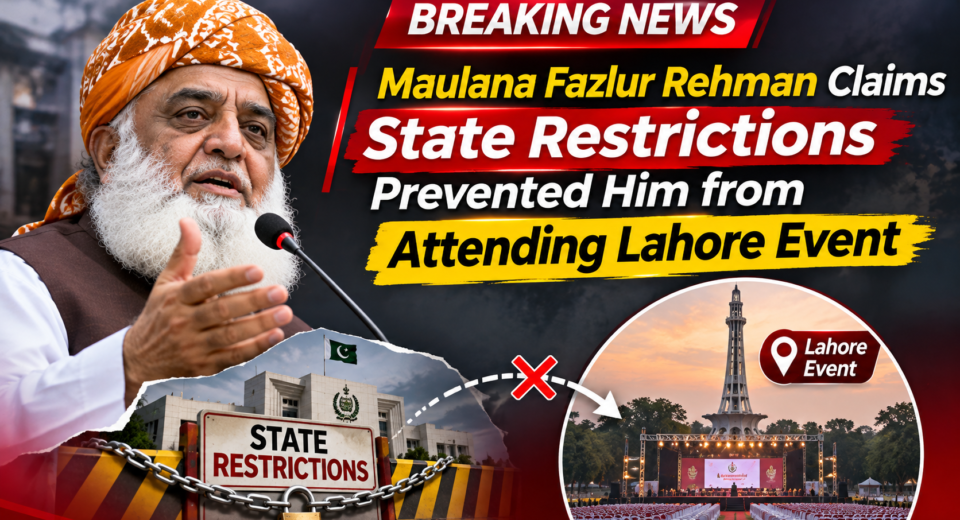
Fazlur Rehman Lahore Event Controversy: Police Restrictions, JUI-F Claims and the Legal Fight
On Tuesday, November 24, 2026, a lawyers’ gathering in Lahore became the centre of a sharp political row. Jamiat Ulema-e-Islam-Fazl (JUI-F) chief Maulana Fazlur Rehman was due to speak at it. His party says he never reached the venue because police surrounded the house where he was staying. The story has legal, political and constitutional sides. This article lays out what is known so far. It separates confirmed facts from claims, explains the rights involved, and looks at where the dispute may go next. The reporting here comes from Pakistani and regional outlets published on November 24, and the situation may change quickly. Maulana Fazlur Rehman Claims State Restrictions Prevented Him from Attending Lahore Event According to his party, Maulana Fazlur Rehman arrived in Lahore on Monday night. He was invited by the Lahore High Court Bar Association (LHCBA) to address lawyers at an all-parties conference the next day. Instead of leaving for the venue, the JUI-F says, he found Punjab police deployed in strength outside his residence. The party describes this as house arrest. As The Express Tribune reported, JUI-F Senator Kamran Murtaza said no formal detention order was handed to the Maulana’s staff, even though they asked for one. Murtaza said political differences are one matter, but blocking a leader’s freedom of movement has no justification. He also said police told the party their presence was only meant to stop Fazlur Rehman from attending the event at the Lahore High Court. That is the party’s account of what officers said. The same report says other leaders were due at the venue as well. PTI figures Barrister Gohar Ali Khan and Asad Qaiser were scheduled to speak. That detail matters because it shows the gathering was not a one-party show. It was a multi-party platform hosted by a bar association. The phrase “claims state restrictions” is used deliberately. At the time of writing, the main source of the “house arrest” description is the JUI-F itself. News outlets attribute it to the party. Reports also noted that there was no immediate official response from Lahore police explaining the deployment. Readers should keep that gap in mind. The party’s version is detailed and consistent across outlets, but the official side had not given a full public explanation. Timeline of Events The sequence below is pieced together from reports published on November 24. Times are approximate where outlets did not give exact hours. Date / Time Reported Event Source of Claim Week before Nov. 24 Police and Federal Constabulary security for Fazlur Rehman and family reportedly withdrawn in Islamabad and Dera Ismail Khan JUI-F statement, via PTI Monday night, Nov. 23 Fazlur Rehman arrives in Lahore JUI-F Late Monday night JUI-F Punjab leaders allege party officials were arrested in raids JUI-F Punjab General Secretary Tuesday, Nov. 24, morning Heavy police contingent and barriers appear outside his residence JUI-F; multiple news reports Tuesday, Nov. 24 Planned address to lawyers at LHCBA event does not take place with him present JUI-F; news reports Tuesday, Nov. 24 Petition filed in Lahore High Court seeking his “recovery” and an end to the cordon Court petition, reported by Geo and others Tuesday, Nov. 24 Punjab government reportedly imposes Section 144 in Lahore over law and order ARY News Who Is Maulana Fazlur Rehman and Why His Voice Matters Maulana Fazlur Rehman is one of the most experienced politicians in Pakistan. He leads the JUI-F, a religious-political party with its strongest base in Khyber Pakhtunkhwa and Balochistan. He has served in parliament for decades and has held the role of opposition leader in the National Assembly in the past. He is also known for street politics. In 2019, he led the Azadi March against the then government, a protest that moved across the country and ended in Islamabad. Later, he headed the Pakistan Democratic Movement (PDM), the opposition alliance that brought together parties with very different views. Those episodes show he can mobilise large crowds and bring rival parties to the same table. That history explains why any move involving him draws attention. When a leader with this record is said to be blocked from a public event, people read it as more than a local policing matter. Supporters see an attack on a major party. Critics of the JUI-F may argue that authorities have a duty to manage security risks. Both sides agree on one thing: the stakes are political. Recently, the Maulana has sharpened his criticism of the military establishment. PTI reporting says he has spoken against Army Chief Field Marshal Asim Munir on issues such as rare earth minerals and the imposition of governor’s rule in Khyber Pakhtunkhwa. Earlier in 2026, Daily Pakistan reported that the Punjab Assembly moved a resolution seeking action against him over remarks about the army. These facts do not prove why police acted on November 24, but they form the background that most commentators are using to read the event. The Lahore High Court Bar Association Event Bar associations hold a special place in Pakistani public life. Lawyers played a central role in the movement for judicial independence in 2007 and 2008. Since then, bar platforms have often hosted political leaders who want to speak on constitutional questions, court independence and civil liberties. The event in question was described as an all-parties conference organised by the LHCBA. The petition filed in court said the JUI-F chief was scheduled to attend it. The party stresses that he was formally invited. That point is important to its argument. He was not planning a rally on the street. He was going to speak at an event hosted by a professional body of lawyers, inside a court complex setting. For the party, this makes the alleged restriction harder to defend. A closed-door political meeting might raise one set of security concerns. A bar association gathering is different, since lawyers are the very people who study and defend constitutional rights. Hosting a leader there is a normal part of political and legal debate in