
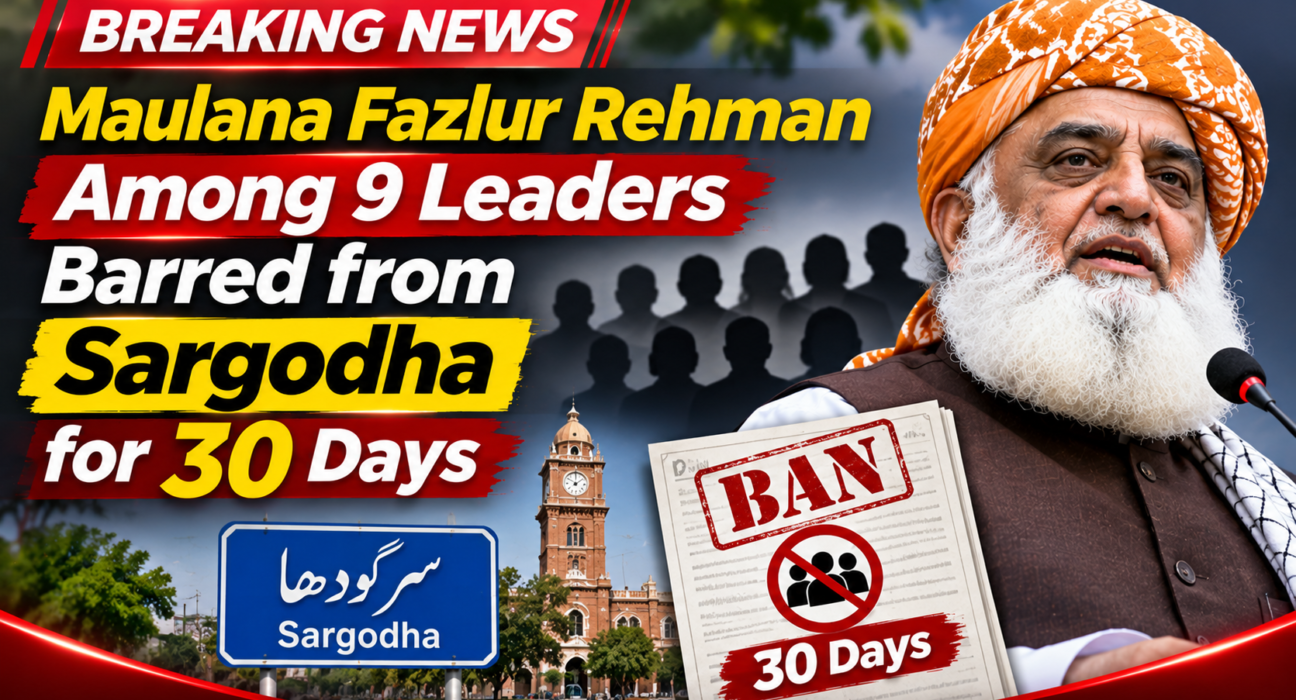
The Sargodha district administration imposed a 30-day entry ban on Maulana Fazlur Rehman and eight other people. The administration cited public safety and the need to maintain law and order. According to a report by The Express Tribune, the order says the named individuals “shall not enter, reside or remain” within the revenue limits of Sargodha district. That wording is broad. It bars the nine men from visiting, from staying overnight, and from living anywhere inside the district’s boundaries.
The order took effect immediately and runs for 30 days from November 25, 2026. That means it stays active until roughly the third week of December, unless a court suspends it or the administration withdraws it earlier.
The order was issued under Section 5(1)(d) of the Maintenance of Public Order (MPO) Ordinance, 1960. This is an old law. Pakistani authorities have used it for decades to control the movement and speech of political and religious figures during tense periods.
The order also carries a pointed remark. It describes the individuals as people in the habit of making provocative and objectionable speeches. That language is important. It tells us the administration is not only worried about crowd size. It is also worried about what might be said from the stage.
Who Is Named in the Order
The nine names reported in the order include several senior figures of Jamiat Ulema-e-Islam-Fazl. The names confirmed in the reports are:
- Maulana Fazlur Rehman, the party’s central chief
- Maulana Naseer Ahmad Abrar, the party’s Punjab secretary-general
- Maulana Amjad Khan, who the party calls its Punjab chief
- Maulana Safi Ullah
- Professor Ghazanfar Aziz
- Maulana Muhammad Noor Khan Hans
- Maulana Muhammad Zakria Shah
- Maulana Muhammad Yahya Abbasi
A ninth name appears in the order, but the available reports cut it off, so it is not listed here. The group mixes national leadership with provincial organizers. That suggests the order tries to cover both the main speakers and the people who manage local crowds.
Key Facts at a Glance
| Detail | Information |
| Issuing authority | Sargodha district administration (Deputy Commissioner) |
| Legal basis | Section 5(1)(d), Maintenance of Public Order Ordinance, 1960 |
| Number of people barred from entry | Nine |
| Duration | 30 days |
| Start date | November 25, 2026 |
| Main person named | Maulana Fazlur Rehman, JUI-F chief |
| Stated reason | Public safety and law and order |
| Related order | Speech ban on 19 local religious scholars for 30 days |
| Earlier order | Section 144 imposed on November 23 for seven days |
What the Sargodha Administration Said
The order was signed by Deputy Commissioner Hussain Ahmed Raza Chaudhry, according to a report by Daily Pakistan. The administration’s reasoning follows a familiar pattern. Officials argue that large political gatherings can lead to clashes, road blockages, and threats to public property. They say they must act before trouble starts, not after.
This approach is called preventive action. Under the MPO, an official can restrict a person’s movement if there is a belief that the person may disturb public peace. The official does not need to wait for a crime to happen. This is the main reason critics dislike such laws. They say the standard is too loose and open to political use.
The administration has not, in the reports reviewed, offered any specific evidence that the nine men planned violence. The order refers to a “habit” of provocative speeches. Supporters of the JUI-F say this is a vague charge. Officials, on the other hand, may say that the wording is standard for such orders.
Section 144 and Speech Bans on 19 Local Clerics
The entry ban on the nine leaders did not arrive alone. It sits on top of other restrictions.
On November 23, the Sargodha administration imposed Section 144 for seven days. This section of the Code of Criminal Procedure bans public gatherings, political meetings, sit-ins, rallies, processions, and demonstrations across the district. In simple terms, it makes almost every kind of public political event illegal for the period it covers.
In a separate order, the administration also barred 19 local religious scholars from delivering speeches for 30 days. These are not the headline names. They are local clerics who might have addressed crowds in mosques, markets, or smaller meetings. By limiting them, the administration tried to close a second route for public mobilization.
Taken together, the three orders form a layered plan:
- Section 144 blocks public gatherings.
- The entry ban keeps the top leaders out of the district.
- The speech ban silences local voices who could rally supporters.
One detail stands out. Section 144 runs for seven days, but the entry and speech bans run for 30. The shorter order covers the conference date. The longer orders reach well beyond it. This suggests officials want to limit JUI-F activity in Sargodha for a full month, not just for one event.
Background: Rising Tension Between JUI-F and the Government
The Sargodha order did not appear from nowhere. Relations between Maulana Fazlur Rehman and the ruling coalition have worsened over the past weeks. Dunya News described the situation as a steady decline in ties, even though the two sides were once close.
Here are the main steps in that decline:
- October 29: During a heated Senate session, Interior Minister Mohsin Naqvi claimed that JUI-F leaders had earlier approached the government and asked for governor’s rule in Khyber Pakhtunkhwa. JUI-F lawmakers protested loudly, and Fazlur Rehman pushed back hard.
- November 21: Fazlur Rehman warned that his party would launch wide protests if action against its members and leaders did not stop. Pajhwok Afghan News carried the report.
- November 24: The party went to the Lahore High Court. It said police had restricted Fazlur Rehman’s movement at his Lahore residence and stopped him from attending a lawyers’ convention.
The Lahore episode deserves a closer look. Police reportedly placed heavy forces and containers near his home in the Chuhng area. Police later removed the containers. Fazlur Rehman addressed the gathering through a video link instead. The Lahore High Court took strict notice of the restrictions, and the restriction on his movement in the city was later lifted.
So the Sargodha order is the third major restriction in about three days. It follows the Lahore confinement and the Section 144 order. Many observers see a pattern here. The government says it is protecting public order. JUI-F says it is being shut out of public space.
The Planned Conference in Sargodha
The reason the order matters so much is the event it targets. JUI-F planned a large public gathering in Sargodha on November 26. The party named it the Protection of the Constitution of Pakistan and Public Rights Conference. The venue was Fatima Jinnah Road.
Fazlur Rehman and other senior leaders were set to address the crowd. The main caravan was to be led by Fazlur Rehman himself, along with Punjab Secretary-General Hafiz Naseer Ahmad Abrar.
The conference title tells us the party’s message. JUI-F wants to present the event as a defense of the constitution and of citizens’ rights. The government, by contrast, treats it as a risk to public order. These two views cannot both win in Sargodha. That is why the clash became so sharp.
JUI-F has strong roots in religious seminaries and has a disciplined worker base. Its rallies are usually large and well organized. This is one reason officials took early steps to limit the event. A crowd of that type can be hard to move once it reaches a venue.
Arrests, House Arrests, and Road Closures
Reports from November 25 and 26 describe a wave of detentions and road closures. Some of these claims come from the JUI-F. Police had not confirmed the detentions in the reports reviewed. So readers should treat them as claims, not settled facts.
According to JUI-F, the following events took place:
- Central Secretary-General Maulana Abdul Ghafoor Haideri was detained and later placed under house arrest at an undisclosed location. Senator Kamran Murtaza said Haideri had been staying with a host in Khushab when he was taken into custody on Wednesday.
- Punjab chief Maulana Amjad Khan was placed under house arrest in Khushab.
- The party’s Islamabad amir, naib amir, and several other leaders were reportedly rounded up.
- A student leader of the party was arrested.
- The son of the Sargodha amir, who is a barrister, was reportedly arrested and treated violently. The Sargodha amir himself was ill and confined at home.
- Workers were arrested in Khushab, Rawalpindi, Dera Ghazi Khan, and other districts.
The party also said roads leading to Sargodha were blocked, including routes linked to Chashma, Mianwali, Khushab, and Faisalabad. A party spokesperson, Aslam Ghori, said the motorway had been closed on the excuse of fog even though the sun was out. He called the government’s steps unfair and warned they would backfire.
Fazlur Rehman described the situation in Sargodha as curfew-like. He said police had taken full control of the conference venue.
The party said it would approach the Rawalpindi bench of the Lahore High Court over the alleged disappearance of its leaders. Murtaza said police had not given the party any lawful order about Haideri’s house arrest.
Again, these are the party’s claims. A fair reading needs the government’s side too. At the time of writing, the Punjab government had not offered a detailed public response to each claim. If it does, that response will be an important part of the story.
Fazlur Rehman’s Response and the Nationwide Protest Call
Fazlur Rehman did not accept the ban quietly. On Thursday, he released a video message on X and announced nationwide protests. He asked party workers across the country to come out and block major highways. He named places from Kohistan and Chitral in the north to Badin, Turbat, Makran, and Chaman in the south and west.
He also said the Sargodha conference announcement had not changed. Convoys, he said, were still moving toward the city from several directions. He added that he was determined to set off for Sargodha himself. His aides said his convoy left but got stuck in traffic.
He gave three reasons for the protest:
- The ban on the party’s gathering
- The arrests of workers
- The alleged violence against them
He said the party would use its right to protest against what he called unlawful and authoritarian tactics.
The call produced results on the ground within hours. JUI-F workers blocked the Peshawar motorway toll plaza and stopped vehicles in both directions between Peshawar and Islamabad. Families were among those caught in the traffic. Senator Attaul-Haq Darwesh joined the workers at the toll plaza. In Quetta, Senator Kamran Murtaza urged workers to block roads at three designated points.
At the same time, the party’s spokesperson urged workers to stay patient, use restraint, and avoid provocation. This mixed message is worth noting. The party is calling for strong pressure but also asking for discipline. How well that balance holds will shape the next few days.
Timeline of Key Events
The events moved quickly. The table below shows the order of the main developments reported so far.
Timeline of the Sargodha Standoff
| Date | Event |
| October 29, 2026 | Heated Senate session over claims about governor’s rule in Khyber Pakhtunkhwa |
| November 21, 2026 | Fazlur Rehman warns of wide protests if action against party members continues |
| November 23, 2026 | Sargodha administration imposes Section 144 for seven days |
| November 24, 2026 | JUI-F petitions Lahore High Court over restrictions at Fazlur Rehman’s Lahore residence |
| November 25, 2026 | Entry ban on nine leaders takes effect; reports of arrests in Khushab begin |
| November 26, 2026 | Conference day; Fazlur Rehman announces nationwide protests; highway blockades begin |
Constitutional Rights and the Limits of Public Order Orders
This case touches several basic rights found in Pakistan’s Constitution. I am not a lawyer, and this section is general information, not legal advice. Still, the key points are easy to explain.
Article 15 protects the freedom of movement. Article 16 protects the right to assemble peacefully. Article 17 protects the right to form associations and political parties. All three rights come with limits. The Constitution allows “reasonable restrictions” imposed by law, including restrictions in the interest of public order.
That phrase is where the debate sits. Both sides can claim the Constitution backs them.
The Argument from Supporters of the Ban
Supporters of the administration’s move say:
- Public order is a core duty of the state.
- A large rally can lead to clashes and blocked roads.
- Preventive steps are cheaper than dealing with violence later.
- The MPO and Section 144 are legal tools that the law allows.
The Argument from Critics of the Ban
Critics, including the JUI-F, say:
- A 30-day entry ban is a heavy step against a national leader.
- The order points to speeches, not to any proven plan for violence.
- The measures seem to target one party at a time of political tension.
- Courts have often questioned the wide use of such orders.
Courts have a real role here. The Lahore High Court already took notice of the movement restrictions in Lahore. The party has said it will go back to court on the arrests and the disappearances. A judge could suspend the entry ban, narrow it, or leave it in place. Any of these outcomes would send a strong signal.
Past Entry Bans on Religious and Political Leaders in Pakistan
This kind of order has a long history in Pakistan. Provincial and district governments have repeatedly barred leaders from entering a city, district, or province for a fixed time.
Fazlur Rehman himself has faced such steps before. Earlier reports describe a seven-day ban on his entry into Punjab, which was served to him by a magistrate in the parliament area while he was serving as Leader of the Opposition. Another report describes a ban on his entry into Sindh, which led to him being sent back from Karachi airport without leaving the arrival lounge.
District administrations have also banned many clerics at once, often during Muharram and Safar. In those cases, the stated goal is usually to prevent sectarian trouble. A Chakwal order, for example, barred dozens of clerics from entering the district and stopped ten local clerics from speaking.
The Sargodha order has a similar form. But it is different in one key way. It targets the head of a major parliamentary party during a sharp political fight, not a group of clerics during a religious season. That difference is why it has drawn so much attention.
What Happens Next
Several paths are open. Here are the main ones to watch.
The court route. JUI-F is likely to challenge the orders in the Lahore High Court. The court could ask the administration to explain its reasons. It could also pause the ban while it hears the case. Courts in Pakistan have often looked closely at preventive orders, especially when they affect elected leaders.
The street route. The party’s call for highway blockades puts pressure on the government. Road blockades hurt ordinary people, including families, patients, and traders. If they continue, officials may respond with more arrests or more restrictions. That could create a cycle that is hard to stop.
The talks route. Political parties in Pakistan often settle such standoffs through back-channel talks. Other opposition voices have been calling for national dialogue and a political reset. If the government and JUI-F open a line of contact, the ban could be relaxed as part of a deal.
The calendar. The Section 144 order for seven days is due to end soon after the conference date. The entry and speech bans last for 30 days. This gap means that even if the immediate crisis fades, a legal issue will remain open until late December.
For ordinary residents of Sargodha, the effect is practical. Road closures, traffic jams, and a heavy police presence can disrupt daily life. People who live and work near the planned venue are likely to feel this most.
Final Thoughts
The decision to bar Maulana Fazlur Rehman and eight others from Sargodha for 30 days is more than a local administrative step. It sits at the center of a wider clash over who gets to hold public events, who decides what counts as a threat to peace, and how far preventive laws can go.
The administration says it acts for public safety. The JUI-F says it is being pushed out of public life without proof of wrongdoing. Both sides have a case that fits parts of the law. Neither side has yet given the public a full, checkable account. Many claims about arrests and disappearances come from the party and have not been confirmed by police.
What is clear is the speed of events. In under a week, the country saw a Section 144 order, a movement restriction in Lahore, a court petition, a 30-day entry ban, arrests, and a nationwide protest call. How courts, the government, and the party respond in the coming days will decide whether this episode cools down or grows.
Readers who want to follow the story should rely on updates from established news outlets and on official statements. They should also look for confirmation of claims from more than one side. This report will remain only a snapshot of a story that is still unfolding. For another detailed account of the orders and the 19-cleric speech ban, readers can see the Daily Pakistan report.