

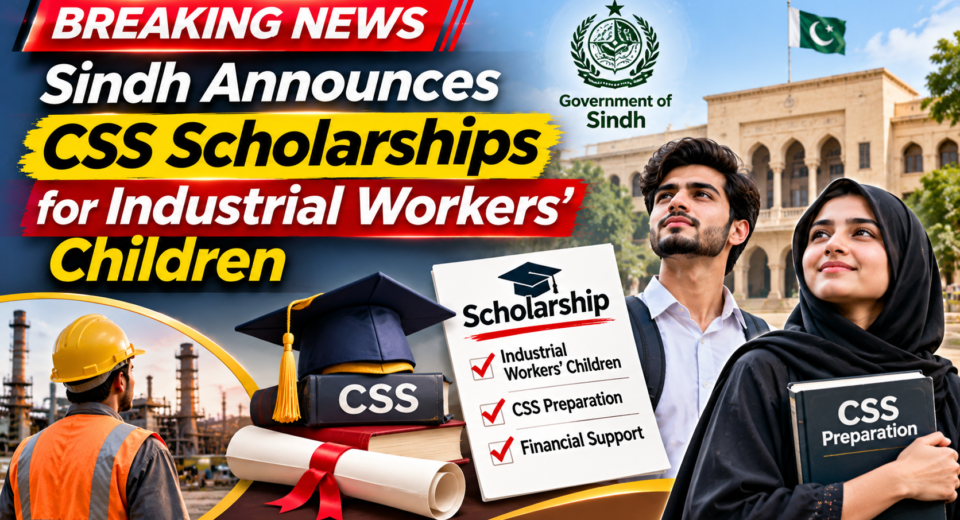
Sindh Announces CSS Scholarships for Industrial Workers’ Children
According to a ProPakistani report, the Workers’ Welfare Board Sindh approved a four-month CSS preparatory programme at the Civil Services Academy (CSA) in Lahore. The programme is for 20 children of registered industrial workers. Each selected candidate will receive a board scholarship worth Rs. 800,000. The announcement was made at the board’s 37th governing body meeting. Labour Minister Saeed Ghani, who chairs the board, led the meeting. The scholarships are reserved for children of registered industrial workers from Sindh. This ties the benefit directly to the province’s labour community. The idea is simple. The CSS exam is the main door to Pakistan’s top civil service posts. Preparing for it takes money, time, and good guidance. A fully funded course at a recognized academy gives worker families a chance to compete on more equal ground. Twenty seats is a small number against the number of industrial workers in the province. It is better to see this as a pilot that proves the idea. If the first batch does well, the board may expand it. That is an expectation, not an announced plan. Key Facts at a Glance Detail Information Announcing body Workers’ Welfare Board Sindh (WWBS) Meeting 37th governing body meeting Chaired by Labour Minister Saeed Ghani Programme type CSS preparatory programme Duration Four months Venue Civil Services Academy (CSA), Lahore Number of seats 20 Scholarship value Rs. 800,000 per selected candidate Who can apply Children of registered industrial workers from Sindh Related decision Regional welfare committees restored to speed up pending cases Why This Scholarship Matters Public service jobs carry respect, stable pay, and the power to shape policy. Yet the officer class in Pakistan has long come from a narrow slice of society. Children from working-class homes rarely reach the CSS exam hall. They often lack money for coaching fees, relocation, and study materials. A factory worker’s income usually goes to rent, food, and school fees. Little is left for a costly exam course in another city. Even a bright student may decide not to try. This scheme removes that barrier for 20 young people. There is also a social benefit. When a worker’s child becomes a civil servant, the whole community sees a new path. Younger students in labour colonies and workers’ model schools can look at that example and think bigger. That effect is hard to measure, but it is real. The programme also fits the stated goal of the WWBS. The board was created to turn money from the Workers Welfare Fund into services for workers and their families. A CSS scholarship is an unusual use of that money, but it follows the same logic as other education grants: invest in the next generation. Understanding the CSS Exam and Why Preparation Is Costly The CSS exam is run by the Federal Public Service Commission (FPSC). Candidates compete for posts in groups such as the District Management Group, Police Service of Pakistan, Foreign Service, and others. The process has several stages. It includes written papers, a medical test, a psychological assessment, and an interview. The written papers cover English essay and precis, general knowledge, and several optional subjects. Candidates need a bachelor’s degree to apply, and age limits apply. The FPSC sets these rules and can change them, so candidates should always check the latest notice on the FPSC website before applying. Preparation is hard for three reasons: A four-month intensive programme cannot replace years of reading. It can, however, sharpen exam technique, build writing discipline, and give structure to a student who already has a strong academic base. That is where the Rs. 800,000 scholarship fits. Who Is Eligible: What We Know and What Is Still Unclear The reports confirm one main rule. The scholarship is for children of registered industrial workers from Sindh. The word “registered” is important. The WWBS serves workers employed in establishments that are registered and that contribute to the Workers Welfare Fund. Workers outside this system generally do not qualify for board benefits. The WWBS website lists general rules for its existing talent scholarship. These give a useful picture of how the board checks eligibility: These rules belong to the talent scholarship, not the CSS programme. The CSS scheme may use similar tests, but the board has not yet published its own criteria in the reports reviewed. Details such as the minimum degree, marks, age limit, selection test, and application dates are not confirmed at the time of writing. Families should not guess. Wait for the official notice from the WWBS, and then read it carefully. Likely Documents to Keep Ready The final list will come from the board. Based on how WWBS schemes usually work, these papers are commonly requested: Collecting these early can save time once the application window opens. How the Digital Worker Welfare Card Fits In Sindh has also moved WWBS services online. The Worker Welfare Card Sindh (WWCS) is a paperless system that gives registered industrial workers a CNIC-linked digital profile. Reports say it covers about 3.4 million registered workers across the province. The system checks eligibility in real time through NADRA, EOBI, and employer records. No physical card is needed. Workers and verifiers can confirm status through the WWBS website using the CNIC. The Sindh Labour Minister at the time of launch said the aim was to deliver rights digitally to every worker without office visits or middlemen. This matters for the CSS scholarship because the first step for any family is proof that the worker is registered. A worker who has already completed online registration will find it easier to prove status when applications open. Workers who have not registered yet should check the WWBS portal and ask their employer for help. One point deserves care. Reports on the card state that eligibility is limited to registered industrial workers, and that dependents and family members are not covered as card holders. The child’s benefit comes through the parent’s registration. So the parent, not the child, must be in the system. Other Education Benefits