
Pakistan has spent much of 2026 at the center of world diplomacy. A war between the United States, Israel and Iran broke out in February. Within weeks, Islamabad became a key go-between for the warring sides. In April, it hosted the first direct high-level talks between Washington and Tehran in decades.
Pakistan’s leaders now say the same thing in almost every speech. Talking is better than fighting. Open channels matter most when relations are at their worst. Peaceful resolution of disputes is the only workable path.
This article explains what those words mean in practice. It covers the history behind Pakistan’s stance, the Islamabad Talks, the country’s role at the United Nations, and its handling of tensions closer to home. It also looks at the risks and the criticism. The facts come from official statements and news reports published up to late November 2026.
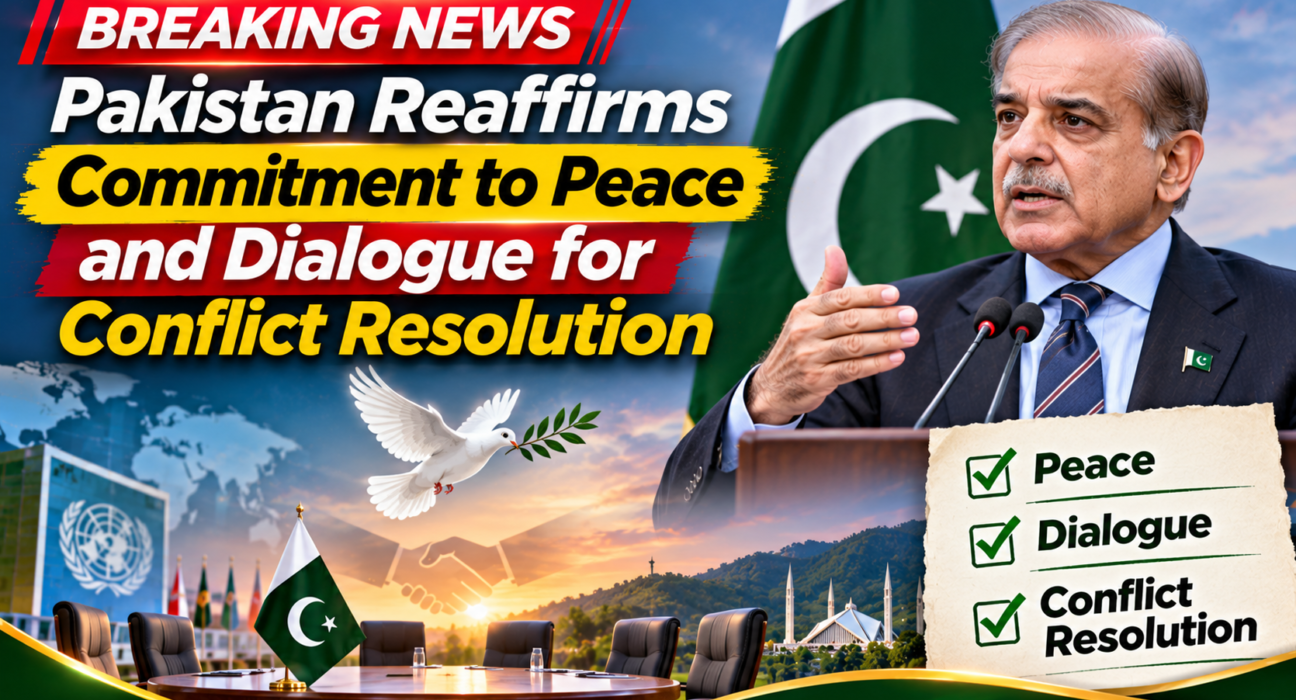
Pakistan Reaffirms Commitment to Peace and Dialogue for Conflict Resolution
The latest reaffirmation came on November 10, 2026. Deputy Prime Minister and Foreign Minister Ishaq Dar spoke at the opening of the Margalla Dialogue in Islamabad. He said Pakistan will keep working to bring the United States and Iran back to the negotiating table. He also warned that rising rivalries and weak arms control rules are raising the risk of miscalculation.
Dar’s central message was simple. Even during serious confrontation, he said, channels of communication must remain open. Closing them makes the next crisis harder to manage. He tied this to Pakistan’s own experience, pointing to the April talks in Islamabad and a memorandum of understanding signed on June 18.
A few days later, on November 16, Dar repeated that dialogue and diplomacy are the only viable means to address outstanding issues and prevent escalation. On November 21, he told Euronews that the Middle East needs a special mechanism and a new security architecture. He argued that the effects of the conflict reach far beyond the Gulf and touch the global economy.
These statements are not new for Pakistan. In 2025, the country said the same thing at the United Nations, in its talks with Afghanistan, and after its clash with India. What is new is the scale. Pakistan is no longer only calling for dialogue. It is hosting and carrying it.
Why Dialogue Sits at the Heart of Pakistan’s Foreign Policy
Pakistan’s peace message is both principled and practical. Leaders often cite the UN Charter. They also know that Pakistan has a lot to lose from instability.
Security Needs Behind the Peace Message
Pakistan sits in a tough neighborhood. It shares borders with India, Afghanistan, Iran and China. It has a long and sensitive history with India. It faces militant violence linked to groups operating from Afghan soil. A major war next door can quickly become a Pakistani problem.
Energy is another pressure point. Pakistan imports much of its fuel. When shipping through the Gulf is disrupted, prices rise at home. Analysts in Islamabad have described the Iran conflict as one of the biggest economic and energy security challenges the country has faced. Dar made the same point in November. A security crisis, he said, can turn into an economic shock that raises food and fuel prices and strains public services.
So peace is not only a moral position for Pakistan. It protects households, trade routes and national security.
Legal and Moral Foundations: The UN Charter
Pakistani officials return often to the UN Charter. It supports sovereign equality, the peaceful settlement of disputes and respect for international law. On the International Day of Multilateralism and Diplomacy for Peace, Dar said Pakistan has long championed dialogue, mediation and good offices to settle disputes. The Prime Minister, Shehbaz Sharif, made a similar pledge on the same day.
Pakistan also points to its record in UN peacekeeping. It is one of the longest-serving and largest troop contributors to UN missions. Officials say this gives the country credibility when it talks about peace. Critics may argue that a country with its own disputes cannot be a neutral voice. Pakistan’s answer is that experience with conflict teaches the value of talking.
Key Milestones in Pakistan’s Peace Diplomacy
Pakistan’s peace diplomacy did not appear overnight. The table below lists the main steps from 2025 to late 2026.
Table 1: Timeline of Pakistan’s Recent Peace and Dialogue Efforts
| Date | Event | Why It Matters |
| May 2025 | Military clash with India ends after a short period of fighting | Showed the danger of escalation in South Asia and shaped Pakistan’s call for dialogue on Kashmir and water |
| July 2025 | Pakistan holds the UN Security Council presidency | Led work on a resolution about peaceful settlement of disputes |
| July 2025 | Council adopts Resolution 2788 unanimously | Reaffirmed mediation as a tool for preventing and ending conflict |
| November 2025 | Pakistan restates commitment to dialogue with Afghanistan | Stressed that all peaceful options should be explored first |
| February 28, 2026 | US and Israel launch strikes on Iran | Began the war that pushed Pakistan into a mediator role |
| March 2026 | Pakistan relays messages and a US proposal to Iran | Opened an indirect channel between Washington and Tehran |
| March 28–29, 2026 | Saudi Arabia, Egypt, Türkiye and Pakistan meet in Islamabad | Built a regional group to support de-escalation |
| April 11–12, 2026 | US and Iran hold direct talks in Islamabad | First direct high-level talks between the two in decades |
| June 18, 2026 | US and Iran sign a memorandum of understanding | Seen by Pakistan as a base for future negotiations |
| October 23, 2026 | Four-country regional group consults Britain, France, Germany and Italy | Widened international support for diplomacy |
| November 10, 2026 | Dar speaks at the Margalla Dialogue | Latest public reaffirmation of the dialogue policy |
The pattern is clear. Pakistan first built a reputation through the UN. It then used that standing when the Iran war created a gap for a trusted go-between.
The Islamabad Talks and the US-Iran Mediation
The Iran mediation is the most visible part of Pakistan’s peace diplomacy. It is also the hardest, so it deserves a close look.
How the Back Channel Began
The war began on February 28, 2026, when the United States and Israel launched coordinated strikes on Iran. The attacks killed Supreme Leader Ali Khamenei and other senior figures. This came after a twelve-day conflict in 2025 and months of rising tension.
Within weeks, Pakistan began passing messages between the two sides. In late March, Dar confirmed that indirect US-Iran talks were taking place through messages relayed by Pakistan. He said a 15-point US framework had been shared and was under Iranian review. Iran at first denied that it was in direct talks with Washington. It described Pakistan’s role as limited to carrying messages.
Why Pakistan, and not another country? The answer lies in its unusual position. Few states keep workable ties with Tehran, Washington, Beijing and the Gulf capitals at the same time. Pakistan does. It shares a long border and deep cultural links with Iran. It also has close defense and political ties with the United States and strong partnerships with Saudi Arabia and China. Both Washington and Tehran were willing to trust it as an intermediary.
Pakistan also worked with partners. On March 28 and 29, diplomats from Saudi Arabia, Egypt and Türkiye joined Pakistani officials in Islamabad for two days of talks. The group said it was ready to support meaningful negotiations. Iranian President Masoud Pezeshkian thanked Pakistan for its mediation efforts after a long phone call with Prime Minister Sharif.
The April 2026 Talks in Islamabad
On April 11 and 12, the two sides met in Islamabad. Reports described them as the first direct high-level US-Iran talks in decades. US Vice President J.D. Vance traveled to Pakistan for the meetings. Pakistani leaders, including Field Marshal Asim Munir and Dar, welcomed the delegations. Iranian state media said the talks took place under Pakistan’s mediation.
The talks did not end the war on their own. Still, they proved that both sides could sit in the same city and discuss terms. They also helped support a fragile ceasefire that Pakistan had helped broker. Afterward, indirect contacts continued, with Pakistan as the main channel. The White House said at one point that it was discussing a second round in Islamabad and felt hopeful about a deal.
Pakistan also took practical steps during this period. It reached an arrangement with Iran on the passage of ships through the Strait of Hormuz. Islamabad also stayed in close touch with Gulf states. Officials said they wanted to shield Gulf neighbors from the fallout of the conflict.
The June Memorandum and the Current Stalemate
On June 18, the two sides signed a memorandum of understanding. Dar has called it a foundation for further negotiations. Pakistan’s army chief traveled to Tehran for talks with Iran’s president. Iran later said the United States should honor the Pakistan-brokered deal before expecting flexibility from Tehran. The UN Secretary-General said he hoped both sides would return to the agreement.
The progress has not lasted. By November, Dar spoke of efforts to “restore dialogue” and bring the sides back to the table. That wording shows that talks have stalled. Regional news reports have also described new exchanges of fire near the Strait of Hormuz and attacks involving Houthi forces in the Red Sea area. Pakistan’s own account is careful. It says the diplomatic path is still open, but it does not claim that a final settlement is close.
Pakistan at the United Nations: Mediation as a Global Cause
Pakistan’s peace work is not limited to one conflict. It has also used the UN to push for a wider role for mediation.
In July 2025, Pakistan held the rotating presidency of the UN Security Council. During that month, the Council unanimously adopted Resolution 2788 on the peaceful settlement of disputes. The resolution reaffirmed mediation as a key tool for preventing and resolving conflict. Pakistani officials still point to it as proof that their approach has wide support.
Pakistan has since built on that success. At a UN session on mediation, its representative said a renewed partnership between the UN and regional organizations could revive global peace efforts. He argued that preventive diplomacy matters most at a time when mistrust and rivalry are growing. In November 2025, Dar again called Pakistan a bridge-builder that can unite regions and amplify the voices of developing countries.
There is a clear logic here. Smaller and middle powers often cannot stop wars with force. They can, however, create rules, host talks and keep lines open. Pakistan wants to be seen as a country that does this well.
Peace Efforts Closer to Home
Mediating for others is one thing. Handling disputes on its own borders is another. Pakistan’s record here is more mixed, and the picture needs honest treatment.
South Asia: Kashmir, the Indus Waters Treaty and Relations With India
Relations with India remain tense. In May 2025, the two countries fought a short but serious military clash. Dar said at the Margalla Dialogue that Pakistan gave a firm response to Indian action at that time. He also said that unresolved disputes, military imbalances and unilateral actions still threaten stability in South Asia.
Pakistan’s position is that talks are the only real answer. Officials repeat that Kashmir should be settled peacefully under international law and UN resolutions. Pakistan’s top military officer made the same point in October 2025, linking the Kashmir issue with the Palestinian cause as long-standing disputes that need just and peaceful solutions.
Water is another flashpoint. Dar restated Pakistan’s position on the Indus Waters Treaty in November 2026. He said Pakistan will protect its water rights and oppose attempts to use water as a weapon. India has its own account of these disputes, and the two sides disagree sharply. That gap is one reason progress has been slow.
Afghanistan and Border Security
Pakistan has also said it wants dialogue with Afghanistan. In November 2025, its foreign ministry stated that all avenues for peaceful resolution should be fully explored. At the same time, Pakistani leaders insist that militant threats from Afghan territory must stop. Dar raised this concern again in November 2026.
This shows an important feature of Pakistan’s policy. Dialogue does not replace security measures. Pakistan says it will talk, but it will also defend its borders and citizens. Supporters call this a balanced approach. Critics say it makes real breakthroughs harder. Both views are worth keeping in mind.
The Margalla Dialogue 2026 and the Call for a New Security Framework
The Margalla Dialogue is an annual event hosted in Islamabad. The 2026 theme was “Global Order in Transition: Navigating Strategic Uncertainty.” Dar used the stage to lay out Pakistan’s view of a changing world.
He described a world with sharper great-power rivalry, longer conflicts and weaker arms control. He warned that selective use of international law hurts trust in global institutions. When agreed rules apply to some countries and not others, he said, every country becomes less safe. He also backed a more multipolar world order. However, he cautioned that spreading power does not automatically bring fairness or stability. Strong institutions and respect for rules are still needed.
Dar then linked security with the economy. He said Pakistan will deepen ties with China, the United States, Saudi Arabia, Türkiye and others. He added that Pakistan must build a stronger economy, stronger institutions and better technology to protect its interests.
In his Euronews interview on November 21, he went further. He called for a special mechanism to build regional peace across the Middle East and a new security architecture for the region. This idea is still general, and no formal plan has been published. Even so, it signals that Pakistan wants a lasting role beyond one round of talks.
What Pakistan Gains and What It Risks
Mediation brings rewards, and it brings risks. The table below sums up both sides.
Table 2: Benefits and Risks of Pakistan’s Mediation Role
| Area | Possible Benefit | Possible Risk |
| Global image | Pakistan is seen as a constructive and trusted peacemaker | A failed effort could hurt its credibility |
| Relations with the US | Closer contact with Washington at the highest levels | Pressure to take sides if talks collapse |
| Relations with Iran | Strong trust with a key neighbor | Strain if Tehran feels Pakistan favors Washington |
| Gulf partners | Chance to shield Gulf states and deepen security ties | Pakistan may be drawn into Gulf rivalries |
| Economy | Safer energy supply and trade routes if peace holds | Fuel and food price shocks if the war widens |
| Security at home | Stronger standing in talks on regional threats | Border tensions and militant activity may continue |
| UN influence | More weight for Pakistan’s views on mediation and multilateralism | High expectations that are hard to meet |
The table shows why Pakistan moves with care. Each gain comes with a matching risk. A mediator who gets too far ahead of the parties can lose their trust. A mediator who stays silent loses relevance. Pakistan has tried to stay in the middle by keeping its statements calm and its channels open.
Challenges That Could Slow Progress
Pakistan’s peace diplomacy faces real obstacles. Some come from outside, and some come from home.
The first is the gap between the United States and Iran. Analysts warned from the start that the two sides were far apart. Iran has said it remains deeply suspicious of US intentions. It has also warned that it will respond strongly to any new military escalation. A mediator can carry messages and host meetings, but it cannot force either side to compromise.
The second challenge is timing. Pakistan’s foreign ministry admitted early on that there were obstacles. Threats and counter-threats between the two sides have repeatedly hurt the mood. Each new strike makes the next round of talks harder to arrange.
The third challenge is Pakistan’s own security situation. The country faces militant attacks and tense borders. Its leaders must handle these while also acting as a global peacemaker. Any major attack at home could shift attention and resources.
The fourth challenge is the economy. Pakistan needs investment, stable energy prices and strong trade ties. Dar said so himself. If regional conflict grows, the country’s economic goals become harder to reach. That gives Pakistan a strong reason to keep working for peace. It also means that failure would cost it dearly.
Finally, there is the question of perception. Pakistan has ties with many powers, and each one may read its actions differently. A statement meant to calm one side can annoy another. Careful and steady messaging is therefore part of the job.
What Experts Say About Pakistan’s Mediation Role
Experts and observers hold a range of views. Most agree that Pakistan’s position is unusual and useful. Few countries can speak to Tehran, Washington, Beijing and the Gulf at once. Analysts have said this flexibility gives Islamabad weight that its size alone would not.
An Islamabad-based security researcher said Pakistan’s mediation may have helped bring some restraint to the conflict. Others are more cautious. Commentators noted that mediation carries risks, and that the distance between the main parties remains wide. Some say Pakistan’s efforts are best seen as keeping a door open, not as a guarantee of peace.
Pakistan’s own officials make a modest claim. They say the country is a facilitator, not a judge. They also say that both the United States and Iran had confidence in Pakistan as a neutral go-between. Whether that confidence lasts will depend on events in the coming months.
For readers who want to follow the story, two reliable sources are worth reading. Arab News Pakistan has a report on Dar’s remarks at the Margalla Dialogue, which covers the November 2026 statement and the regional diplomacy behind it. Al Jazeera has a useful early analysis of Pakistan’s offer to host US-Iran talks, which shows how the effort began and why analysts urged caution.
What to Watch in the Coming Months
Several signs will show whether Pakistan’s peace diplomacy is working.
The first is whether the United States and Iran return to formal talks. Pakistan has said it is ready to host another round. A second meeting in Islamabad would be a strong signal. A long gap would suggest that the process has lost speed.
The second is the strength of the regional group. Saudi Arabia, Türkiye, Egypt and Pakistan now work together, and they have reached out to Britain, France, Germany and Italy. If this wider group stays united, it could add weight to the talks.
The third is the idea of a new regional security framework. Dar has called for one, but details are missing. Watch for any proposal that names members, rules or steps. Without detail, the idea may stay a hope.
The fourth is Pakistan’s relations with its neighbors. Any real thaw with India or Afghanistan would back up the country’s peace message. New tension would test it.
The fifth is the economy. Fuel and food prices at home will show how much the conflict is costing ordinary people. Pakistan’s leaders have said that economic strength and peace go together. The numbers will show if that holds true.
Conclusion
Pakistan’s commitment to peace and dialogue is not just a slogan. In 2026, it became a working policy with real results. Pakistan relayed messages between Washington and Tehran. It hosted the Islamabad Talks in April, the first direct high-level US-Iran talks in decades. It helped support a fragile ceasefire and a June memorandum of understanding. It also built a regional group and took its case to the UN, where Resolution 2788 backed mediation as a tool for peace.
The story is not complete. The war has not ended, and talks have stalled. Pakistan still faces tense borders and hard disputes with India and Afghanistan. Critics point out that dialogue abroad must be matched by progress at home. Even so, the country’s central claim has held up well. Channels of communication should stay open, especially in a crisis.
For readers, the key takeaway is simple. Pakistan’s role matters because of its unusual ties with many powers and its strong stake in a stable region. Whether it can turn that position into lasting peace will depend on the choices made in Washington, Tehran and Islamabad over the coming months.