


KSE-100 Index Facing Fresh Volatility in Pakistan? News

Why Is the KSE-100 Index Facing Fresh Volatility in Pakistan?

If you have watched the Pakistan Stock Exchange (PSX) screen lately, you know the feeling. One day the KSE-100 drops by more than a thousand points. A few days later it bounces back like nothing happened. It is hard to know what to think. I wrote this guide to explain what is going on in plain words. We will look at the real numbers from the past few weeks, the main reasons behind the swings, and some simple habits that help ordinary investors stay calm. No heavy jargon, I promise. One note before we start. I am not a licensed financial advisor, and nothing here is investment advice. Think of it as a clear explanation to help you understand the market better. Why Is the KSE-100 Index Facing Fresh Volatility in Pakistan? The short answer is that several pressures are hitting the market at the same time. No single cause explains it. Here is the simple version. A quick summary of the main causes Global tension, especially around the Middle East, keeps oil prices and investor nerves jumpy. Foreign investors have been pulling money out. Local traders are booking profits in big, heavily weighted stocks. Interest rate worries and political headlines add even more noise. Each of these alone might cause a small wobble. Together, they make the index swing hard in both directions. Why “volatility” does not always mean “crash” Many people hear “volatility” and think the market is collapsing. That is not quite right. Volatility just means prices move up and down a lot in a short time. A market can be volatile and still hold a strong level overall. Look at recent history. Late in November 2026, the KSE-100 was trading around the 178,000 mark. That is still a high level compared with where Pakistan’s market stood only a few years ago. The daily swings are the story right now, not a total collapse. Why this feels bigger than usual The KSE-100 has become a much larger index in points. So a move of 1,000 points feels dramatic, but in percentage terms it may be under one percent. When you see a scary headline, always check the percentage change too. It gives you a more honest picture. What Is the KSE-100 Index and Why Does It Matter? Let me explain this like I would to a friend. The KSE-100 is a scorecard for the Pakistan Stock Exchange. It tracks 100 of the largest and most actively traded companies. When most of them rise, the index rises. When most fall, it falls. How the index is built The index is “market-cap weighted.” That means bigger companies have more power over the score. A sharp drop in a few giant banks, cement firms or energy companies can pull the whole index down, even if smaller stocks hold steady. Why ordinary people should care You might think this only matters to traders, but it reaches further. Pension funds, mutual funds and company investments all connect to the market. The index also works like a mood meter for the economy. When investors feel confident, it usually shows up here first. What Has the Index Done in October and November 2026? Let me share the actual numbers so we stay grounded in facts. A tough October According to Topline Securities, as reported by The Express Tribune, the KSE-100 fell 2.09% over October 2026. That is roughly 3,560 points. The reasons given were geopolitical uncertainty, foreign portfolio outflows, profit-taking in heavyweight stocks and cautious investor sentiment. You can read the full report here at The Express Tribune. A choppy November November has stayed bumpy. On November 6, the index lost 1,493 points to close near 173,886. A few days later it recovered toward 179,000. Then on November 12 it fell another 1,710 points, closing near 177,374. Reports about a possible release of former Prime Minister Imran Khan were cited as a trigger for that sell-off. Table 1 shows a snapshot of several recent sessions. Table 1: Recent KSE-100 Closing Levels Date (2026) Daily Move Closing Level November 6 Down 1,493 points About 173,886 November 11 Down 251 points 179,083.80 November 12 Down 1,710 points About 177,374 November 18 Down 1,223 points 176,294.33 November 25 Down 421 points 178,121.25 November 26 Down 61 points 178,060.69 What the pattern tells us Look closely at that table. The index did not fall in a straight line. It dropped hard, bounced back, dropped again, and then settled in a narrower range near 178,000. That up-and-down shape is exactly what volatility looks like. Sellers and buyers are fighting, and neither side has won yet. On November 27, the index slipped again by about 0.22% despite a late recovery. Analysts quoted by Pakistan Observer pointed to rising global oil prices, geopolitical tension and rollover-week activity as reasons the swings could continue. How Do Geopolitics and Oil Prices Shake the Market? If I had to pick the single biggest outside force on Pakistan’s market this year, it would be the Middle East situation and what it does to oil. Why oil matters so much to Pakistan Pakistan imports a large share of its fuel. When global oil prices jump, the country pays more dollars for the same barrels. That puts pressure on the rupee, on inflation and on company costs. Investors do not like surprises in any of these. The 2026 conflict effect Earlier this year, a conflict involving Iran pushed oil prices sharply higher. At one point, Brent crude was reported above $111 a barrel, as diplomacy stalled. In June, a preliminary US-Iran deal lifted hopes and oil fell almost 5% in one day. The PSX rallied on that news. So the market has learned that every headline about the Strait of Hormuz or Middle East talks can move prices within hours. When talks stall or new strikes are reported, selling picks up. When peace hopes rise, buyers return. Which sectors feel it first Energy and fuel-linked stocks react quickly. Oil marketing companies, refineries and exploration firms can
Pakistan Stock Exchange Business

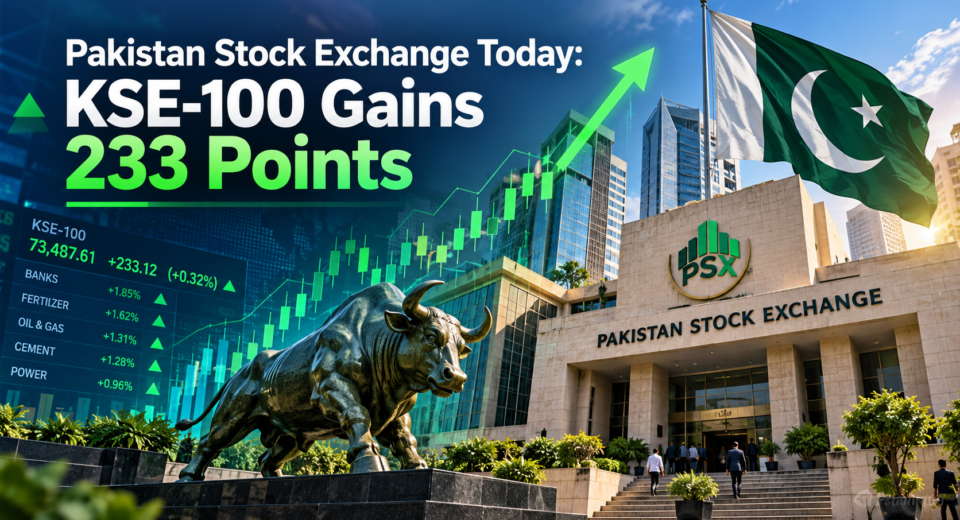
Pakistan Stock Exchange Today: KSE-100 Gains 233 Points

Karachi, October 16, 2026 — The Pakistan Stock Exchange (PSX) ended Friday’s trading session with a small gain, giving investors a positive finish after a day of changing market prices. The benchmark KSE-100 Index increased by 233.55 points, or 0.14%, to close at 166,419.71 points. The market opened under pressure as investors remained careful about economic conditions, rising energy costs, and regional uncertainty. However, buying in selected banking and technology shares helped the index recover its early losses. Despite the positive closing, trading remained mixed. Several companies recorded losses, showing that investors were still choosing stocks carefully rather than buying across the whole market. The latest Pakistan Stock Exchange today update shows a market that is trying to recover while facing economic and international challenges. Pakistan Stock Exchange Today: KSE-100 Gains 233 Points? Yes, the KSE-100 Index gained 233.55 points on Friday, October 16, 2026, marking its third consecutive positive closing. The index finished at 166,419.71 points, compared with 166,186.16 points in the previous session. This represented a daily increase of 0.14%. Although the gain was small, it was important because the market had experienced sharp price changes earlier in the week. The KSE-100 Index today showed that buyers were still interested in selected large companies. However, the wider market remained under pressure, with more listed symbols declining than advancing. This mixed performance suggests that investors were watching economic news closely before making major trading decisions. PSX Market Summary for October 16, 2026 The following table provides the main figures from Friday’s trading session, based on official market data. Market Indicator October 16, 2026 KSE-100 Closing Index 166,419.71 Previous Closing Index 166,186.16 Daily Point Increase +233.55 Percentage Change +0.14% Intraday Highest Level 166,708.36 Intraday Lowest Level 165,956.51 Total Exchange Trading Volume 396.90 Million Shares Total Traded Value Rs18.68 Billion Total Regular-Market Trades 266,753 Market Status Closed These figures show that the Pakistan stock market today remained active despite the limited improvement in the benchmark index. The difference between the daily high and low was 751.85 points. This shows how much the market moved during the session, even though its final increase was relatively small. How Did the KSE-100 Index Perform During Trading? Friday’s trading began with selling pressure. The index moved below its previous closing level and reached a low of 165,956.51 points. During the session, buyers returned to selected shares, helping the market recover. The index later touched 166,708.36 points before losing some of those gains. By the end of the trading day, the benchmark had settled at 166,419.71. Why Did the Market Move Up and Down? Stock prices often change during the day as investors respond to economic news, company performance, and international developments. Some traders buy shares when prices fall, while others sell after prices recover to secure profits. Friday’s movement showed both activities taking place. Investors were willing to buy selected shares, but they were not confident enough to support a strong market-wide rally. That is why the index ended higher without recording a major increase. Why Did the Pakistan Stock Exchange Close Higher? The market’s positive closing came mainly from gains in selected large companies. According to market commentary from Topline Securities, Systems Limited, United Bank Limited, MCB Bank, Bank AL Habib, and Engro Fertilizers were among the major positive contributors. Together, these five companies added about 269 points to the benchmark index. Their performance helped balance losses in other major shares and supported the positive closing. Banking and Technology Stocks Supported the Index Banking companies often have a strong influence on the KSE-100 because several large banks carry significant weight in the benchmark. When important banking shares rise, they can help the index move higher even if many smaller companies decline. Technology shares also supported Friday’s performance, with Systems Limited among the main positive contributors. However, the performance of these companies should not be treated as evidence that every banking or technology stock increased. Which Companies Put Pressure on the Market? Although the PSX closed higher, several major companies reduced the benchmark’s overall gain. According to the same market report, Oil and Gas Development Company, Lucky Cement, Meezan Bank, Pakistan Telecommunication Company, and Engro Holdings were among the negative contributors. Together, these five stocks reduced the index by approximately 223 points. The contrast between winning and losing shares explains why Friday’s trading was mixed. Investors were not simply buying everything. They were responding differently to individual companies and business sectors. This is an important part of understanding PSX latest news. A rising index does not always mean that most listed shares are increasing. PSX Trading Volume and Market Activity Trading volume provides another useful way to understand stock market activity. On October 16, total exchange trading volume reached approximately 396.90 million shares, compared with 517.60 million shares in the previous session. The value of traded shares also decreased, falling from around Rs23.57 billion to Rs18.68 billion. These figures suggest that trading activity slowed compared with Thursday. A lower trading volume does not automatically mean that the market will decline. However, it can show that fewer shares are changing hands while investors wait for clearer developments. Most Actively Traded Shares Pakistan Refinery Limited was one of Friday’s busiest stocks, with approximately 38.42 million shares traded. Cnergyico PK Limited followed with around 37.14 million shares, while K-Electric recorded approximately 27.98 million shares. These companies attracted considerable trading interest during the session. It is important to understand that high trading volume does not automatically mean a company is performing well financially. It simply means that more of its shares were bought and sold. Other Major Pakistan Stock Exchange Indices The KSE-100 was not the only market index to record changes on Friday. PSX Index Performance on October 16, 2026 Stock Market Index Closing Value Daily Change KSE-100 166,419.71 +0.14% KSE-30 49,316.65 +0.05% All Share Index 100,871.91 +0.05% KMI-30 239,907.59 -0.05% Banking Tradable Index (BKTI) 45,849.28 +0.23% Oil & Gas Tradable Index (OGTI) 33,523.01 -0.51% PSX Dividend 20 Index 76,053.59 +0.39% The figures show that different groups