

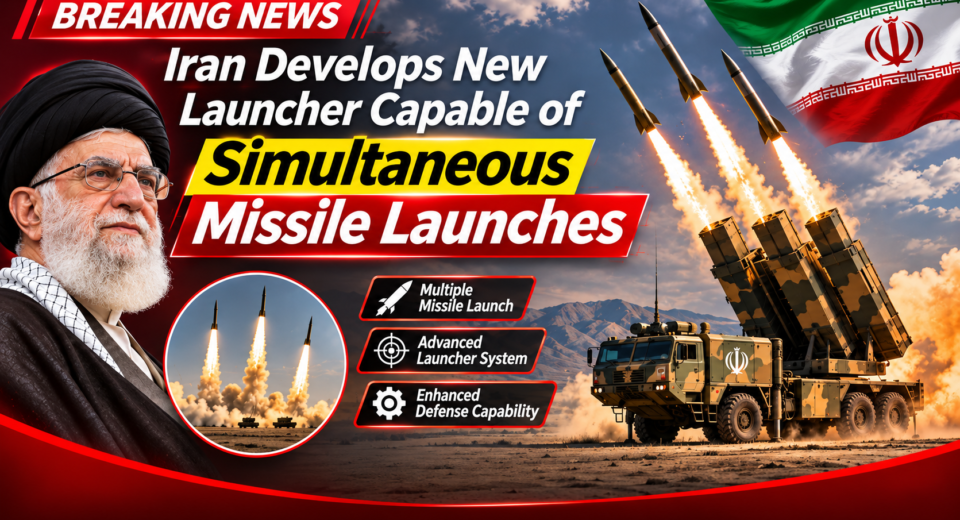
Iran’s New Dual-Missile Launcher: What We Know So Far
Big military news can feel confusing fast. One day you see a short clip on state TV, and an hour later every headline has a different spin. So let’s slow down and go through this one step by step, in plain English. Iran has shown off a new launcher that it says can fire two missiles at the same time. The footage came from inside an underground base. It landed in the middle of a tense war, so people far outside the region are paying attention. Below, I’ll cover what was shown, what is still unproven, and why the story matters. Breaking News: Iran Unveils New Launcher Capable of Firing 2 Missiles at Once The story broke over the weekend. Iranian state media aired footage of military commanders touring an underground missile facility, and the footage included a launcher designed to fire two liquid-fuelled missiles at once. The news spread quickly across outlets in the Middle East, Europe, and the United States. What State TV Actually Showed The broadcast was a showcase. Footage from the site went out on Iranian state television, and the Islamic Revolutionary Guard Corps (IRGC) presented the system. The location of the complex was not disclosed. That last detail matters. We know what the cameras showed us, but we do not know where it was filmed. Who Was in the Room State news agency IRIB said the unveiling happened during a visit by IRGC commander Ahmad Vahidi and aerospace chief Seyed Majid Mousavi. When top commanders show up on camera, the message is usually meant for more than one audience. It speaks to people at home, to Iran’s allies, and to its enemies. Why the Timing of This Announcement Matters Timing is a big part of any military reveal. Countries rarely show new hardware by accident. They pick the moment, and they pick the message. This reveal came while Iran is in a heated standoff with the United States and Israel. Reports say the broadcast was meant to show Iran can still strike if the war speeds up again, and to push back on Washington’s claims that the missile program has been destroyed. So this was about more than a new piece of equipment. It was a statement. Think of it like a boxer who has taken a few hits and steps into the ring with his gloves up. He may be hurting, but he wants the other side to know he can still swing. That is how many analysts read this video. There is also an economic side. Iran is under growing economic pressure from a US naval blockade that has disrupted its oil exports. When a country is squeezed financially, showing military strength can be a way to signal that it will not back down. Al Jazeera How a Dual Launcher Works in Simple Words You do not need an engineering degree to get the basic idea. A missile launcher is a vehicle or platform that carries a missile, raises it into position, and sends it on its way. Most launchers carry one missile. A dual launcher carries two. Why Two Is Better Than One The main benefit is speed and volume. If a crew can fire two missiles in one go, it does not need to reload as often. That means fewer vehicles, fewer crews, and less time out in the open. In a fast-moving conflict, less time exposed can be the difference between a launcher surviving and a launcher being hit. What Iran Has Done Before This is not Iran’s first dual launcher. The new launcher appears to be an advance over an earlier dual launcher that fired two solid-fuel missiles at a time. So the idea is not new. What seems new is that this version is built for liquid-fuel missiles. Liquid Fuel vs. Solid Fuel: Why It Matters The fuel type is the most interesting detail in this whole story. Here is a simple comparison. Feature Liquid-Fuel Missile Solid-Fuel Missile Fuel storage Often fueled before launch Fuel is packed inside ahead of time Launch readiness Usually takes more prep time Usually quicker to fire Flight control Can adjust speed and path more easily Less adjustable once lit Efficiency Generally more efficient Generally simpler and sturdier Handling More complex to manage Easier to move and store The Efficiency Angle Liquid fuel is more efficient and gives operators some ability to change a missile’s speed and trajectory. That is a real advantage on paper. It can help a missile reach farther or follow a smarter path. The Trade-Off The trade-off is prep time. Liquid-fuel systems are often harder to get ready quickly. That is one reason an underground base makes sense. Crews can work out of sight, away from satellites and drones, and then move fast when it is time to act. Inside the Underground “Missile City” The launcher was not shown on its own. It was part of a bigger reveal, and the setting was just as important as the hardware. Earlier this month, Iran also revealed a new underground missile base equipped with ballistic and cruise missiles. People now call these sites “missile cities” because they are huge tunnel networks cut deep into rock and mountains. Why Go Underground There are a few simple reasons. Tunnels protect weapons from air strikes and spying. They also give crews a place to store, repair, and prepare missiles in one spot. One analyst quoted by Al Jazeera made this point well. Rami Khouri of the American University of Beirut said Iran can safely store spare parts, raw materials, and chemicals for making missiles and drones at underground sites, along with the finished weapons. In other words, these places are factories and warehouses as well as hideouts. A Hard Target For any military planning a strike, tunnels are a headache. You may know roughly where a base is, but getting weapons deep enough to cause damage is tough. That is why underground bases keep showing up in Iran’s messaging. What Iran Claims About