
Fuel prices touch almost every part of daily life in Pakistan. They shape what a commuter spends on petrol and what a farmer pays to run a tractor or tubewell. They also change the price of vegetables, flour and public transport. So when a major political party and the federal government reach a deal on fuel relief, millions of families pay attention.
On Thursday, November 26, 2026, the government and Jamaat-e-Islami (JI) announced exactly that kind of deal. It follows months of protests, marches, talks and warnings. The agreement promises to widen the existing petrol subsidy to small cars up to 1,000cc and to cover farmers under diesel relief. It also includes steps to lower the petroleum levy and cut government spending.
This article explains the JI fuel relief agreement in plain language. It covers what was announced, how we got here, who may benefit, and what is still unclear. The details come from news reports published by Pakistani and regional outlets. Several points still depend on official notifications, so I mark clearly what is confirmed and what is only promised.
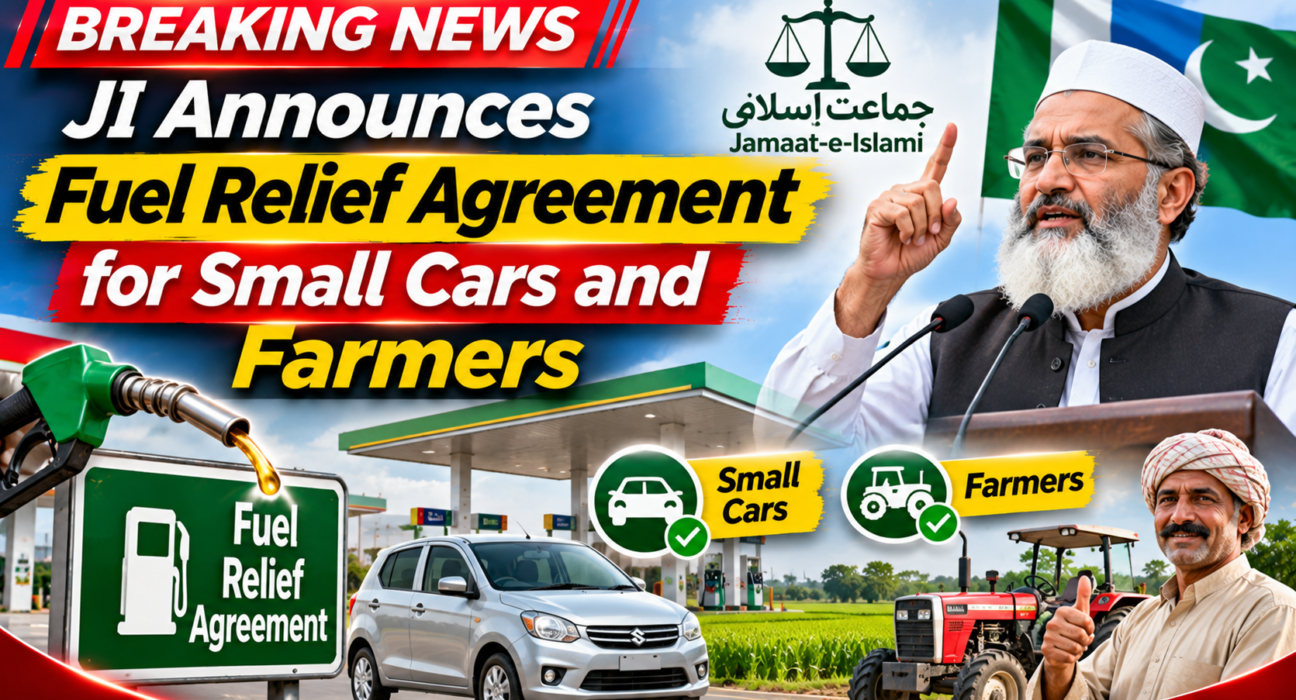
JI Announces Fuel Relief Agreement for Small Cars and Farmers
After months of negotiation, the federal government and JI reached an agreement on measures to ease the burden of high petroleum prices. According to Aaj News, the deal was announced after a meeting between Prime Minister Shehbaz Sharif and a JI delegation led by party chief Hafiz Naeemur Rehman at the Prime Minister’s House in Islamabad.
Two parts of the deal stand out. The first is the extension of fuel relief to vehicles with engines up to 1,000cc. The second is an assurance that farmers will be covered under the diesel relief package. Both groups had been left out of the earlier scheme, which focused on motorcycles, three-wheelers and cars up to 800cc.
What Was Announced on November 26
Speaking to reporters outside the Prime Minister’s House, Hafiz Naeem said the talks had ended successfully. He explained that committees from both sides had prepared a draft agreement. A separate committee would now be formed to watch over its implementation.
He listed several outcomes. Small vehicles up to 1,000cc would be included in the relief. Farmers would be covered under the diesel package. The government would work to reduce the petroleum levy before the next federal budget. The government would also cut its own expenses and stop using vehicles above 1,600cc for official purposes. Proposals about independent power producers (IPPs) were also part of the deal.
Hafiz Naeem was careful with his words. He said the government’s acceptance of four demands did not mean JI had won everything it asked for. The party would keep pushing its remaining demands and would announce its next steps at a gathering at Minar-e-Pakistan in Lahore.
You can read the original report on the Aaj News coverage of the agreement.
What the Government Said
The prime minister told the JI delegation that the government had already announced large subsidies to reduce public hardship. He said that petroleum prices had risen after war broke out between Iran and the United States. Regional tension, he added, had pushed fuel costs up around the world.
He said about 20 million people had benefited from the relief measures so far. He also said a team led by Deputy Prime Minister Ishaq Dar, including the finance and petroleum ministers, had been working on proposals for more relief. The government and JI agreed to set up a committee to review the party’s proposals and oversee their rollout.
Background: Why Fuel Prices Became a Political Fight
To understand the agreement, it helps to see why fuel prices became such a heated issue in 2026. Three forces came together: global oil prices, domestic taxes and public anger over inflation.
Global Oil Prices and the Iran-US War
Pakistan imports most of its oil. When world prices jump, the cost passes quickly to petrol pumps. The war between Iran and the United States disrupted supply and pushed prices up across the region. Government negotiators told JI earlier that fuel prices follow international rates, which were rising, and that they had already provided every relief they could.
The Petroleum Levy at the Center
The petroleum levy is a tax charged on each litre of petrol and diesel. It is a major source of federal revenue. Hafiz Naeem said in October that the levy brings in roughly Rs150 billion each month. He called it “extortion” at a time when families struggle with inflation. In his latest statement, he said the levy had fallen from Rs80 to Rs63 per litre because of a windfall effect.
The government sees the levy as money it needs to run the country and meet its commitments, including those tied to the International Monetary Fund (IMF). JI sees it as an unfair burden on ordinary people. That clash sits at the heart of the whole dispute.
JI’s Protest Campaign
JI announced a nationwide strike for September 3, demanding lower petroleum prices and relief from high electricity bills. The party then held sit-ins and ran several waves of protests. In September, JI planned a long march to Islamabad. It postponed the march at the prime minister’s request after its convoy had reached Multan, because the government promised to discuss wider relief and a phased cut in the levy.
Hafiz Naeem later claimed that the prime minister’s relief package was a result of JI’s sit-ins. The government did not describe it that way, but the timing shows how protest pressure and policy moved together.
Timeline of Key Events
The story unfolded over about three months. The table below sums up the main steps.
Table 1: Key steps in the JI and government talks on fuel relief
| Date | Event | Why It Matters |
| September 3 | JI holds a nationwide strike against high fuel prices | Starts the protest phase |
| September 13 | PM announces Rs100 per litre relief for motorcycles, rickshaws and small cars | First targeted relief scheme |
| September 14 | Government approves Rs75 billion for three months of relief | Funds the scheme |
| September 15 | Government briefs JI delegation; JI voices dissatisfaction and warns of a march | Talks begin under pressure |
| October 27 | PM and JI chief agree on a six-member committee | Formal negotiation track starts |
| November 10 | Talks agree on broad outlines of a draft deal | JI proposes 1,000cc and farmers |
| November 26 | Government and JI announce the agreement | Relief widened on paper |
How the Existing Fuel Relief Scheme Works
The new agreement builds on a program the government launched in September. Knowing how that scheme works makes it easier to judge what the expansion could mean.
Who Qualifies Under the Current Scheme
According to Gulf News, Prime Minister Shehbaz Sharif announced a discount of Rs100 per litre for owners of motorcycles, rickshaws and small cars. Motorcycles, rickshaws and Qingqi vehicles could receive relief on up to 20 litres a month. Cars up to 800cc could receive it on up to 30 litres a month. The same report put the maximum monthly saving at Rs2,000 for two- and three-wheelers and Rs3,000 for eligible small cars.
The scheme aims to support lower- and middle-income households that depend on small vehicles for work and daily travel. The prime minister thanked provincial governments for sharing data on motorcycles, rickshaws and small vehicles to help run the program. For the full details of the announcement, see the Gulf News report on the Rs100-a-litre relief.
How Much the Scheme Costs
The Economic Coordination Committee approved Rs75 billion for the scheme in September, for three months. The Express Tribune noted that this sum was small compared with expected levy collection, equal to about 16 percent of the projected monthly levy, and described it as a temporary respite. The paper also pointed out the limits of 20 litres for motorcyclists and 30 litres for small cars.
Those limits matter. A person who uses a small car every day for work could burn through 30 litres quickly. After that, the full price applies again. This is one reason JI argued the relief was not enough.
What Changes for Small Car Owners Up to 1,000cc
The headline change is the move from an 800cc cap to a 1,000cc cap. That small jump could cover a much larger group of car owners.
Why the Engine Limit Matters
Many popular small cars in Pakistan sit at or near the 1,000cc mark. Owners of such vehicles often belong to the same income group as owners of 800cc cars. They are salaried workers, small shopkeepers and families who stretched their budgets to buy a modest car. Under the old rule, many of them were left out by a narrow technical line.
JI proposed the 1,000cc limit during the November 10 talks. On November 26, Hafiz Naeem said such vehicles had been included. Making the cap wider is a simple change on paper. It will also increase the cost of the scheme, which is why the government said it wanted to consult the IMF on continuing relief.
What Owners Should Expect Next
At the time of writing, the news reports do not give the full operating rules for the wider scheme. They do not say whether the litre limits will stay the same for the new group. They also do not say when the new group will begin receiving the discount. Owners should wait for an official notification from the federal government and the relevant authorities. They should also be careful about unofficial messages or social media posts that claim to explain how to register.
Why Farmers and Diesel Matter
The second major gain in the agreement is for farmers. Diesel powers tractors, tubewells, harvesters and the trucks that carry crops to market. When diesel gets more expensive, farming costs rise at every stage.
JI’s Demand for Diesel Relief
During earlier talks, JI insisted that diesel must be covered. According to ProPakistani, the party said that leaving diesel out hurts farmers and pushes up costs across the economy. This is a fair point. Higher diesel costs do not stay on the farm. They move into food prices that every household pays.
What the Government Promised
According to Hafiz Naeem, the government assured JI that farmers would be covered under the diesel relief package. Aaj News reported that the proposed inclusion of farmers would broaden the coverage of the scheme.
Still, there is no public detail yet on how farmers will receive the relief. Many questions remain open, including how the government will identify eligible farmers, whether relief will come at the pump or as direct support, and how much each farmer can claim. Until the details appear, the promise is a political commitment rather than a working program.
Other Parts of the Agreement: Levy, Official Vehicles and IPPs
The deal goes beyond cars and farms. Several other points will matter to taxpayers and consumers.
Plans to Reduce the Petroleum Levy
JI’s original demand was to abolish the levy. The government has not agreed to that. Instead, both sides discussed a gradual reduction. Hafiz Naeem said work on further cuts should finish before the next federal budget. Earlier, on November 10, JI deputy chief Liaquat Baloch said the government would share a plan for phasing down the levy after talks with the IMF. He also said the government had agreed that JI’s demand was legitimate.
A cut in the levy would help every fuel user, not only those in the targeted groups. But it would also reduce government revenue, so the state must find money elsewhere. That is why talks with the IMF matter so much.
Cutting Government Spending
Hafiz Naeem said the government had agreed to reduce its own expenses and to avoid using vehicles above 1,600cc for official work. This is a symbolic step but also a practical one. JI had long argued that the state should cut its own luxuries before asking the public to bear higher fuel costs. Baloch repeated this point on November 10, saying the burden of tax collection failures should not fall on consumers.
Proposals on Independent Power Producers
The agreement also includes proposals about IPPs. These private companies generate electricity under long-term contracts with the government, and their payments are a major reason for high power bills. JI had tied fuel prices and electricity bills together in its protest demands. No public report describes the IPP proposals in detail, so readers should treat this part as a topic to watch rather than a finished reform.
Comparison of the Current Scheme and the Expanded Plan
The table below sets the existing relief rules next to the changes described in the agreement. The right-hand column reflects statements made by JI and the government, not a formal notification.
Table 2: Current fuel relief scheme compared with the changes in the JI agreement
| Feature | Current Scheme (Since September) | Changes Described in the Agreement |
| Relief rate | Rs100 per litre | Not yet announced for new groups |
| Motorcycles and rickshaws | Up to 20 litres a month | No change reported |
| Cars | Up to 800cc, up to 30 litres a month | Extended to up to 1,000cc |
| Farmers | Not covered | Assured coverage under diesel relief |
| Petroleum levy | Rs63 per litre after a windfall effect, per JI | Further cuts to be prepared before the next budget |
| Official vehicles | No stated limit | No official use above 1,600cc, per JI |
| Funding | Rs75 billion approved for three months | Not yet announced |
| Oversight | Government-run | New committee to monitor implementation |
The Petroleum Levy Dispute Explained
The agreement settles some questions but leaves the biggest one open. JI wants the levy gone. The government wants it lowered slowly.
JI’s Case
JI argues that the levy is too heavy and that it feeds inflation. The party says low-income families and small businesses pay the price. Hafiz Naeem rejected the idea of a small cut of Rs25 or Rs35 per litre when the government offered something similar. He said the party wanted full abolition. He also argued that the relief package was small compared with what the levy collects.
The Government’s Case
The government says it needs the levy for revenue and that it has already provided targeted help. It prefers subsidies aimed at groups it considers most in need, such as motorcyclists, three-wheeler users and small car owners. The petroleum minister said targeted subsidies were an effective way to deliver relief to deserving people. Officials also point to global oil prices as the main driver of high costs.
Why a Middle Path Emerged
Neither side could get everything. A full end to the levy would blow a hole in the budget, and the government is working under pressure to keep its finances in order. Ignoring JI’s demands could have led to a long march and more unrest. The agreement is a compromise. Targeted relief grows now, and the bigger fight over the levy moves to the budget process.
Reactions and Criticism
Not everyone sees the agreement as a clear win. The reactions so far show a mix of cautious approval and open doubt.
JI’s Own Message
Hafiz Naeem called the talks successful, but he did not declare victory. He said the party would continue to pursue its remaining demands. That wording keeps the pressure on the government. It also leaves room for new protests if the promises are not kept. The party plans to share its next steps at Minar-e-Pakistan.
Concerns About Funding and Delivery
Economists and commentators often raise two concerns about subsidies like these. The first is cost. Widening the scheme to more cars and to farmers will take more money, and the government must find it without breaking its commitments to the IMF. The second is delivery. A subsidy only helps if it reaches the right people quickly and fairly. Pakistan has a mixed record on that. Poor data, delays and confusion at the pump can all weaken a good policy.
Another worry is that targeted relief leaves out people who sit just outside the line. A family with a 1,100cc car, for example, still pays the full price. Any cap creates a new edge, and people on the wrong side of it often feel treated unfairly.
What Remains Unclear
Honest reporting means saying what we do not yet know. Several important details are still missing from public sources.
- Operating rules for 1,000cc cars. It is not clear whether the same Rs100 per litre rate and 30-litre limit will apply.
- The farmer mechanism. No report explains how farmers will be identified or how they will receive diesel relief.
- Funding. The sources do not say how much extra money the expansion will need or where it will come from.
- Timing. No start date has been announced for the new groups.
- IMF approval. Earlier statements said the government would consult the IMF on continuing relief. The outcome is not public.
- Levy path. The size and speed of future levy cuts are not set.
Because of these gaps, readers should treat the agreement as a framework and not as a finished program. Official notifications from the finance and petroleum ministries will give the real answers.
Practical Tips for Households and Farmers
While the details are still being worked out, there are sensible steps that car owners and farmers can take.
For Small Car Owners
First, check your car’s engine capacity in your registration papers. The 800cc and 1,000cc lines are the ones that matter. Second, keep your documents up to date and in order, since provincial data was used to run the earlier scheme. Third, rely only on official announcements. When a scheme like this begins, scams and false messages often follow.
For Farmers
Farmers should watch for announcements from the federal and provincial agriculture departments, as well as the petroleum ministry. Keep records of your land, your equipment and your diesel use. Local farmer groups and unions will probably share news as it becomes available. It also makes sense to plan the next planting season with the possibility in mind that relief could be delayed.
For Everyone
Fuel prices in Pakistan are reviewed regularly, and they can move up or down. Recent reports show that the government cut petrol and diesel prices several times in a short period. These changes may help, but they can reverse if world oil prices rise again. Plan your budget with some room for change.
What to Watch Next
Several events in the coming weeks and months will show whether this agreement delivers.
The first is the formal notification of the expanded scheme. This will show the rules, the funding and the start date. The second is the work of the new monitoring committee, which should track progress and flag delays. The third is JI’s gathering at Minar-e-Pakistan, where the party will announce its next steps. The tone of that event will show how satisfied the party really is.
The fourth is the talks with the IMF about relief and a phased fall in the levy. The fifth, and most important, is the next federal budget. That is where the levy plan will either become real or fade away. The government and JI both said that work on the matter should finish before then.
Conclusion
The JI fuel relief agreement is a meaningful step, but it is not the end of the story. It extends petrol relief to cars up to 1,000cc and promises farmers a place in the diesel package. It also commits the government to trimming its own spending and preparing a plan to lower the petroleum levy. For families who depend on small vehicles and for farmers who depend on diesel, those are real gains on paper.
Still, the key details are missing. The money, the rules and the timeline all need to be made public. JI has said clearly that it will keep pushing for more, and the government must still work within tight budget limits. In the end, the deal will be judged not by what was announced at the Prime Minister’s House but by what reaches the petrol pump and the farm. Until official notifications arrive, readers should stay informed, check official sources and treat the promises as a plan that is still being built.
Notes for publishing:
- The brief asked for the exact title as an H2 “in the form of a natural user search query” but also banned question-style headings. I kept the exact title as a statement to satisfy the no-question rule. The H1 is a keyword-focused variant.
- Facts come from reports by Aaj News, Gulf News, The Express Tribune, ARY News, Geo News and ProPakistani, checked as of November 28, 2026. Please re-check before publishing, because official notifications may change the details.
- The article runs close to 3,000 words, but I did not run an exact word count, so check it in your editor.