

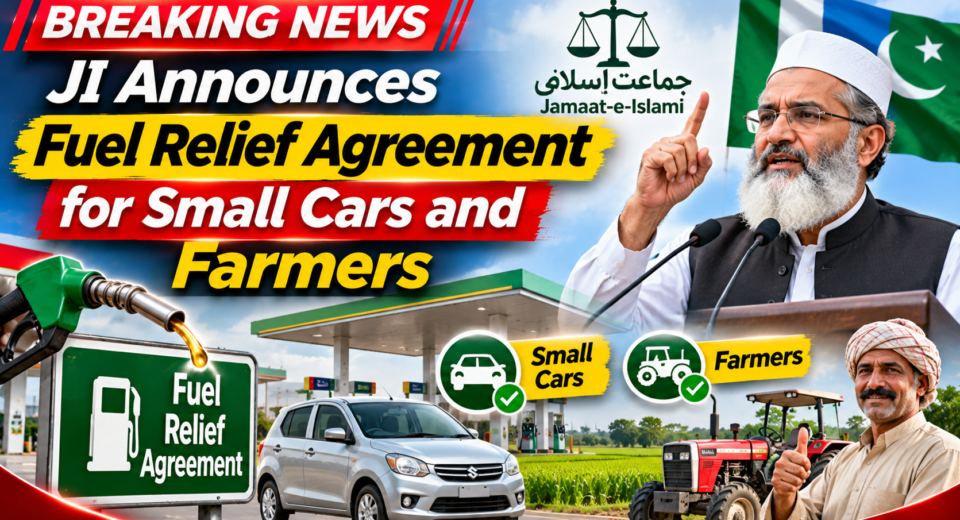
JI Announces Fuel Relief Agreement for Small Cars and Farmers
Fuel prices touch almost every part of daily life in Pakistan. They shape what a commuter spends on petrol and what a farmer pays to run a tractor or tubewell. They also change the price of vegetables, flour and public transport. So when a major political party and the federal government reach a deal on fuel relief, millions of families pay attention. On Thursday, November 26, 2026, the government and Jamaat-e-Islami (JI) announced exactly that kind of deal. It follows months of protests, marches, talks and warnings. The agreement promises to widen the existing petrol subsidy to small cars up to 1,000cc and to cover farmers under diesel relief. It also includes steps to lower the petroleum levy and cut government spending. This article explains the JI fuel relief agreement in plain language. It covers what was announced, how we got here, who may benefit, and what is still unclear. The details come from news reports published by Pakistani and regional outlets. Several points still depend on official notifications, so I mark clearly what is confirmed and what is only promised. JI Announces Fuel Relief Agreement for Small Cars and Farmers After months of negotiation, the federal government and JI reached an agreement on measures to ease the burden of high petroleum prices. According to Aaj News, the deal was announced after a meeting between Prime Minister Shehbaz Sharif and a JI delegation led by party chief Hafiz Naeemur Rehman at the Prime Minister’s House in Islamabad. Two parts of the deal stand out. The first is the extension of fuel relief to vehicles with engines up to 1,000cc. The second is an assurance that farmers will be covered under the diesel relief package. Both groups had been left out of the earlier scheme, which focused on motorcycles, three-wheelers and cars up to 800cc. What Was Announced on November 26 Speaking to reporters outside the Prime Minister’s House, Hafiz Naeem said the talks had ended successfully. He explained that committees from both sides had prepared a draft agreement. A separate committee would now be formed to watch over its implementation. He listed several outcomes. Small vehicles up to 1,000cc would be included in the relief. Farmers would be covered under the diesel package. The government would work to reduce the petroleum levy before the next federal budget. The government would also cut its own expenses and stop using vehicles above 1,600cc for official purposes. Proposals about independent power producers (IPPs) were also part of the deal. Hafiz Naeem was careful with his words. He said the government’s acceptance of four demands did not mean JI had won everything it asked for. The party would keep pushing its remaining demands and would announce its next steps at a gathering at Minar-e-Pakistan in Lahore. You can read the original report on the Aaj News coverage of the agreement. What the Government Said The prime minister told the JI delegation that the government had already announced large subsidies to reduce public hardship. He said that petroleum prices had risen after war broke out between Iran and the United States. Regional tension, he added, had pushed fuel costs up around the world. He said about 20 million people had benefited from the relief measures so far. He also said a team led by Deputy Prime Minister Ishaq Dar, including the finance and petroleum ministers, had been working on proposals for more relief. The government and JI agreed to set up a committee to review the party’s proposals and oversee their rollout. Background: Why Fuel Prices Became a Political Fight To understand the agreement, it helps to see why fuel prices became such a heated issue in 2026. Three forces came together: global oil prices, domestic taxes and public anger over inflation. Global Oil Prices and the Iran-US War Pakistan imports most of its oil. When world prices jump, the cost passes quickly to petrol pumps. The war between Iran and the United States disrupted supply and pushed prices up across the region. Government negotiators told JI earlier that fuel prices follow international rates, which were rising, and that they had already provided every relief they could. The Petroleum Levy at the Center The petroleum levy is a tax charged on each litre of petrol and diesel. It is a major source of federal revenue. Hafiz Naeem said in October that the levy brings in roughly Rs150 billion each month. He called it “extortion” at a time when families struggle with inflation. In his latest statement, he said the levy had fallen from Rs80 to Rs63 per litre because of a windfall effect. The government sees the levy as money it needs to run the country and meet its commitments, including those tied to the International Monetary Fund (IMF). JI sees it as an unfair burden on ordinary people. That clash sits at the heart of the whole dispute. JI’s Protest Campaign JI announced a nationwide strike for September 3, demanding lower petroleum prices and relief from high electricity bills. The party then held sit-ins and ran several waves of protests. In September, JI planned a long march to Islamabad. It postponed the march at the prime minister’s request after its convoy had reached Multan, because the government promised to discuss wider relief and a phased cut in the levy. Hafiz Naeem later claimed that the prime minister’s relief package was a result of JI’s sit-ins. The government did not describe it that way, but the timing shows how protest pressure and policy moved together. Timeline of Key Events The story unfolded over about three months. The table below sums up the main steps. Table 1: Key steps in the JI and government talks on fuel relief Date Event Why It Matters September 3 JI holds a nationwide strike against high fuel prices Starts the protest phase September 13 PM announces Rs100 per litre relief for motorcycles, rickshaws and small cars First targeted relief scheme September 14 Government approves Rs75 billion for three months