

News Tech

Balochistan Security Alert: Fresh Reports of Separatist Activity Emerge

If you’ve been keeping half an eye on Pakistan’s southwest, you already know Balochistan rarely stays quiet for long. But even by its own turbulent standards, the past few weeks have been rough. Fresh reports out of the province point to a fresh wave of separatist activity, and honestly, the numbers being tossed around are hard to ignore. Let me walk you through what’s actually happening on the ground. What’s Driving the Latest Surge The trouble kicked off in early July when militants believed to be linked to the Balochistan Liberation Army (BLA) struck a police post guarding construction work on the Mangi Dam project near Quetta. That single attack set off a chain reaction. Within days, Pakistan’s military confirmed dozens of security personnel had been killed in a string of coordinated assaults across the province, and the army responded with sweeping counter-insurgency operations that reportedly left dozens of militants dead too. What makes this round feel different isn’t just the body count, it’s the geography. Analysts tracking the violence note that attacks have been popping up in more than a dozen districts, from Chagai to Kech to Dera Bugti, which suggests the insurgency isn’t shrinking into a corner. If anything, it looks like it’s spreading its footprint. A Snapshot of Recent Incidents Here’s a quick rundown of some of the flashpoints reported in recent months: Location Reported Incident Approximate Impact Mangi Dam, near Quetta Assault on police post guarding dam project Sparked days of military operations Hanna Urak Valley Attacks near a rural valley, tribal jirga later negotiated hostage releases Multiple casualties, local unrest Chagai District Assault on public and private property Significant property destruction Panjgur & Noshki Twin attacks on troops and installations Security personnel and militants killed Coastal Jiwani region Military operation cutting off local communities Displacement concerns raised by rights groups Beyond the attacks themselves, there’s a whole other layer to this story that doesn’t always make the headlines. Why This Keeps Happening: Underlying Grievances Baloch nationalist groups have long argued that the province, despite sitting on enormous mineral and coastal wealth, sees little of that money trickle down to ordinary residents. Add to that longstanding accusations of enforced disappearances, and you start to understand why recruitment for these groups doesn’t seem to be drying up, no matter how many military operations roll through. Grievance Community Concern Resource distribution Locals say provincial wealth bypasses Baloch communities Enforced disappearances Rights groups report ongoing detentions without due process Water scarcity Protests over drinking water shortages in districts like Kohlu Security crackdowns Communications blackouts and travel restrictions affecting daily life Where Things Stand Now Pakistan’s civil and military leadership has publicly pledged a unified push to root out the insurgency, and Prime Minister Shehbaz Sharif has personally visited Quetta to meet with families of slain personnel. At the same time, local jirgas, tribal elder councils, have quietly stepped in to negotiate hostage releases in some cases, working almost independently of formal government channels. That tells you something about how fragmented the response on the ground really is. For now, mobile data restrictions, travel curbs, and heightened checkpoints remain common across several districts. Whether the current military push actually curbs the insurgency’s reach, or just pushes it further into new districts, is the question everyone in the region is watching closely. One thing seems fairly certain: Balochistan’s security story isn’t wrapping up anytime soon, and fresh developments are likely just around the corner.

News Tech

AJK Election Politics: PPP Government Faces Criticism Over PSC Appointments

If you’ve been following the political drama unfolding in Azad Jammu and Kashmir lately, you already know things have gotten pretty heated. Just days before exiting power, the outgoing PPP government made a move that’s got almost every opposition party crying foul — and honestly, the timing couldn’t have looked worse. What Actually Happened Here’s the deal: days before its exit from power, the incumbent PPP government appointed seven members to Azad Jammu and Kashmir’s Public Service Commission, the top recruitment body of AJK, a move that has raised questions about its propriety and timing. The notification wasn’t some backroom deal, at least on paper — the appointments were made under Article 48(2) of the AJK Interim Constitution, 1974, read alongside Section 4(3) of the AJK Public Service Commission Act, 1986. So legally, the government had the authority to do this. But that’s exactly where the controversy kicks in. These appointments come as the PPP government continues in office after the expiry of the AJK Legislative Assembly’s constitutional five-year term, pending completion of the election process, and the party has already lost its majority in the elections held so far, with PML-N emerging as the largest party and poised to form the next government. In other words, a government that’s essentially on its way out just locked in seven people into powerful three-year posts. You can see why that’s raising eyebrows. Why the Opposition Is Furious Naturally, both PML-N and PTI jumped on this immediately. PML-N leader Shahid Mehmood Wani, who also sat on the party’s election manifesto committee, took strong exception to what he called the questionable propriety and timing of the appointments. PTI wasn’t far behind either. Senior PTI leader Khawaja Farooq criticised the appointments, saying that making such decisions during the election process was “not morally good,” arguing they should have been left to the incoming government that receives a fresh mandate from the people of AJK. His point was pretty straightforward — he argued that appointments to important public institutions should be made by the government formed after elections, so the new administration isn’t stuck inheriting decisions made during a transition period. It’s a fair argument if you think about it. Imagine winning an election, only to find out the previous team already filled up the most important recruitment body with their own picks for the next three years. A Commission With a History of Controversy This isn’t the first time the AJK Public Service Commission has found itself in hot water. The body has long faced criticism over delays in its own formation, along with allegations that members are appointed based on the preferences of whichever government happens to be in power, rather than through a transparent process. Back in May 2023, when the previous chairman’s term along with other members expired, the commission was left incomplete for the next eight months. DawnDawn So this pattern of politically-timed appointments isn’t exactly new — it’s just the latest chapter. Quick Snapshot of the Situation Detail Information Body Affected AJK Public Service Commission (AJKPSC) Number Appointed Seven members Term Length Three years Legal Basis Article 48(2) of AJK Interim Constitution, Section 4(3) of PSC Act 1986 Party in Power PPP (outgoing) Party Leading Elections PML-N Opposition Reaction at a Glance Party Key Concern PML-N Questioned propriety and timing of long-term appointments after assembly term ended PTI Called the move “not morally good,” said appointments should wait for new government What This Means Going Forward With polling still ongoing in parts of AJK and phases of the 2026 elections continuing amid law-and-order concerns, this PSC controversy is likely to become another talking point once the new government takes charge. Whether PML-N, once in power, tries to reverse or challenge these appointments remains to be seen — but given the region’s history with the commission, this probably won’t be the last we hear of it. The Express Tribune

News Tech

Pakistan vs England 3-Test Series: 19 August Se Cricket Ka Bara Muqabla

Cricket fans, apna calendar nikaal lein kyunki iss saal ka summer ek zabardast Test series ke saath khatam hone wala hai. Pakistan aur England ke darmiyan teen match ki Test series 19 August se shuru ho rahi hai, aur ye series sirf ek routine tour nahi hai — ye 2025-27 World Test Championship cycle ka bhi ek important hissa hai. Matlab har match, har session, points table par seedha asar dalega. Ye tour England mein 19 August se 13 September 2026 tak chalega, jismein teen Test matches shamil hain. Series ka pehla muqabla historic Headingley ground, Leeds mein khela jayega, jahan crowd ka josh dekhne layak hoga. Uske baad team London ke legendary Lord’s ground mein utrengi, aur series ka aakhri aur decisive Test Birmingham ke Edgbaston mein hoga. Wikipedia Sab se dilchasp baat ye hai ke Pakistan team ki qayadat ek baar phir Babar Azam ke haath mein hogi. Babar teen saal ke baad Test cricket mein captaincy sambhal rahe hain — iss se pehle unhone last Test 2023 mein Sri Lanka ke khilaf Colombo mein captain ki haisiyat se khela tha. Ye comeback fans ke liye kisi festival se kam nahi, kyunki Babar ki leadership mein Pakistan team hamesha ek alag hi confidence dikhati hai. Outlook India Neeche diye gaye table mein aap series ka poora schedule ek nazar mein dekh sakte hain: Test Venue Dates 1st Test Headingley, Leeds 19 – 23 August 2026 2nd Test Lord’s, London 27 – 31 August 2026 3rd Test Edgbaston, Birmingham 9 – 13 September 2026 Ab baat karte hain iss series ki ahmiyat ki. Dono teams iss waqt WTC points table mein apni position behtar banane ki koshish mein hain, aur England ka home advantage kaafi strong maana ja raha hai. Lekin Pakistan ki bowling line-up, jisme fast bowlers ke saath saath spin options bhi shamil hain, English conditions mein surprise pack sabit ho sakti hai. English pitches par swing aur seam movement ka fayda uthana Pakistan ke fast bowlers ke liye ek bara test hoga, jabke batsmen ko patience aur technique dono chahiye hogi. Doosri taraf, England apni “Bazball” approach ke liye mashhoor hai — aggressive batting, fast scoring, aur risk lene wala andaz. Ye style dekhne walon ke liye entertaining hoti hai lekin Pakistan bowlers ke liye ye bhi ek mauka hoga ke agar England jaldi wickets gawaye, to match ka rukh palat sakta hai. Squad selection ki baat karein to Pakistan ne experienced players ke saath kuch naye chehre bhi include kiye hain, jo future ke liye bhi ek promising sign hai. Squad mein Mohammad Rizwan aur Ghazi Ghori wicketkeeper ke tor par shamil hain, jabke Shan Masood aur Imam-ul-Haq jaise senior batsmen bhi mojood hain. England ki taraf se bhi squad mein kuch interesting inclusions hue hain, jinme returning players aur naye talent ka mix dikhai deta hai. Outlook India Yahan ek chhota sa comparison table bhi dekh lein, jo dono teams ki strengths ko highlight karta hai: Team Strengths Comparison Aspect Pakistan England Captaincy Babar Azam (experienced return) Home conditions expertise Batting Style Technical, patient Aggressive “Bazball” approach Bowling Focus Pace + spin variety Seam and swing exploitation Home Advantage None (touring side) Strong Iss series ka sab se interesting pehlu ye hoga ke kya Pakistan English conditions mein apni traditional cautious approach rakhta hai ya phir England ki tarah aggressive cricket khelne ki koshish karta hai. Fans ke liye ye series sirf matches nahi, balke ek emotional journey hogi — har over, har wicket, aur har boundary crowd ko jhoomne par majboor kar degi. To bhai, apni chai ka cup taiyar rakhein aur TV screen ke saamne baith jayein, kyunki 19 August se shuru hone wala ye muqabla cricket lovers ke liye kisi eid se kam nahi hoga.

News Tech

Pakistan Dismisses Taliban Weapons-Smuggling Allegation as Frivolous

If you’ve been following the ever-tense relationship between Islamabad and Kabul, you already know that accusations tend to fly back and forth pretty regularly these days. The latest one, though, has managed to grab headlines across the region. Pakistan has flatly rejected a claim made by the Afghan Taliban regime that weapons were being smuggled across the border from Pakistan into Afghanistan for what the Taliban called “subversive activities.” And Islamabad didn’t hold back in its response either — the country’s Ministry of Information and Broadcasting called the whole thing “frivolous, baseless and contrary to established facts.” So, what actually happened? According to reports, the Afghan Defence Ministry claimed it had discovered and seized dozens of tons of light and heavy weapons allegedly smuggled from Pakistan. That’s a pretty serious accusation on paper, and naturally, Pakistan wasn’t going to let it slide without a strong rebuttal. Pakistan’s Response Comes Fast and Firm Within hours, Pakistan’s information ministry posted a detailed statement on social media pushing back hard against the claim. The ministry pointed out something that’s honestly hard to ignore: Afghanistan is already sitting on a massive stockpile of weapons. Officials noted that the country is awash with enormous quantities of sophisticated weapons and military equipment abandoned after the withdrawal of US and coalition forces, with that leftover hardware estimated to be worth around $7.2 billion. On top of that, there are decades’ worth of Soviet-era weapons still floating around the country from earlier conflicts. Given all that, Pakistan’s argument is pretty straightforward — why would anyone need to smuggle weapons into a country that’s already overflowing with them? The ministry suggested that pinning a “Pakistani connection” on these weapons looks less like a genuine security concern and more like a convenient distraction. Shifting the Spotlight Back to Cross-Border Terrorism This is really where the heart of Pakistan’s argument lies. Islamabad has consistently maintained that the real issue isn’t weapons moving into Afghanistan — it’s militant groups operating freely from Afghan soil and using that space to plan and launch attacks inside Pakistan. The ministry stated that these attempts to manufacture a Pakistani connection seem designed to divert international attention from the far more serious and documented concern of terrorist groups finding safe haven across the border. This isn’t a new grievance, either. Pakistan has repeatedly pressed the Afghan Taliban government to crack down on militant hideouts, especially given the sharp rise in cross-border terrorist incidents in Khyber Pakhtunkhwa and Balochistan since 2021. Senior military officials have echoed this stance multiple times, stressing that Pakistan’s issue lies with the Taliban regime itself, not with the Afghan people. A Quick Snapshot of the Dispute Aspect Details Allegation Taliban claims weapons smuggled from Pakistan into Afghanistan Pakistan’s Response Called “frivolous, baseless and contrary to established facts” Key Counterargument Afghanistan holds $7.2 billion in abandoned US/coalition weapons Additional Context Large stockpiles of Soviet-era weaponry also present Pakistan’s Core Concern Terrorist groups operating from Afghan soil Where Things Stand Between Islamabad and Kabul Issue Current Situation Cross-border terrorism Sharp rise in KP and Balochistan since 2021 Pakistan’s demand Dismantle terrorist sanctuaries in Afghanistan Diplomatic tone Increasingly strained, marked by public accusations Broader context Follows earlier disputes over alleged militant strikes At the end of the day, this latest exchange is just one more chapter in a relationship that’s been fraying for years. Whether or not the smuggling claim gets any traction internationally remains to be seen, but Pakistan’s message is loud and clear: stop pointing fingers across the border and start addressing what’s actually happening on Afghan soil.

News Tech

Pakistan Passport August 2026 Update: Visa-Free, Visa-on-Arrival & E-Visa Countries List

If you’re a Pakistani passport holder planning your next trip, I’ve got some genuinely encouraging news for you. As of August 2026, our green passport is opening more doors than it has in years, and honestly, that’s worth celebrating. Let’s break down exactly where you can go, how easy it is to get there, and what’s happening on the diplomatic front that could shape travel even further. Where Things Stand Right Now According to the latest Henley Passport Index figures, <cite index=”3-1,3-2″>Pakistan currently sits at 100th place globally, giving passport holders access to around 30 destinations through visa-free entry, visa-on-arrival, or electronic travel authorisation.</cite> That might not sound like a massive number compared to, say, Singapore or Japan, but here’s the thing — it’s a real improvement from where we were sitting just a couple of years back, and the trend line has generally been pointing upward. What’s interesting is how much this ranking has moved around lately. <cite index=”3-2″>Pakistan was ranked 103rd in 2025, then climbed to 98th in January 2026, improved further to 97th in February, before settling back to 100th by May and holding steady there through July.</cite> These shifts aren’t random — they reflect real diplomatic negotiations, agreement renewals, and occasionally, countries tightening or loosening their entry rules. Visa-Free and Easy-Access Destinations Let’s get to the good part. <cite index=”3-1″>Pakistani passport holders can currently travel visa-free to Barbados, Cook Islands, Dominica, Haiti, Micronesia, Montserrat, Rwanda, St Vincent and the Grenadines, The Gambia, Trinidad and Tobago, and Vanuatu.</cite> Beyond that, <cite index=”3-2″>popular spots like Maldives, Nepal, Sri Lanka, Kenya, Rwanda, and Seychelles remain accessible through visa-on-arrival or similar simplified schemes.</cite> If quick weekend-style getaways are your thing, the Maldives and Sri Lanka are hard to beat for the ease of entry alone. For something a bit more budget-conscious, Nepal continues to be a favorite among Pakistani travelers, especially trekkers and backpackers. Countries Offering E-Visa Access to Pakistani Passport Holders Region Notable E-Visa Countries Asia Malaysia, Indonesia, Vietnam, Philippines, Bhutan, Myanmar, Singapore Middle East Bahrain, Iraq Africa Nigeria, Ghana, Ethiopia, Uganda, Zambia, Zimbabwe, South Africa Caribbean & Americas Cuba, Colombia, Suriname, Nicaragua, El Salvador Europe & Central Asia Albania, Azerbaijan, Kyrgyzstan, Tajikistan Worth noting: for destinations like Turkey and Georgia, you’ll typically need a valid UK, US, or Schengen visa already stamped in your passport before you can apply for their e-visa. It’s an extra hurdle, but not an impossible one if you’ve traveled to those regions before. A Regional Shift Worth Watching Now, here’s where things get genuinely fascinating from a bigger-picture standpoint. On August 7, 2026, <cite index=”9-1″>Turkish President Recep Tayyip Erdogan, Saudi Crown Prince and Prime Minister Mohammed bin Salman, and Pakistani Prime Minister Shehbaz Sharif signed the Mecca Joint Deterrence Agreement in the Saudi holy city.</cite> <cite index=”9-1″>The pact establishes that an armed attack against any one of the three nations will be treated as an attack against all of them.</cite> This isn’t a random announcement — <cite index=”12-1″>it builds on an earlier mutual defence agreement between Saudi Arabia and Pakistan from September 2025</cite>, and <cite index=”12-1″>comes as regional tensions from the ongoing Iran conflict and Houthi attacks continue to worry Gulf states about relying on traditional Western security guarantees.</cite> While this alliance is primarily about security, deals like this often ripple outward into economic and travel cooperation too. <cite index=”10-1″>One analyst noted that such agreements tend to strengthen ties in other sectors, with expectations in Ankara that it could boost economic connections with Riyadh and Islamabad.</cite> Could that eventually translate into smoother travel arrangements between the three nations? It’s too early to say definitively, but it’s certainly a space worth watching if you travel frequently to the Gulf or Turkey. My Takeaway Whether you’re chasing beaches in the Maldives, trekking in Nepal, or keeping an eye on how geopolitics might reshape future travel deals, August 2026 is shaping up to be a genuinely interesting month for Pakistani passport holders. Always double-check requirements directly with embassies before booking, since visa policies can shift quickly — but overall, the outlook is more optimistic than it’s been in a while. Artifacts Pakistan us trade talks resume Document · MD  Nirmal purja broad peak tragedy Document · MD  Pakistan us trade talks Document · MD  Pakistan petrol price cut Document · MD 

News Tech

Pakistan, Saudi Arabia and Türkiye Forge Powerful New Defence Alliance

If you’ve been keeping an eye on Middle Eastern politics lately, you probably felt the ground shift a little on August 7, 2026. That’s the day Pakistan, Saudi Arabia and Türkiye put pen to paper on a landmark trilateral defence pact, and honestly, it’s the kind of move that could reshape how an entire region thinks about security for years to come. What Actually Happened in Mecca The leaders of all three nations — Turkish President Recep Tayyip Erdogan, Saudi Crown Prince Mohammed bin Salman, and Pakistani Prime Minister Shehbaz Sharif — met in Mecca to sign what’s now being called the Mecca Joint Defence Pact. At its core, the agreement borrows a page straight out of NATO’s playbook: <cite index=”1-1″>any armed attack against one of the three states will be treated as an attack against all of them</cite>. That’s a huge commitment, and it signals just how seriously these three governments are taking the current regional turbulence. This isn’t something that came out of nowhere either. It actually builds on an earlier bilateral pact between Saudi Arabia and Pakistan, the Strategic Mutual Defence Agreement, which the two countries signed back in September 2025 in Riyadh. That deal already established the “an attack on one is an attack on both” principle between Islamabad and Riyadh. Türkiye’s decision to join takes that foundation and turns it into something much bigger — a genuine three-way security bloc. Why Now? Timing matters a lot here. Saudi Arabia has been dealing with repeated attacks this year from Iran-backed groups, especially as tensions boiled over following the American-Israeli military campaign against Iran. <cite index=”1-1″>Saudi officials were reportedly bracing for further strikes from Iranian proxies in Yemen and Iraq</cite> even in the hours before the pact was signed. Meanwhile, Pakistan has quietly positioned itself as a diplomatic go-between throughout the Iran conflict, and Türkiye has its own long list of security concerns closer to home. Bringing Ankara into the fold adds real weight to the alliance, partly because Türkiye is a NATO member with a serious, fast-growing defence export industry. For Saudi Arabia and Pakistan, that opens the door to easier access to Turkish military hardware and technology, something analysts see as a genuinely practical upside beyond the symbolic show of unity. A New Regional Order? Experts are divided on how far this alliance will actually go. Some describe it as a blend of deterrence and diplomacy, a way to nudge the region toward stability without pointing fingers at any one adversary. Others are more cautious, pointing out that the practical mechanics still aren’t clear. If, say, Houthi forces strike Saudi Arabia, does that automatically pull in Türkiye and Pakistan too? Nobody’s entirely sure yet, and that ambiguity is exactly what makes this pact so interesting — and a little unpredictable. Turkish officials have been careful to frame the agreement as purely defensive and not aimed at any specific country, while also noting it remains open to other regional states down the line. That last part is worth watching closely, because it hints this could grow into something even bigger than a trilateral arrangement. Quick Comparison: The Two Pacts Feature Strategic Mutual Defence Agreement Signed September 17, 2025 Location Riyadh, Saudi Arabia Parties Pakistan, Saudi Arabia Core principle Attack on one = attack on both Mecca Joint Defence Pact Feature Mecca Joint Defence Pact Signed August 7, 2026 Location Mecca, Saudi Arabia Parties Pakistan, Saudi Arabia, Türkiye Core principle Attack on one = attack on all three Where Things Go From Here Whether this pact becomes a true regional stabilizer or just another paper agreement will depend a lot on how it’s tested — and given the current climate, that test might come sooner rather than later. For now, though, one thing’s certain: the security map of the Middle East and South Asia just got a lot more interesting. Artifacts Pakistan us trade talks resume Document · MD  Nirmal purja broad peak tragedy Document · MD  Pakistan us trade talks Document · MD  Pakistan petrol price cut Document · MD 

News Tech

Jamaat-e-Islami Protests Cause Major Traffic Disruption in Karachi

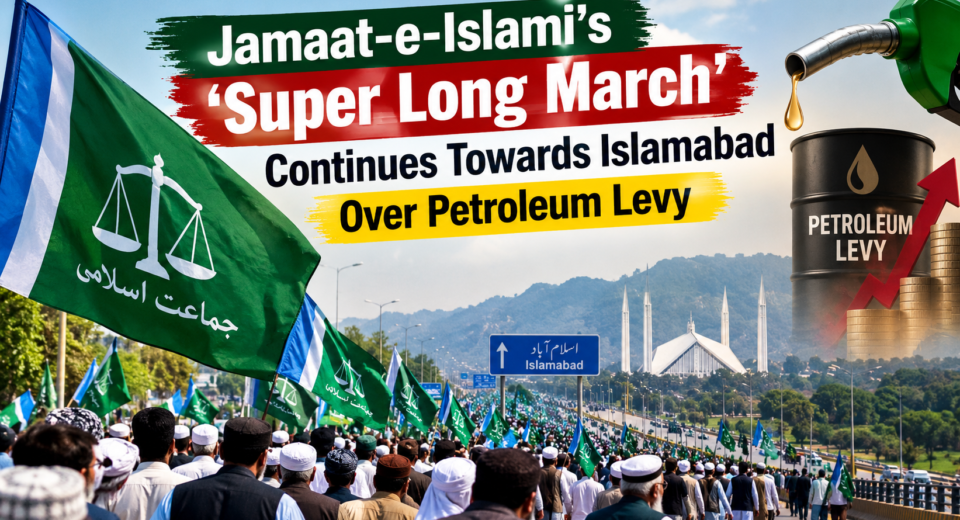
If you were trying to get anywhere in Karachi on Friday, chances are you got stuck. I mean really stuck — the kind of gridlock where you turn off the engine and just wait it out. That’s exactly what happened when Jamaat-e-Islami (JI) rolled out a massive, coordinated protest against the petroleum levy, and honestly, the whole city felt it. Let me walk you through what actually went down. Why Were People Protesting? JI didn’t just pick Karachi at random. This was part of a much bigger, nationwide push. The party’s Emir, Hafiz Naeemur Rehman, had already announced that demonstrations would take place at 510 major roads and highways spread across 170 districts in the country. That’s not a small number — that’s a statement. The Express Tribune The core grievance? Fuel prices and the petroleum levy. JI leadership argued that when international oil prices dropped, the government failed to pass that benefit on to ordinary citizens, choosing instead to keep taxes and levies high. For a country already struggling with inflation, that message clearly resonated with a lot of people, based on turnout alone. Geo News What Happened on the Ground in Karachi In Karachi specifically, protest rallies started from various parts of the city and made their way toward Mazar-e-Quaid, following designated routes. One of the more visible flashpoints was at Natha Khan Bridge on Shahrah-e-Faisal, where a convoy blocked the road entirely. But it wasn’t just one street. According to traffic police, Mazar-i-Quaid, Numaish Chowrangi, Saddar, Sharea Faisal, Sharae Pakistan, UP Mor, Power House Chowrangi, Defence Housing Authority, Sea View, Shahrah-i-Orangi, Hub River Road, Super Highway, and National Highway were all affected in some way, whether that meant full closures or painfully slow-moving traffic. If you commute anywhere near these areas, you know that’s basically half the city’s arteries clogged at once. The Ripple Effect on Daily Life Here’s the thing about blocking major roads in a city of over 20 million people — it doesn’t just inconvenience commuters. It disrupts everything. Ambulances trying to reach hospitals, people rushing to catch flights, parents picking up kids from school — all of it gets tangled in the same mess. Not everyone was sympathetic to the cause, either. Some officials publicly pushed back, with one questioning how patients in ambulances were supposed to reach hospitals when major roads were shut down. It’s a fair point, and it captures the tension at the heart of these protests: the right to demonstrate versus the practical cost to a city trying to function normally. How Traffic Police Responded To their credit, Karachi traffic police didn’t sit idle. They issued advisories ahead of time, warning residents to avoid the affected zones unless absolutely necessary and to plan alternative routes. Personnel were deployed at key congestion points like Lasbela Chowk, Numaish Chowrangi, and the Tibet Centre stretch to try and keep vehicles moving, even if slowly. Karachi Traffic Congestion Snapshot Affected Area Type of Disruption Shahrah-e-Faisal Full road blockage Numaish Chowrangi Heavy congestion Super Highway Slow-moving traffic Hub River Road Partial closure Saddar Diversions in place The Bigger Picture This wasn’t a one-off event — it’s part of a sustained pressure campaign JI has been running for weeks, with similar protests happening simultaneously in Lahore, Islamabad, Peshawar, and several other cities. Whether or not it moves the needle on government policy remains to be seen, but one thing’s certain: for Karachi residents, Friday was a reminder of just how quickly the city can grind to a halt. If you’re planning to head out anytime soon, it’s probably worth checking local traffic updates first — just to be safe.

News Tech

Pakistan Petrol Price Cut: Petrol Rs2.20 aur Diesel Rs1.50 Sasta

If you’ve filled up your tank recently, here’s some good news for your wallet. The federal government has once again trimmed fuel prices, and this time petrol has become cheaper by Rs2.20 per litre, while high-speed diesel (HSD) has dropped by Rs1.50 per litre. The new rates kicked in from August 8, 2026, and honestly, for anyone who commutes daily or runs a business that depends on transport, every rupee saved matters. Let’s be real — Pakistanis have gotten used to a rollercoaster when it comes to fuel prices. One week it’s up, the next it’s down, and it’s hard to keep track without checking the news every few days. But this latest cut is a welcome breather, especially coming right after another reduction just a day earlier. So in back-to-back adjustments, motorists have actually seen a fairly noticeable drop over just 48 hours. What Are the New Petrol and Diesel Prices? According to the notification issued by the Petroleum Division, here’s how the numbers stack up now: Fuel Type Previous Price (Rs/litre) Price Cut (Rs/litre) New Price (Rs/litre) Petrol 329.82 2.20 327.62 High-Speed Diesel (HSD) 382.36 1.50 380.86 These revised prices are set to remain in effect from August 8 to August 10, after which the government will once again review rates based on international oil trends and rupee fluctuations. Why Does the Government Keep Adjusting Fuel Prices So Often? You might be wondering why Pakistan doesn’t just fix a price and leave it be for a month like it used to. Well, since mid-July, the Petroleum Division switched to a daily-review pricing mechanism. This was largely a response to volatility in global oil markets, driven by renewed tensions in the Middle East. Instead of the usual fortnightly review, prices are now based on a seven-day rolling average of international market rates, which is supposed to bring Pakistan’s system closer to global standards and make sure that both increases and decreases reach consumers faster. This also explains why we’ve seen such frequent back-and-forth movement in prices lately — some days petrol goes up by a few rupees, other days it comes down. It’s not random; it’s simply the market mechanism doing its job in near real-time. Recent Fuel Price Trend in Pakistan Date Petrol Change (Rs) Diesel Change (Rs) Aug 8, 2026 -2.20 -1.50 Aug 7, 2026 -3.19 -1.50 Aug 6, 2026 +4.45 -2.00 Aug 4, 2026 -4.08 -2.45 As you can see, it’s been a bit of a mixed bag over the past week, but the overall direction for diesel especially has leaned downward, which is good news for the transport and agriculture sectors that rely heavily on it. What This Means for the Average Pakistani Cheaper diesel isn’t just about your car — it has a ripple effect. Transport costs for goods, fresh produce, and daily essentials are all tied to diesel prices, so even a small cut can ease pressure on household budgets over time. Petrol relief, on the other hand, directly benefits daily commuters, bike riders, and small vehicle owners who make up a huge chunk of Pakistan’s road users. That said, experts caution against reading too much into a single cut. Global crude oil prices remain unpredictable, especially with ongoing geopolitical tensions affecting shipping routes and OPEC+ decisions. So while this reduction is a relief right now, don’t be surprised if prices shift again within days. For now though, take the win. Rs2.20 off petrol and Rs1.50 off diesel might not sound huge, but for a country where fuel prices directly shape inflation and everyday affordability, every cut counts.

News Tech

Tragedy on Broad Peak: World-Famous Climber Nirmal Purja Dies in Avalanche

The mountaineering world is in mourning this week after news broke that Nirmal “Nimsdai” Purja, the record-breaking climber who once summited all fourteen of the world’s 8,000-metre peaks in a matter of months, has died in an avalanche on Pakistan’s Broad Peak. He was 43 years old, and if you’ve followed climbing news at all over the past few years, his name probably rings a bell — he’s the guy who made “impossible” climbing feats look almost routine. Here’s what we know so far. Purja was leading a ten-person international expedition up Broad Peak, the world’s twelfth-highest mountain, when disaster struck around midday on July 30, 2026. An avalanche swept the entire team down the mountain’s main gulley, some of them falling nearly a vertical mile. Communication with the group went dead almost immediately, and that silence is what first told rescuers something had gone terribly wrong. Search and rescue teams didn’t waste a second. Military helicopters, high-altitude porters, and ground crews scoured the Karakoram range despite brutal terrain and unpredictable weather — the kind of conditions that make Broad Peak beautiful and dangerous in equal measure. Sadly, over the following days, rescuers recovered the bodies of several climbers, and on Saturday, Purja’s own expedition company, Elite Expeditions, confirmed in a heartbreaking social media statement that he had not survived, along with other members of his team. Quick Facts Detail Information Climber Nirmal “Nimsdai” Purja Age 43 Location Broad Peak, Karakoram Range, Pakistan Peak Height 8,047 metres (12th highest in the world) Date of Avalanche July 30, 2026 Expedition Size 10 climbers Confirmed by Elite Expeditions What makes this loss sting so much is who Purja was to the climbing community. A former British special forces soldier turned mountaineer, he shattered records in 2019 by climbing all fourteen of the planet’s 8,000-metre peaks in under seven months — a feat that had previously taken the fastest climbers years to accomplish. His story was even turned into the widely watched documentary “14 Peaks,” which introduced millions of people who’d never think twice about mountaineering to the sheer grit the sport demands. He wasn’t just fast; he was fearless, and he had a knack for making people believe in things they thought were out of reach. Timeline of Events Date Event July 30, 2026 Avalanche strikes ten-member team on Broad Peak July 30–31 Contact lost; search and rescue mobilized Aug 1, 2026 Bodies of several climbers recovered Aug 1, 2026 Elite Expeditions confirms Purja’s death Ongoing Search continues for remaining climbers Officials from the Alpine Club of Pakistan have called the loss heartbreaking, and tributes have poured in from mountaineers, government leaders, and fans across the world. Nepal’s Prime Minister offered condolences, noting that while the physical journeys of these climbers have ended, their courage will keep inspiring people for years to come. Broad Peak has a grim history of its own — it’s considered less technically demanding than its infamous neighbor K2, but its weather can turn without warning, and past expeditions have paid the price for underestimating it. This latest tragedy is a sobering reminder that even the most experienced, most celebrated climbers in the world are never truly safe once they’re above 8,000 metres, in what mountaineers grimly call the “death zone.” For now, search efforts continue for the remaining members of the expedition, and the climbing world is left to process the loss of one of its most extraordinary figures — a man who redefined what was thought humanly possible on the world’s highest peaks.

News Tech

Breaking: Heavy Rain and Flood Alert Issued Across Pakistan

Pakistan is once again bracing for a tough stretch of weather. The National Disaster Management Authority (NDMA) and the Pakistan Meteorological Department (PMD) have issued fresh warnings about heavy rain, rising rivers, and possible flooding in several parts of the country. If you live in Pakistan or have family here, this is the kind of news you don’t want to scroll past. Let’s break down what’s happening, why it matters, and what you can do to stay safe. What Is the Current Flood Alert About? The latest alert covers a wide stretch of the country, including Punjab, Sindh, Khyber Pakhtunkhwa, Balochistan, and the northern areas like Gilgit-Baltistan. Authorities are warning of heavy to very heavy rainfall, which could trigger urban flooding, flash floods in hilly areas, and rising water levels in major rivers like the Indus, Chenab, and Jhelum. This isn’t a one-city problem. It’s a nationwide situation that’s being tracked hour by hour. Which Areas Are Most at Risk? Some cities and regions are flagged as more vulnerable than others. Big population centers like Lahore, Rawalpindi, Islamabad, Faisalabad, Sialkot, Gujranwala, and Sargodha are on the watch list for urban flooding. In Sindh, places like Hyderabad, Sukkur, Badin, and Mirpurkhas are also on alert. Meanwhile, Balochistan’s hill torrent zones and the mountainous regions of Gilgit-Baltistan face a different kind of danger: flash floods and landslides. Why Is Pakistan Facing Heavy Rain Right Now? Monsoon season is the short answer. Every year, between July and September, Pakistan sees a wet spell driven by seasonal wind patterns that pull moisture in from the Arabian Sea. This year, weather systems combined with low-pressure zones over the region have made the rain heavier and more widespread than usual in some areas. When you add water releases from upstream dams and rivers that already carry runoff from the mountains, you get a recipe for flooding. The Role of River Systems and Dams Pakistan’s rivers don’t exist in isolation. Water levels depend on rainfall locally, snowmelt from the north, and sometimes water discharged from dams upstream. When several of these factors line up at once, rivers like the Indus can swell quickly. This is why officials keep such a close eye on barrages like Guddu, Chashma, Kalabagh, and Sukkur. A sudden rise at any one of these points can be an early warning sign for what’s coming downstream. What Has NDMA and PMD Said? Both agencies have been vocal this week. The NDMA has directed provincial and district administrations to stay on high alert and get precautionary measures ready. The PMD’s Flood Forecasting Division has forecast heavy to very heavy rain continuing over the next few days, with some spells expected to persist through early August. Officials are also warning about the risk of landslides in mountainous terrain, so travel advisories are in place for tourists heading to the north. Should You Trust These Warnings? Yes, and here’s why. These alerts come from official government bodies that track weather data, satellite imagery, and river gauges in real time. They’re not guesses. When NDMA or PMD says “heavy rain expected,” it’s based on actual meteorological models. Ignoring these warnings, especially if you live near a river or in a flood-prone neighborhood, can put you and your family at serious risk. How Does This Affect Daily Life in Pakistan? Heavy rain and flood alerts don’t just mean wet roads. They can disrupt transportation, damage crops, cut off electricity, and in worse cases, force people to evacuate their homes. Farmers in Punjab and Sindh often worry the most, since standing water can wipe out entire seasons of crops like cotton and rice. Urban residents deal with clogged drains, traffic jams, and power outages when the rain gets intense. Impact on Farming Communities Agriculture is the backbone of Pakistan’s rural economy, and floods hit it hard. When fields get waterlogged, crops can rot before harvest. Livestock can also be at risk if water levels rise too fast for farmers to move their animals to safer ground. This is why flood alerts matter so much beyond just city dwellers. They’re a lifeline for rural families trying to protect their livelihoods. What Precautions Should Residents Take? If you’re in an area under alert, a little preparation goes a long way. Here’s a simple breakdown of what experts recommend during heavy rain and flood warnings. Safety Checklist for Flood-Prone Areas Precaution Why It Matters Avoid unnecessary travel Roads can flood quickly and become unsafe Keep emergency contacts handy Quick access to rescue services saves time Store clean drinking water Floodwater often contaminates local supply Move valuables to higher ground Reduces property damage risk Stay updated via official channels Prevents reliance on rumors or fake news Basic steps like these can genuinely reduce risk. It’s not about panicking, it’s about being ready. How Are Authorities Responding to the Flood Threat? Rescue departments across provinces have been placed on standby. In Punjab, the Provincial Disaster Management Authority is monitoring dams and barrages around the clock. In Sindh, local administrations are clearing drainage systems in cities that flood easily, like Hyderabad and Karachi. The idea is to catch problems early rather than react after water has already entered homes. Emergency Helplines and Resources During situations like this, it helps to know who to call. NDMA and provincial disaster authorities usually share dedicated helpline numbers through official press releases and social media. Rescue 1122 remains one of the most trusted emergency services across Punjab and other provinces for flood-related emergencies. Keeping these numbers saved on your phone before disaster strikes is a smart move. What Can You Learn From Past Flood Events in Pakistan? Pakistan has a long history with monsoon flooding, and the lessons from past years still apply today. The devastating floods of 2010 and 2022 showed how quickly water can overwhelm entire regions when rainfall is unusually intense. Both events led to major loss of life, displaced millions of people, and caused billions of dollars in damage. These aren’t just numbers. They’re a